An Argument Born of Silence?
James Kwak of The Baseline Scenario wonder why the modern GOP can position itself as a party of fiscal responsibility when its policies promote fiscal profligacy. Kwak sees several reasons for that strange development.
… One is that many Americans reflexively associate large deficits with excessive spending, even though reductions in tax revenues have played just as big a role since George W. Bush became president. (Compare, for example, receipts and outlays in 2000 and 2011 as a percentage of GDP.) Then they associate excessive spending with Democrats, although the only president to reduce spending significantly in the past forty years was Bill Clinton. It turns out that if you repeat the same tired attack lines year after year—Democrats are all tax and spend liberals, for example—people believe them.
…
The other, more important reason why Republicans like talking about the national debt is that Democrats don’t have a good response. Sure, Democrats have lots of policy proposals, and theirs make a good deal more sense than the Republicans’; it was President Obama who proposed trillions of dollars in spending cuts and tax increases, which is what people supposedly want (according to opinion surveys, at least).
…
But most Democrats just don’t like talking about deficits and the national debt. They think it’s a distraction from talking about jobs and unemployment, or they think simply broaching the subject is succumbing to a vast right-wing conspiracy to slash entitlements, or both. The result is that there is noliberalprogressive position on the national debt….
Around The Dial – May 23, 2012
Economic policy reports, blog postings, and media stories of interest:
- Paul Krugman offers the case for bank regulation.
- Economix looks at the impact of public investments.
- Simon Johnson argues for Jamie Dimon to resign from the NY Fed.
- Brad DeLong puts the current labor market recovery in context.
A Lesson In Differing Priorities, Courtesy Of The Economist
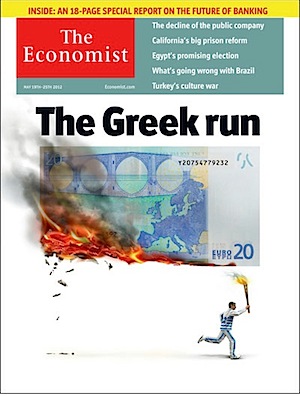
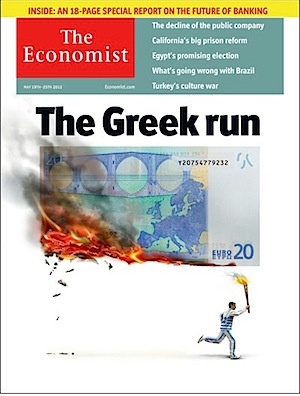
Sadly, The Economist opted to use a different cover image and altogether different cover story from the one below for this week’s US edition. Felix Salmon explains why this difference matters.
Cool Products, Few Jobs
Writing at Policy Shop, David Callahan explains just how few jobs are created by technology companies like Facebook.
Technology companies deliver amazing products and services, and Facebook is a prime example of how breakthroughs in the tech sector can change how we live. But don’t look to the tech sector to create the middle class jobs of tomorrow. Facebook illustrates this reality. Even as the company has become spectacularly successful, and vastly enriched individuals associated with it, it has generated relatively few jobs.
…
Facebook added just over 1,000 jobs in 2011, bringing its total work force to 3,200 employees. Indirectly, through the apps and other subsidiary components supported by Facebook, the company is estimated to have created between 53,000 and 129,000 jobs in the United States.
…
Even if Facebook doubles or triples its labor force with the new investment capital it raises from the IPO, it will employ vastly fewer people than any other U.S. corporation of a similar value in the range of $100 billion. For example, PepsiCo has 285,000 employees with a market value of $103 billion, according to Fortune. Abbott Laboratories employs 91,000 people with a market value of $95.6 billion. Walt Disney has 156,000 employees with a market value of $77 billion. Bank of America, with a market value of $102 billion has 284,000 employees. GM, with a third the market cap of Facebook, has 209,000 employees.
Around The Dial – May 22, 2012
Economic policy reports, blog postings, and media stories of interest:
- David Kirp traces the decline in interest in desegregating schools.
- Suzy Khimm mulls the limits of a financial transactions tax, and Dean Baker responds.
- Economist’s View discusses one transmission mechanism for inequality.
- The News & Record reports on the debate over “fracking” in North Carolina.
 Email Sign-Up
 RSS Feed