

Demographic Change In North Carolina
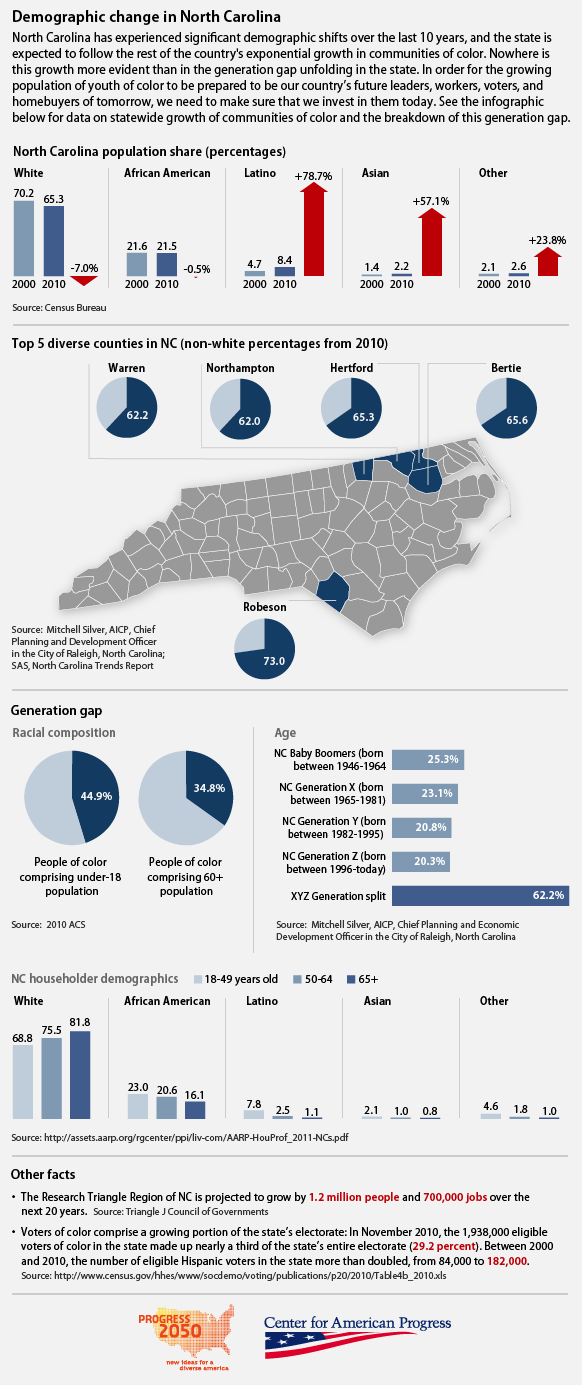
A new infographic prepared by the Center for American Progress rounds up data pertaining to demographic change in North Carolina during the 2000s.
Building The South’s Future Workforce
In conjunction with its upcoming annual conference, scheduled to be held in late June in Chattanooga, Tennessee, Southern Growth Policies Board is soliciting opinions about the workforce challenges facing the American South.
Southerners interested in sharing their thoughts about the topic should complete a brief survey that is available here.
Around The Dial – May 14, 2012
Economic policy reports, blog postings, and media stories of interest:
- The Charlotte Observer reports on Bank of America’s weakening ties to the city.
- The Center for American Progress highlights five facts about poor single mothers.
- Barry Eichengreen wonders if “the Euro doomsayers” are right.
- Felix Salmon’s blog rounds up the latest in the JPMorgan Chase debacle.
- Richard Thaler isn’t buying “slippery-slope logic” regarding health care.
Merchants of Debt: College Edition
Naked Capitalism joins the debate about the social consequences of escalating student loan debt, as described in a recent article in The New York Times.
One of the distressing threads in the article was elected officials and even students arguing that it was completely reasonable to expect students to carry most of the freight of their education. I wonder if any of the ones over, say, 35 giving that view would be anywhere near as comfortable as they are now if that had been required of them. You can see the open, casual rendering of one of the obligations of society, that of educating the young.
…
I’ve never understood when (once in a while) someone (clearly young) shows up in comments and rails against Social Security and Medicare because of the burden it imposes on him. Now I get it. The student debt issue is deepening social fractures. If young people are asked to stand on their own, and given only unpalatable choices (forego a college degree, the entrance ticket to middle class life, or accept debt slavery at a tender age), no wonder they adopt a “devil take the hindmost” attitude. I hope some of these people who so cavalierly argue for loading up the next generation with debt realize that the young may not want to take care of them either, and they are far more at risk. The outcome of cutting social safety nets to the elderly ultimately means that old people will die faster.
“Degrees Of Debt”
A lengthy report in The New York Times explores the impact that rising college costs is having on the lives of young adults. The report mirrors many of the themes raised in “The Great Cost Shift,” a report prepared by South by North Strategies for Demos, a public policy organization in New York City. From the story in The New York Times …
The roots of the borrowing binge date to the 1980s, when tuition for four-year colleges began to rise faster than family incomes. In the 1990s, for-profit colleges boomed by spending heavily on marketing and recruiting. Despite some ethical lapses and fraud, enrollment more than doubled in the last decade and Wall Street swooned over the stocks. Roughly 11 percent of college students now attend for-profit colleges, and they receive about a quarter of federal student loans and grants.
…
In the last decade, even as enrollment at state colleges and universities has grown, some states have cut spending for higher education and many others have not allocated enough money to keep pace with the growing student body. That trend has accelerated as state budgets have shrunk because of the recent financial crisis and the unpopularity of tax increases.
…
Nationally, state and local spending per college student, adjusted for inflation, reached a 25-year low this year, jeopardizing the long-held conviction that state-subsidized higher education is an affordable steppingstone for the lower and middle classes. All the while, the cost of tuition and fees has continued to increase faster than the rate of inflation, faster even than medical spending. If the trends continue through 2016, the average cost of a public college will have more than doubled in just 15 years, according to the Department of Education.
 Email Sign-Up
 RSS Feed