

The Limits Of Exceptionalism
Simon Johnson explains “the limits of American exceptionalism.”
The ability of the United States to borrow reflects its collective strength. After a difficult struggle to establish viable public finances during and immediately after the War of Independence, the United States finally found its fiscal footing. The bicentennial of the real turning point is this year — it was the War of 1812 that finally created a political consensus for fiscal prudence, including agreement on the need to pay, with taxes, for what the government spends. The United States earned the hard way and long deserved its reputation for fiscal prudence.
…
Its ability to borrow today creates what can be an advantage. When the economy turns down sharply — for example, because some big banks blew themselves up — it is much better to avoid being forced into fiscal austerity. Ask the Europeans.
…
But our willingness to borrow has also become a weakness. We need to bring the deficit and our national debt under control. In large part we should restore revenues to where they were in the mid-1990s, before the rash move to lower tax rates in the mistaken belief that there was a budget surplus to distribute.
Economic Recovery Not Assured
Mohamed El-Erian argues that America’s economic recovery is far from assured.
The problem is that the sense of relief now can – and probably will – be taken too far. Indeed, today’s good news should not obscure some consequential structural limitations that will require prolonged therapy and caution. After all, the US economy has yet to regain its full strength, is too structurally impaired to sustain any rapid forward movement, and has not yet started to overcome the many distortive side effects of the extreme medicine that it received.
…
Locking in recovery implies a multi-year program of serious and coordinated reforms that fundamentally improve the way the country educates and trains its citizens, invests in infrastructure and finances other productive outlays and housing, competes in the global economy, and formulates and adheres to a rational budgetary process. Such a program will also require a recovering America to navigate several key challenges in the next few months.
Around The Dial – March 22, 2012
Economic policy reports, blog postings, and media stories of interest:
- TaxVox looks askance at Rep. Paul Ryan’s “mystery meat budget.”
- The Center for American Progress explains why education debt needs attention.
- Off the Charts has a preliminary analysis of the Ryan budget proposal.
- Naked Capitalism points out the limits of venture capital.
- Jared Bernstein asks if there will be enough jobs for enough people.
NC Unemployment Claims: Week Of 3/3/12
For the benefit week ending on March 3, 2012, some 12,220 North Carolinians filed initial claims for state unemployment insurance benefits and 115,490 individuals applied for state-funded continuing benefits. Compared to the prior week, there were more initial and fewer continuing claims. These figures come from data released by the U.S. Department of Labor.
Averaging new and continuing claims over a four-week period — a process that helps adjust for seasonal fluctuations and better illustrates trends — shows that an average of 11,763 initial claims were filed over the previous four weeks, along with an average of 118,058 continuing claims. Compared to the previous four-week period, the average number of initial claims was higher and the average number of continuing claims was lower.
One year ago, the four-week average for initial claims stood at 12,684, and the four-week average of continuing claims equaled 128,687.
In recent weeks covered employment has increased and now slightly exceeds the level recorded a year ago (3.74 million versus 3.71 million). Nevertheless, there are still fewer covered workers than there were in January 2008, which means that payrolls are smaller today than they were four years ago.
The graph shows the changes in unemployment insurance claims measured as a share of covered employment in North Carolina since the recession’s start in December 2007. 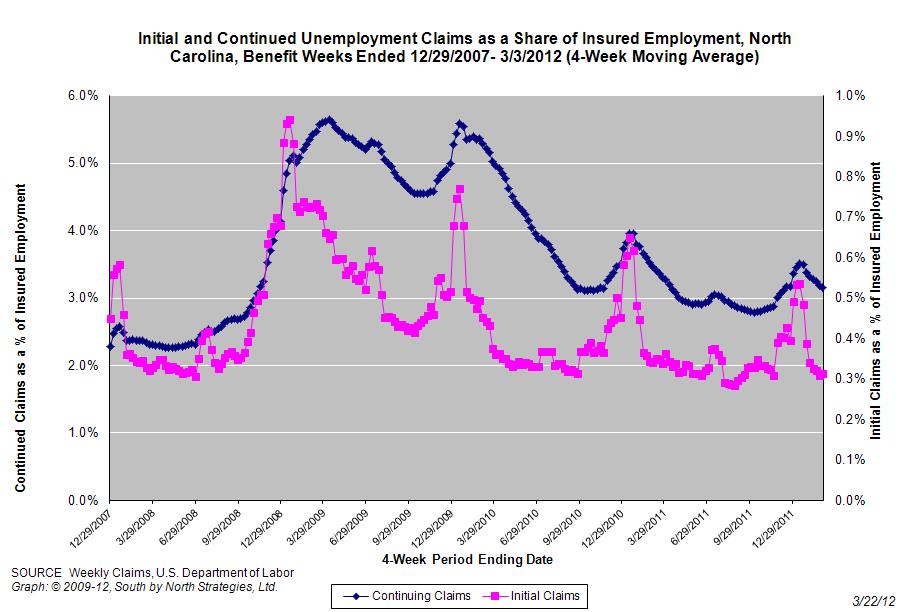
Both new and continuing claims appear to have peaked for this cycle, and the four-week averages of new and continuing claims have fallen considerably. Yet continuing claims remain at an elevated level, which suggests that unemployed individuals are finding it difficult to find new positions.
Playing The Wrong Game
Writing in The American Prospect, Clyde Prestowitz, a trade official in the Reagan Administration, explains why American trade policy continues to fail.
Most misplaced has been the geopolitical priority with its subordination of long-term economic interests to short-term political/military objectives. Washington continually makes concessions, refrains from insisting on application of the GATT/WTO rules, or backs away from taking actions to counter mercantilism on national–security grounds. In the 1980s, the Reagan administration declined to invoke GATT rules against European subsidization of the Airbus, because Secretary of State George Shultz said doing so would shatter the North Atlantic Treaty Organization. Today, Washington declines to respond to China’s blatant currency manipulation. Why? It thinks it needs the Chinese to help with problems like Iran and North Korea. It doesn’t understand that erosion of U.S. wealth-producing capacity is the most important national–security threat.
…
A corollary is the false premise that mercantilists who intervene to distort markets should not face retaliation because they are only hurting themselves and will eventually see that and abandon their policies. Studies have shown that the Airbus subsidies helped rather than hurt the European Union economy. The Airbus killed off all the U.S. commercial aircraft makers except Boeing and cost the U.S. economy many thousands of jobs that won’t be recovered even if Europe stops the subsidies. All the evidence of the past 200 years suggests that mercantilism works and that mercantilists win.
 Email Sign-Up
 RSS Feed