

NC Unemployment Claims: Week of 2/18/12
For the benefit week ending on February 18, 2012, some 11,436 North Carolinians filed initial claims for state unemployment insurance benefits, and 118,923 individuals applied for state-funded continuing benefits. Compared to the prior week, there were fewer initial and continuing claims. These figures come from data released by the U.S. Department of Labor.
Averaging new and continuing claims over a four-week period — a process that helps adjust for seasonal fluctuations and better illustrates trends — shows that an average of 12,002 initial claims were filed over the previous four weeks, along with an average of 121,240 continuing claims. Compared to the previous four-week period, the average number of initial claims was lower, as was the average number of continuing claims.
One year ago, the four-week average for initial claims stood at 13,266, and the four-week average of continuing claims equaled 133,634.
In recent weeks covered employment has increased and now slightly exceeds the level recorded a year ago (3.74 million versus 3.71 million). Nevertheless, there are still fewer covered workers than there were in January 2008, which means that payrolls are smaller today than they were four years ago.
The graph shows the changes in unemployment insurance claims measured as a share of covered employment in North Carolina since the recession’s start in December 2007. 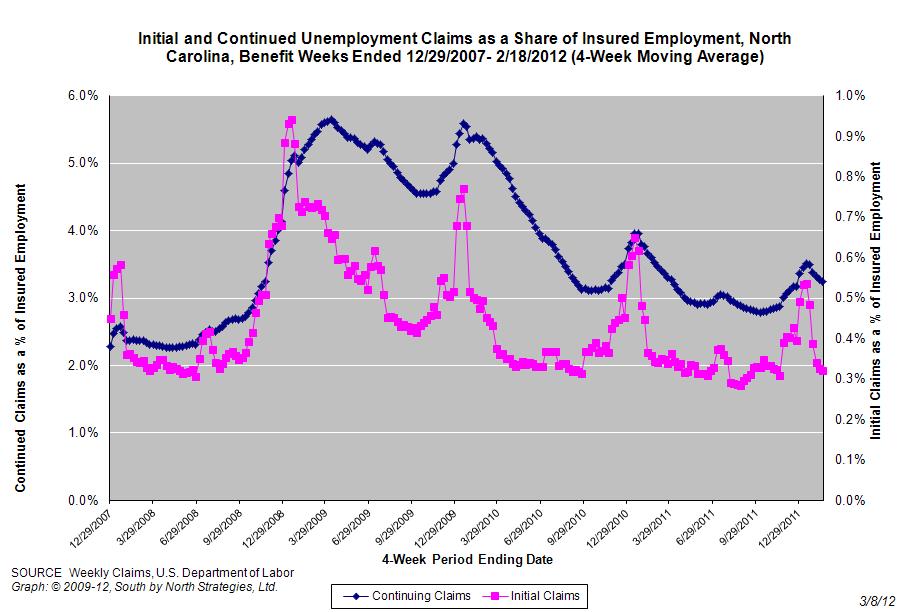
Both new and continuing claims appear to have peaked for this cycle, and the four-week averages of new and continuing claims have fallen considerably. Yet continuing claims remain at an elevated level, which suggests that unemployed individuals are finding it difficult to find new positions.
The Recovery Act At Work In NC
A short documentary film (~30 minutes) prepared by the NC Department of Commerce shows how supplemental funding for workforce development programs under the American Recovery and Reinvestment Act have helped businesses, workers, and communities across the state.
Around The Dial – March 7, 2012
Economic policy reports, blog postings, and media stories of interest:
- Rortybomb warns against another “pivot” from unemployment.
- The Economic Policy Institute analyzes the new H2B visa rules.
- Off the Charts blogs about extreme poverty.
- Robert Kuttner explains “the cost of financial favoritism.”
More Than One Answer
Lawrence Mishel of the Economic Policy Institute points out that more “college is not always the answer.”
The width of the path to the middle class is narrower than many people think: the inflation-adjusted wage of college graduates has not improved in a decade, and fewer now receive health and pension benefits, especially among young workers. A four-year college degree is not the panacea that many people think it is.
…
There is plenty of snobbery afoot regarding college educations. I have heard esteemed academics — conservative and liberal — wrongly equate college graduates with “smart people” and “skilled workers.” And, I have heard many conservative and liberal educational policy experts demean destinations other than college. We need a nation that has and values all sorts of work and skills, which means providing decent pay and benefits for many types of jobs.
Fear The Dynamism
Simon Johnson warns people to be very afraid of “dynamic scoring.”
The macroeconomic models used to claim big growth effects for tax cuts are simply wrong – and completely at odds with the empirical evidence. A smart modeler can assume something different and show you that with a great deal of math, but this is just an assumption dressed up in a complicated fashion.
…
Put more bluntly – there is no magic in the real world, just very large budget deficits. As Mr. Buckley puts it, “One cannot find in the economic data for the last 30 years any evidence that supply-side-based tax policy has delivered its promised benefits.”
…
If you cut taxes, revenues will fall and deficits will increase. If you change the CBO’s scoring process to hide this fact – as is under consideration by leading Republicans on the House Budget Committee and the House Ways and Means Committee – you are engaging in exactly the same sort of deception that brought down Greece.
 Email Sign-Up
 RSS Feed