

Going Too Low
The North Carolina Budget & Tax Center explains why North Carolina shouldn’t lower the income standard used to determine enrollment in state-funded pre-kindergarten programs.
Building a pathway for more of North Carolina’s children to achieve financial security and middle-class status is critical to creating a strong economy. NC Pre-K and early childhood programs provide such a pathway by investing in quality learning experiences at a critical developmental period. Because NC Pre-K’s current “at-risk” eligibility threshold is inclusive of a broader range of children in households experiencing economic hardship with incomes above the flawed federal poverty level, it has the greatest potential to improve the earnings for more North Carolinians and strengthen the economy in turn. Efforts to narrow the number of children able to benefit from NC Pre-K’s learning opportunity will thus decrease the positive long-term learning and economic impacts of the program on North Carolina’s children and our economy.
Around The Dial – March 2, 2012
Economic policy reports, blog postings, and media stories of interest:
Around The Dial – March 1, 2012
Economic policy reports, blog postings, and media stories of interest:
- Economix worries about the corporate bias toward “short-termism.”
- The Nation notes that the unemployment deal ignores the poorest Americans.
NC Unemployment Claims: Week of 2/11/12
For the benefit week ending on February 11, 2012, some 11,648 North Carolinians filed initial claims for state unemployment insurance benefits, and 120,190 individuals applied for state-funded continuing benefits. Compared to the prior week, there were more initial and fewer continuing claims. These figures come from data released by the U.S. Department of Labor.
Averaging new and continuing claims over a four-week period — a process that helps adjust for seasonal fluctuations and better illustrates trends — shows that an average of 12,231 initial claims were filed over the previous four weeks, along with an average of 122,768 continuing claims. Compared to the previous four-week period, the average number of initial claims was lower, as was the average number of continuing claims.
One year ago, the four-week average for initial claims stood at 13,621, and the four-week average of continuing claims equaled 135,859.
In recent weeks covered employment has increased and now slightly exceeds the level recorded a year ago (3.74 million versus 3.71 million). Nevertheless, there are still fewer covered workers than there were in January 2008, which means that payrolls are smaller today than they were four years ago.
The graph shows the changes in unemployment insurance claims measured as a share of covered employment in North Carolina since the recession’s start in December 2007. 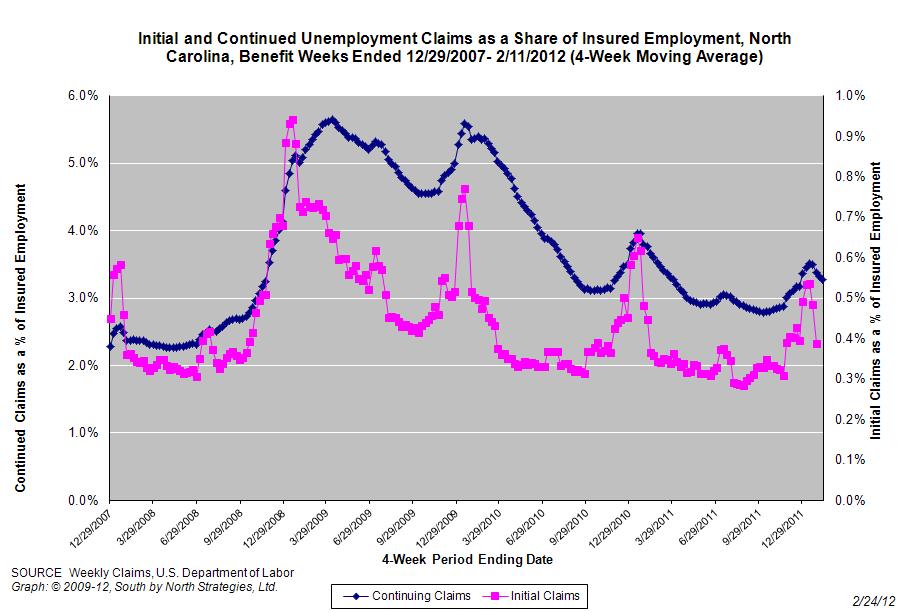
Both new and continuing claims appear to have peaked for this cycle, and the four-week averages of new and continuing claims have fallen considerably. Yet continuing claims remain at an elevated level, which suggests that unemployed individuals are finding it difficult to find new positions.
Service Activity In The South Atlantic: Feb. 2012
From the Federal Reserve Bank of Richmond’s latest survey of service-sector activity in the South Atlantic (District of Columbia, Maryland, North Carolina, South Carolina, Virginia and West Virginia):
Activity in the service sector improved in February, notably with respect to employment, according to the latest survey by the Federal Reserve Bank of Richmond. Retail sales advanced at a slower pace, although shopper traffic increased. Big-ticket sales remained weak, but pulled back from last month’s sharp drop. Retail inventory accumulation nearly matched January’s rise. Revenues slowed abruptly at non-retail services firms. Retailers expected weak demand for their goods during the next six months. In contrast, non-retail services providers anticipated stronger demand for their services over that period.
…
Labor market indicators strengthened across the broad service sector, with a jump in the number of employees and widespread wage increases.
…
Price change in the overall service sector sped up slightly, with most of that pick-up in retail. Looking ahead six months, expectations were for continued mild acceleration.
 Email Sign-Up
 RSS Feed