

Censoring The Net?
A short video prepared by Fight for the Future, an advocacy coalition, explains how the “Stop Online Piracy Act/Protect IP Act” works and how it would negatively impact free speech on the Internet.
Not Much Reason To Celebrate
Joseph Stiglitz is not very optimistic about the economy’s prospects in 2012.
This year is set to be even worse. It is possible, of course, that the United States will solve its political problems and finally adopt the stimulus measures that it needs to bring down unemployment to 6% or 7% (the pre-crisis level of 4% or 5% is too much to hope for). But this is as unlikely as it is that Europe will figure out that austerity alone will not solve its problems. On the contrary, austerity will only exacerbate the economic slowdown. Without growth, the debt crisis – and the euro crisis – will only worsen. And the long crisis that began with the collapse of the housing bubble in 2007 and the subsequent recession will continue.
Editor’s Note
Policy Points is taking a few days off to commemorate the Martin Luther King, Jr. holiday. Regular posting will resume on January 17, 2011.
Thank you for your interest in the blog.
Around The Dial – January 12, 2012
Economic policy reports, blog postings, and media stories of interest:
- Harry Payne describes a “loss of civility” in the NC legislature.
- Jared Bernstein depicts the likely “fiscal drag” on the economy.
- Paul Krugman notes that business success doesn’t qualify someone as a policymaker.
- The New York Times reports on a slowdown in the German economy.
- McClatchy Newspapers reports on the details of the Countrywide Mortgage collapse.
NC Unemployment Claims: Week of 12/24/11
For the benefit week ending on December 24, 2011, some 20,098 North Carolinians filed initial claims for state unemployment insurance benefits, and 127,019 individuals applied for state-funded continuing benefits. Compared to the prior week, there were more initial and continuing claims. These figures come from data released by the U.S. Department of Labor.
Averaging new and continuing claims over a four-week period — a process that helps adjust for seasonal fluctuations and better illustrates trends — shows that an average of 14,777 initial claims were filed over the previous four weeks, along with an average of 118,495 continuing claims. Compared to the previous four-week period, the average number of initial claims was lower, and the average number of continuing claims was higher.
One year ago, the four-week average for initial claims stood at 16,890 and the four-week average of continuing claims equaled 130,453.
In recent weeks covered employment has increased slightly and has returned to the 3.73 million level recorded a year ago. Nevertheless, there are still fewer covered workers than there were in January 2008, which means that payrolls are smaller today than they were almost three years ago.
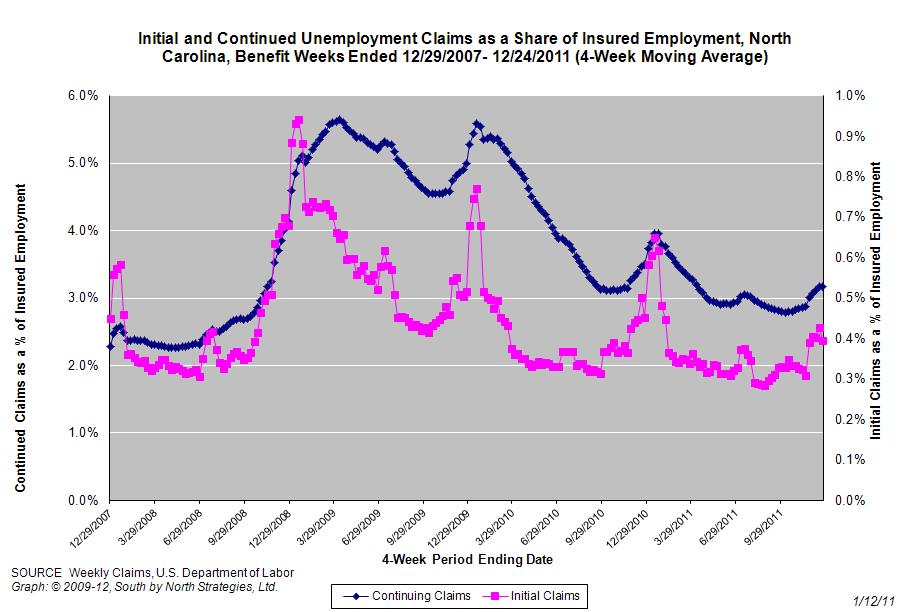
The graph shows the changes in unemployment insurance claims measured as a share of covered employment in North Carolina since the recession’s start in December 2007.
Both new and continuing claims appear to have peaked for this cycle, and the four-week averages of new and continuing claims have fallen considerably. Yet continuing claims remain at an elevated level, which suggests that unemployed individuals are finding it difficult to find new positions.
 Email Sign-Up
 RSS Feed