

Around The Dial – December 22, 2011
Economic policy reports, blog postings, and media stories of interest:
- Rortybomb explains various measures of unemployment.
- Dean Baker reflects on “Obama’s stimulus failure.”
- Tim Noah marvels at the proposed GOP “reform” to unemployment insurance.
- Robert Reich mulls the purpose of government.
- Economix notes that “cutting the corporate tax rate is no economic panacea.”
- Simon Johnson considers “austerity and the modern banker.”
NC Unemployment Claims: Week of 12/3/11
For the benefit week ending on December 3, 2011, some 13,553 North Carolinians filed initial claims for state unemployment insurance benefits, and 115,107 individuals applied for state-funded continuing benefits. Compared to the prior week, there were fewer initial and continuing claims. These figures come from data released by the U.S. Department of Labor.
Averaging new and continuing claims over a four-week period — a process that helps adjust for seasonal fluctuations and better illustrates trends — shows that an average of 15,149 initial claims were filed over the previous four weeks, along with an average of 114,208 continuing claims. Compared to the previous four-week period, the average number of initial claims was higher, as was the average number of continuing claims.
One year ago, the four-week average for initial claims stood at 16,362 and the four-week average of continuing claims equaled 123,741.
In recent weeks covered employment has increased slightly and has returned to the 3.73 million level recorded a year ago. Nevertheless, there are still fewer covered workers than there were in January 2008, which means that payrolls are smaller today than they were almost three years ago.
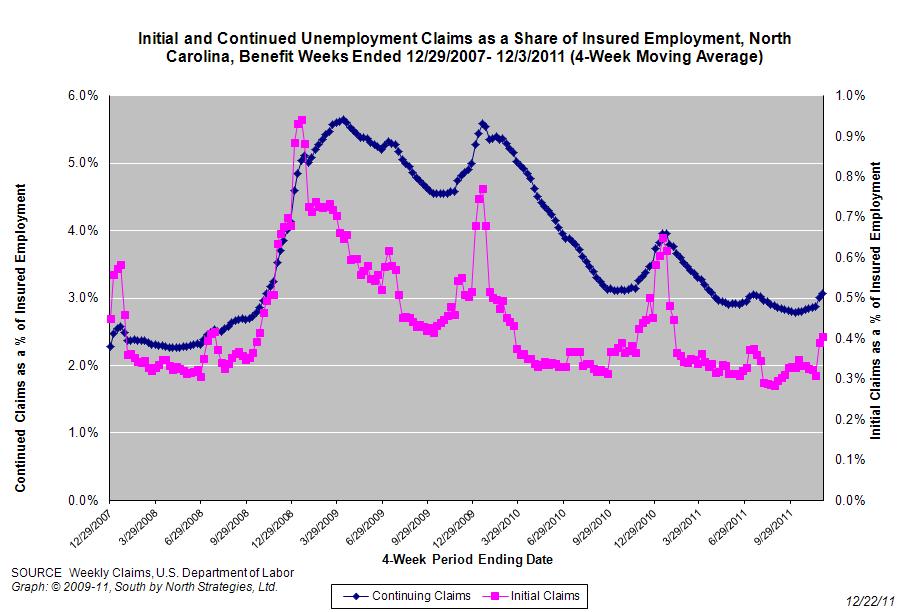 The graph shows the changes in unemployment insurance claims measured as a share of covered employment in North Carolina since the recession’s start in December 2007.
Both new and continuing claims appear to have peaked for this cycle, and the four-week averages of new and continuing claims have fallen considerably. Yet continuing claims remain at an elevated level, which suggests that unemployed individuals are finding it difficult to find new positions.
Wealth Gaps, Efficiency, and Well-Being
Mark Thoma explains how wealth disparities undermine economic efficiency and social well-being.
This is, of course, an argument for the government provision of certain types of goods through a tax structure that requires the wealthy to pay a larger share of the bill based upon efficiency rather than equity grounds, but here’s the problem. This only works if the rich and the poor live in the same neighborhoods, share the same roads, use the same parks, attend the same schools, and so on. In an increasingly divided economy and society – as in the US in recent decades – the opportunities for mutually beneficial arrangements diminish. If the wealthy do not attend the same schools, live in the same areas as the poor, have special lines at airports, shun public pools, have their own tennis courts, golf courses, and parks, if they have helicopters to avoid city traffic, their own security arrangements independent of the police – the list goes on and on – then these opportunities are lost.
Thoma’s article continues:
The more divided our society becomes, and the divisions are growing, the less shared experience we will have. The rich live in one world, the poor in another, and mutually beneficial arrangements between the two groups fail to occur.
And we are all worse off because of it.
Around The Dial – December 21, 2011
Economic policy reports, blog postings, and media stories of interest:
- The BBC reports on how municipal creditors are squeezing public services.
- Economist’s View discusses “the Darwin economy.”
- Policy Shop thinks on “the real lesson of high retail politics.”
- Jared Bernstein points out that Pell grants are “under fire.”
- Off the Charts points out that it is the Great Recession, not Great Vacation.
Making Work Family-Friendly
A major report from the North Carolina Justice Center details “workplace policies that promote family economic security, such as paid sick days and family leave insurance, allow workers to keep much-needed wages and provide job protection when inevitable life events arise.” From the report …
Despite the job losses of recent years, today most families are headed by working adults, and many of these workers, women and men, have child-care responsibilities, elder-care responsibilities, or both. Overall, almost one-third of all households in north Carolina include children under the age of 18, and the percentage of households with all parents in the labor force actually increased slightly from 2007 to 2010.
—
But work-family policies are not just about families with children. A recent study found that in 2009, almost 1.2 million North Carolinians cared for adult family members, partners, or friends suffering from chronic illness…. Almost 900,000 North Carolina households included a person aged 65 years or older in 2010. By 2030, North Carolina’s population of people aged 65 and older is expected to grow by 80 percent, meaning that more workers will be looking after loved ones who require care.
—
Today’s workplace policies were created for a labor force that does not exist— one built on the concept of a sole male breadwinner and a female homemaker who tended to family responsibilities and caregiving needs. Though this concept was already problematic when major federal policies governing the workplace were instituted, the more complicated reality of North Carolina’s current workforce is not reflected in the laws that are in place.
 Email Sign-Up
 RSS Feed