

Around The Dial – November 17, 2011
Economic policy reports, blog postings, and media stories of interest:
- Felix Salmon wonders about the future of online advertising.
- Martin Wolf argues that “Europe must not allow Rome to burn.”
- Economix reports on American migration reaching a record low.
- Fed Watch describes the Eurozone’s “path that leads to a very nasty equilibrium.”
- New Deal 2.0 points out the failure of providing basic goods through consumer debt.
NC Unemployment Claims: Week of 10/29/11
For the benefit week ending on October 29, 2011, some 12,637 North Carolinians filed initial claims for state unemployment insurance benefits, and 105,718 individuals applied for state-funded continuing benefits. Compared to the prior week, there were more initial and continuing claims. These figures come from data released by the U.S. Department of Labor.
Averaging new and continuing claims over a four-week period — a process that helps adjust for seasonal fluctuations and better illustrates trends — shows that an average of 12,394 initial claims were filed over the previous four weeks, along with an average of 105,294 continuing claims. Compared to the previous four-week period, the average number of initial claims was lower and the number of continuing claims was higher.
One year ago, the four-week average for initial claims stood at 13,655 and the four-week average of continuing claims equaled 115,962.
In recent weeks covered employment has increased slightly and has returned to the 3.73 million level recorded a year ago. Nevertheless, there are still fewer covered workers than there were in January 2008, which means that payrolls are smaller today than they were almost three years ago.
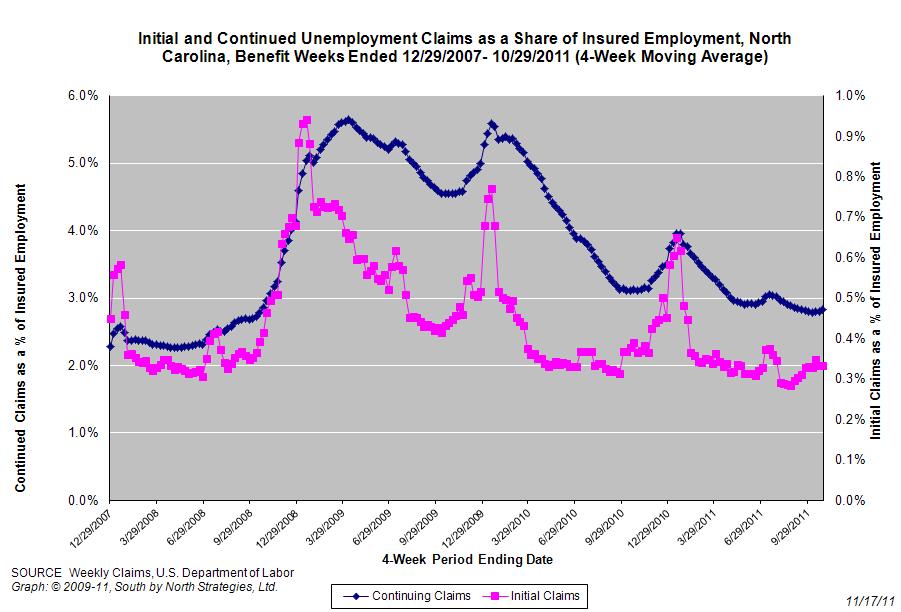 The graph shows the changes in unemployment insurance claims (as a share of covered employment) in North Carolina since the recession’s start in December 2007.
Both new and continuing claims appear to have peaked for this cycle, and the four-week averages of new and continuing claims have fallen considerably. Yet continuing claims remain at an elevated level, which suggests that unemployed individuals are finding it difficult to find new positions.
On The Chopping Block
Together NC recently released “On The Chopping Block,” a nifty online tool that maps job losses and budget cuts occurring in communities across North Carolina. Click on the image below to access the interactive tool.

Around The Dial – November 16, 2011
Economic policy reports, blog postings, and media stories of interest:
- Wolfgang Muenchau says the time for Eurobonds is here.
- Nancy Folbre weighs the policy implications of poverty measures.
- The NY Times profile Mario Monti, Italy’s likely caretaker prime minister.
- Nouriel Roubini see the Eurozone’s periphery as mired in “the paradox of thrift.”
- Dean Baker asks why the middle class has to take a hit in the deficit debates.
Is There A “Bubble” In Higher Education?
James Surowiecki of The New Yorker looks at the arguments over whether there exists a “bubble” in higher education. and finds the arguments in favor of a bubble somewhat wanting, with one big exception.
The bubble analogy does work in one respect: education costs, and student debt, are rising at what seem like unsustainable rates. But this isn’t the result of collective delusion. Instead, it stems from the peculiar economics of education, which have a lot in common with the economics of health care, another industry with a huge cost problem. (Indeed, in recent decades the cost of both college education and health care has risen sharply in most developed countries, not just the U.S.) Both industries suffer from an ailment called Baumol’s cost disease, which was diagnosed by the economist William Baumol, back in the sixties. Baumol recognized that some sectors of the economy, like manufacturing, have rising productivity—they regularly produce more with less, which leads to higher wages and rising living standards. But other sectors, like education, have a harder time increasing productivity. Ford, after all, can make more cars with fewer workers and in less time than it did in 1980. But the average student-teacher ratio in college is sixteen to one, just about what it was thirty years ago. In other words, teachers today aren’t any more productive than they were in 1980. The problem is that colleges can’t pay 1980 salaries, and the only way they can pay 2011 salaries is by raising prices. And the Baumol problem is exacerbated by the arms-race problem: colleges compete to lure students by investing in expensive things, like high-profile faculty members, fancy facilities, and a low student-to-teacher ratio.
 Email Sign-Up
 RSS Feed