

Halfway There And a Long Way To Go
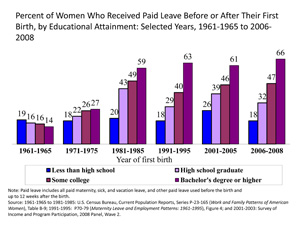
Random Samplings notes that 51 percent of all first-time mothers in America received paid leave in 2008. While the share of all first-time mothers receiving paid maternity leave benefits has grown over the years, access to the benefit varies greatly with more educated workers being much more less likely thank other women to receive any paid maternity benefits.
A Market-Based Solution
Economist’s View points out that there is a market-based solution to the “problem” of Americans not wanting to fill certain jobs.
If these jobs remain open, one of two things will happen. Either wages will rise to a level that will attract workers, or if the wage required is too high to make a profit the firm will go out of business. That’s just the free market at work, and cries from business owners that the inability to hire illegal workers is forcing them out of business is no more compelling than a cry that the inability to do something illegal such as pollute is forcing them to close their doors. The question is whether they are profitable when forced to internalize all costs, and pay the above-board market price for the resources they use.
Editor’s Note
Policy Points will not appear today in honor of the Veterans’ Day holiday. Normal posting will resume on Monday, November 14, 2011.
Thank you for your interest in the blog.
Around The Dial – November 10, 2011
Economic policy reports, blog postings, and media stories of interest:
- Off the Charts again explodes the myth of non-taxpayers.
- Barry Eichengreen sees “Europe’s darkness at noon.”
- Policy Shop describes the Census Bureau’s new supplemental poverty measure.
- Shawn Fremstad raises concerns about the same supplemental poverty measure.
- Dean Baker argues that failure is the best outcome for the Super Committee.
- Martin Wolf thinks “through the unthinkable” about Europe.
NC Unemployment Claims: Week of 10/22/11
For the benefit week ending on October 22, 2011, some 11,547 North Carolinians filed initial claims for state unemployment insurance benefits, and 105,200 individuals applied for state-funded continuing benefits. Compared to the prior week, there were fewer initial and continuing claims. These figures come from data released by the U.S. Department of Labor.
Averaging new and continuing claims over a four-week period — a process that helps adjust for seasonal fluctuations and better illustrates trends — shows that an average of 12,446 initial claims were filed over the previous four weeks, along with an average of 104,566 continuing claims. Compared to the previous four-week period, the average number of initial claims was lower and the number of continuing claims was higher.
One year ago, the four-week average for initial claims stood at 14,514 and the four-week average of continuing claims equaled 116,752.
While the number of claims has dropped over the past year so has covered employment. Last week, covered employment totaled 3.72 million, down from 3.73 million a year ago.
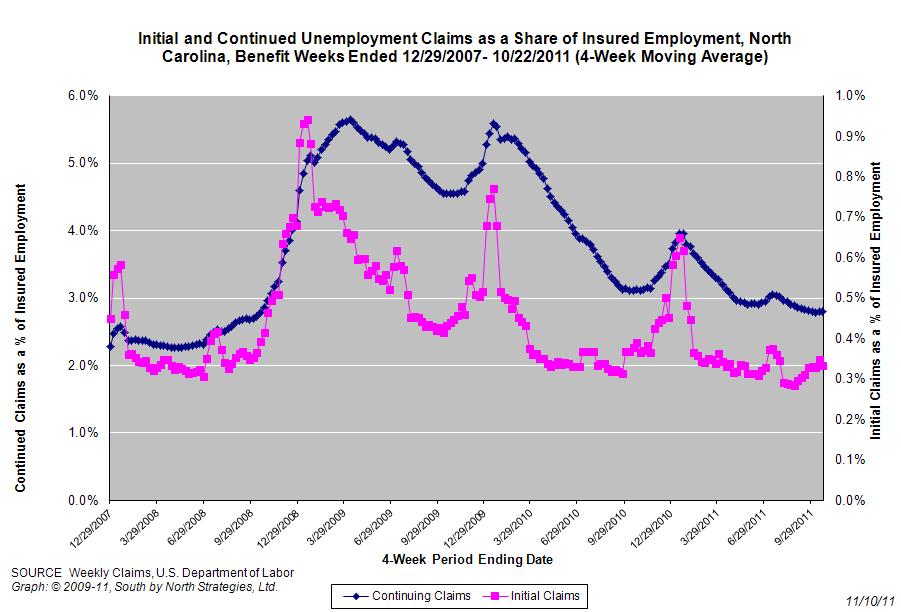 The graph shows the changes in unemployment insurance claims (as a share of covered employment) in North Carolina since the recession’s start in December 2007.
Both new and continuing claims appear to have peaked for this cycle, and the four-week averages of new and continuing claims have fallen considerably. Yet continuing claims remain at an elevated level, which suggests that unemployed individuals are finding it difficult to find new positions.
 Email Sign-Up
 RSS Feed