

Rethinking Small Business Policies
Writing in Bloomberg Businessweek, Charles Kenny of the New America Foundation argues that “the notion that small business is the force behind prosperity is not true” and that “the longer the US and other countries cling to this myth, the harder it will be to carry out the kinds of economic policies that might actually stimulate job growth.” From the article …
In the U.S. in 2007 there were around 6 million companies with workers on the payroll. Ninety percent of those businesses employed fewer than 20 people, according to analysis of the latest census data by Erik Hurst and Ben Pugsley of the University of Chicago. Collectively, those companies accounted for 20 percent of all jobs. Most small employers are restaurateurs, skilled professionals or craftsmen (doctors, plumbers), professional and general service providers (clergy, travel agents, beauticians), and independent retailers. These aren’t sectors of the economy where product costs drop a lot as the firm grows, so most of these companies are going to remain small. And according to Hurst and Pugsley’s survey evidence, the majority of small business owners say that’s precisely their intent—they didn’t start a business for the money but for the flexibility and freedom. Most have no plans to grow.
…
Some small companies do grow, of course. Think Apple (AAPL) or Hewlett-Packard (HPQ), which were initially run out of garages, or Google (GOOG), created by two guys in a dorm room. But the vast majority of small enterprises stay small. Eighty percent of U.S. small companies that remained in business from 2000 to 2003—the most recent period for which Hurst and Pugsley compiled data—didn’t add a single employee.
Debating Social Security
The PBS NewsHour debates the health of the Social Security system.
Watch the full episode. See more PBS NewsHour.
Around The Dial – October 4, 2011
Economic policy reports, blog postings, and media stories of interest:
- Jeffrey Sachs argues that the US government has failed to respond to globalization.
- Fed Watch doesn’t know what policymakers think about the unemployed.
- Off the Charts sketches ideas for improving the financing of unemployment insurance.
- The NY Times reports on the politics of tax breaks.
- Paul Krugman explains Chinese currency policy.
“Small” Is In the Eye Of The Beholder
TaxVox summarizes new research into small businesses and taxes.
Small businesses take on an outsized importance in the tax policy debate for two reasons: These firms play into the great American entrepreneurial narrative and, in the current political debate, they are the “job creators.” Raise their taxes, goes the argument, and you further wreck an already-weak economy by discouraging these firms from hiring and investing.
…
Well, it turns out most of the firms those pols define as small businesses don’t hire or invest very much at all. There is no question that other companies whose income is reported on individual tax returns do hire and invest (quite a lot in some cases), but they are not small businesses, at least not according to this new definition.
…
So what is a small business? The Treasury team, led by Matthew Knittel at the Office of Tax Analysis, defined one as a firm that has combined income or deductions of at least $10,000 but no more than $10 million and one that operates in a businesslike manner. In other words, it has expenses such as wages, office supplies, rent, and the like.
The post then contrasts the Treasury Department definition to that of the Small Business Administration.
This is very different than the Small Business Administration, which uses multiple definitions but can include firms with sales of as much as $35.5 million with as many as 1,500 employees. It also is an effort to distinguish between those who report business income on their individual returns and actual small businesses. Treasury finds that many partnerships, S corporations, and others who file on an individual return don’t meet the small business test—either because they make too much money to be “small” or too little to be a real business.
…
Those distinctions are extremely important since many politicians love nothing more than to happily label all firms whose owners report income on their individual returns as iconic small businesses. If nothing else, the Treasury staff analysis shows how bogus that exercise is.
…
For example, using tax year 2007 data, Treasury found that of the 23.2 million people who reported income on Schedule C, fewer than half met its small business test—nearly all because they were too small. On average, the excluded firms reported just $7,000 of total income and $4,600 of net income.
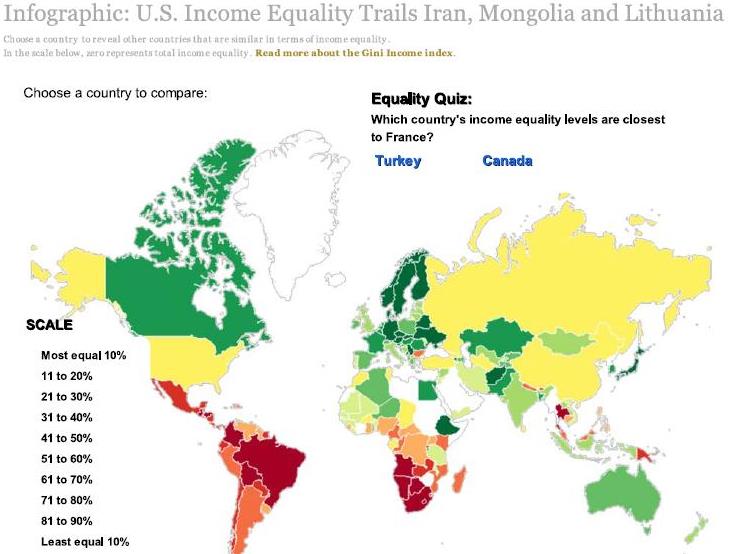
Mapping Global Income Inequality
A nifty online calculator prepared by The PBS NewsHour allows users to compare levels of income inequality across the world. Countries are compared based on their Gini coefficient, a statistical measure of the dispersion of income within a country.
 Email Sign-Up
 RSS Feed