

Playing The (Lousy) Employment Odds
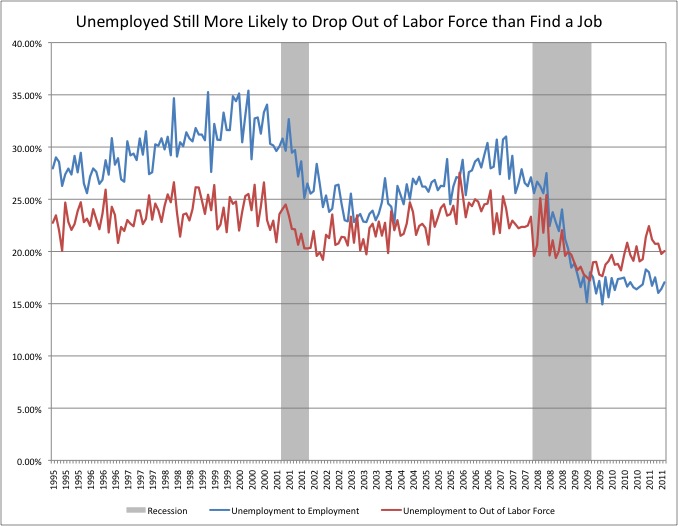
Over at Rortybomb, Mike Konczal points out that unemployed Americans are more likely to drop out of the labor force altogether than they are to find a new job. The graph below shows that trend by illustrating the flow of people classified as unemployed into the categories of employed and out of the labor force over the period spanning 1995 to the present.
Strengthening Apprenticeship Programs
In a recent Policy Brief, The Working Poor Families Project presented ideas for improving state policies and practices pertaining to apprenticeship programs. From the report …
Apprenticeship holds the promise of providing good jobs and a path to self-sufficiency. however, unless states take bold actions to expand apprenticeship opportunities and strengthen entry and completion, low-skilled, low-wage adults may be left behind.
…
Several states have enacted programmatic and policy innovations to encourage employer development of apprenticeships, increase recruitment, preparation, and completion rates of under-represented individuals, and build apprentices’ pathways to postsecondary and industry-recognized credentials. along the way,states have formed closer ties between the registered apprenticeship system and community college, workforce development, and pre-apprenticeship programs. states have leveraged numerous funding sources to aid in apprenticeship expansion and services, including WIA, OJT, general revenue, federal construction funds, bonds, and the Unemployment Insurance Trust Fund, as well as enactment of tax breaks.
…
With state budgets running thin for education, workforce development, it is imperative that states find innovative, sustainable ways to support apprenticeship. Based on the experience of many states, this report recommends a variety of budget neutral strategies, as well as some that require financial investment.
Around The Dial – September 12, 2011
Economic policy reports, blog postings, and media stories of interest:
- Peter Orszag argues for changing the upside-down nature of tax breaks.
- Jared Bernstein explains “high-road contracting.”
- Martin Wolf says it is time to listen “to what the bond markets are telling us.”
- Lawrence Katz calls for investments in workers.
- The New York Times reports on the problems facing BofA.
The State Of Working North Carolina
Lat week, the N.C. Budget and Tax Center published a detailed report on the state of North Carolina’s labor market. Among other finsings, the report notes that “more than 24 months after the official end of the Great Recession, North Carolina’s working families continue to struggle with a lack of job opportunities, staggering loss of earnings and wealth, and the continued transformation of the state’s economy.”
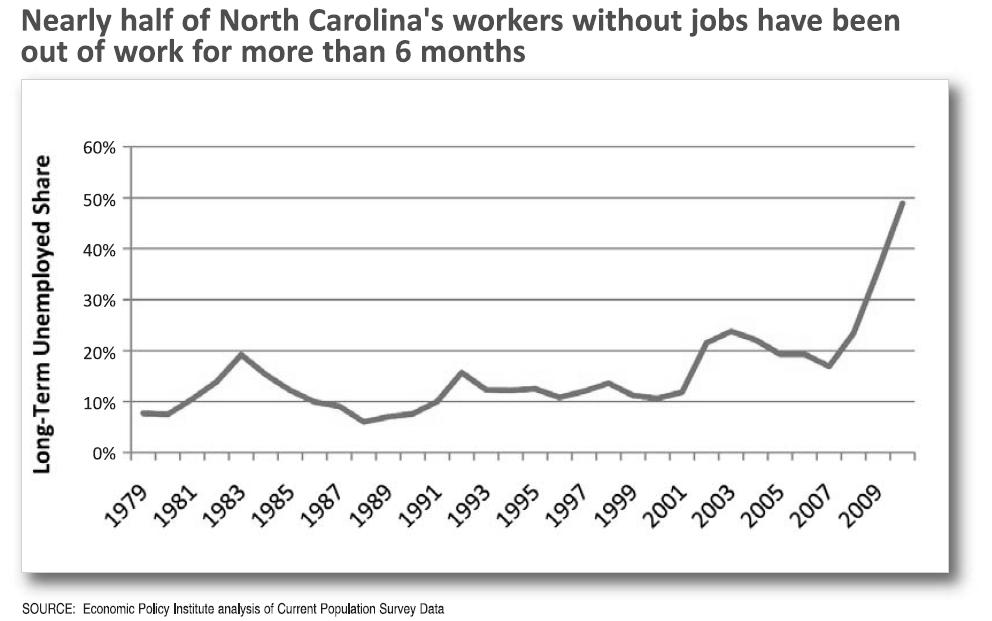
Furthermore, the report found, as the graph below shows, that nearly half of North Carolina’s unemployed workers had been out of work for more than six months.
Job Openings In July 2011
From the Economic Policy Institute’s analysis of the July version of the Job Openings and Labor Turnover Survey (JOLTS) …
In July there were 3.2 million job openings and 13.9 million unemployed workers (unemployment data are from the Current Population Survey), resulting in a 4.3-to-1 ratio of unemployed workers to job openings. This is an improvement from the revised June ratio of 4.4-to-1. However, July marks two years and seven months—134 weeks—that the “job seeker’s ratio” has been substantially above 4-to-1, a level that means there are no jobs to be found for three out of four unemployed workers. By comparison, in December 2000 the job-seeker’s ratio was 1.1-to-1, and the highest it got in the downturn of the early 2000s was 2.8-to-1. The figure shows that unemployed workers vastly outnumber job seekers in every major industry, reflecting an across-the-board shortfall of demand for workers rather than a structural mismatch between unemployed workers and job openings.
 Email Sign-Up
 RSS Feed