

Work Sharing: A Modest Proposal
Dean Baker of the Center for Economic and Policy Research explains the potential benefits of work sharing as a response to weak labor market conditions.
Work sharing is not a new idea. The idea of shortening work time to create more work has a long history. In the context of an economy that is at full employment, this approach can be seen as misguided, since legislated reductions in work time can lead to increased inflationary pressure and economic distortions. However, in an economy that is operating well below its potential – and projected to remain so for much of the next decade – work sharing may be the most viable way of bringing the economy back closer to full employment.
…
Germany is the model in this respect. It has aggressively promoted a policy of work sharing, along with other measures aimed at persuading employers to retain workers. As a result, its standardized unemployment rate now stands at 6.7 percent, 0.4 percentage points below the rate at the start of the downturn. This remarkable achievement was not due to superior economic growth. Through the fourth quarter of 2010, the growth rate of Germany’s economy since the start of the downturn had actually lagged somewhat behind the growth rate of the United States. The fact that Germany’s unemployment rate had fallen, while the unemployment rate in the United States had risen by 4.4 percentage points, was entirely due to different labor-market responses to the downturn.
Around The Dial – July 28, 1011
Economic policy reports, blog postings, and media stories of interest:
- Naked Capitalism notes the bank reaction to proposed IRA rules.
- Mark Thoma says economist’s should listen more.
- Marshall Auerback argues that current administration is “worse than Hoover.”
- Simon Johnson asks if the US or Europe is in worse shape.
- The Washington Post reports on a slowing economy.
NC Unemployment Claims: Week of 7/9/11
For the benefit week ending on July 9th, 18,911 North Carolinians filed initial claims for state unemployment insurance benefits, and 120,142 individuals applied for state-funded continuing benefits. Compared to the prior week, there were more initial and continuing claims. These figures come from data released by the U.S. Department of Labor.
Averaging new and continuing claims over a four-week period — a process that helps adjust for seasonal fluctuations and better illustrates trends — shows that an average of 13,837 initial claims were filed over the previous four weeks, along with an average of 112,502 continuing claims. Compared to the previous four-week period, the averages of initial and continuing claims were higher.
One year ago, the four-week average for initial claims stood at 13,963 and the four-week average of continuing claims equaled 147,373.
While the number of claims has dropped over the past year so has covered employment. Last week, covered employment totaled 3.71 million, down from 3.79 million a year ago.
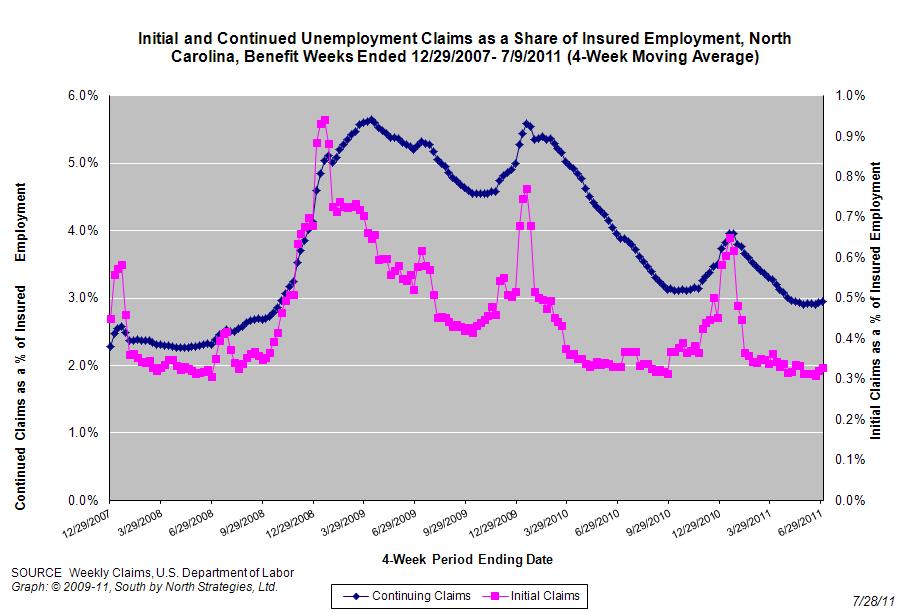 The graph shows the changes in unemployment insurance claims (as a share of covered employment) in North Carolina since the recession’s start in December 2007.
Both new and continuing claims appear to have peaked for this cycle, and the four-week averages of new and continuing claims have fallen considerably. Yet continuing claims remain at an elevated level, which suggests that unemployed individuals are finding it difficult to find new positions.
Patent Trolls
This American Life reports on the resurgence of patent trolling and how it harms economic activity.
Around The Dial – July 27, 2011
Economic policy reports, blog postings, and media stories of interest:
- Bruce Bartlett points out that the Bush-era tax cuts did reduce revenues.
- Econbrowser is worried about “the bonds of August.”
- The Baseline Scenario explains budget deficits.
- James Surowiecki says it is time to smash the debt ceiling.
- Economix notes that “on jobs, the U.S. is turning into Europe.”
 Email Sign-Up
 RSS Feed