

Inequality And Social Spending
Mark Thoma wonders how rising income inequality has shaped American attitudes towards social spending.
… As most everyone is aware at this point, inequality has been growing steadily since the 1970s. There have been substantial gains at the top of the income distribution charts, but incomes for those in the middle and bottom have been flat. As households have come under increasing stress because of their stagnant incomes, many people have started to wonder why they should share with others when nobody is sharing with them. Let those who received the gains – those at the top who don’t have to worry about making it to the next paycheck – bear the burden.
…
In order to overcome the increasing resistance to social spending, we must do a better job of educating people about how their tax dollars are used and who those tax dollars actually support. But that alone won’t be enough. We must also find a way to solve the growing inequality problem, or support for important social programs will continue to fall.
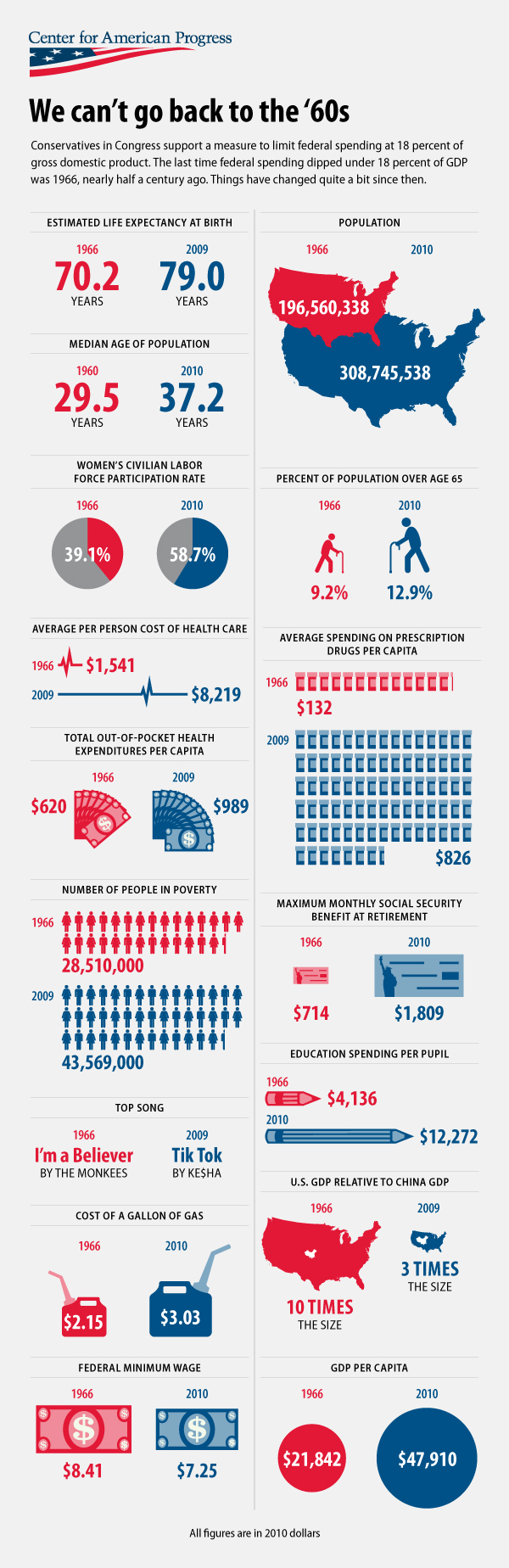
1960s Redux
The Center for American Progress doesn’t think adopting a 1960s budget is a good idea for contemporary America.
Around The Dial – July 19, 2011
Economic policy reports, blog postings, and media stories of interest:
- Fed Watch looks at the data for and against household deleveraging.
- E.J. Dionne wonders why Congress isn’t acting on the country’s problems.
- Harold Meyerson looks at the shift in income from wages to profits.
- Matt Stoller describes two models of political leadership.
- Keith Hennessy runs down “the substance of the budget negotiations.”
One Way To Grow The Government
Simon Johnson points out the a failure to raise the debt ceiling actually would make the size of the federal government larger relative to the overall economy.
The reason is simple: a government default would destroy the credit system as we know it. The fundamental benchmark interest rates in modern financial markets are the so-called “risk-free” rates on government bonds. Removing this pillar of the system – or creating a high degree of risk around US Treasuries – would disrupt many private contracts and all kinds of transactions.
…
In addition, many people and firms hold their “rainy day money” in the form of US Treasuries. The money-market funds that are perceived to be the safest, for example, are those that hold only US government debt. If the US government defaults, however, all of them will “break the buck,” meaning that they will be unable to maintain the principal value of the money that has been placed with them.
…
The result would be capital flight – but to where? Many banks would have a similar problem: a collapse in US Treasury prices (the counterpart of higher interest rates, as bond prices and interest rates move in opposite directions) would destroy their balance sheets.
Made In Germany
In a paper for the New America Foundation, Katherine Newman of Johns Hopkins University asks what American manufacturing can learn from Germany.
Why is Germany able to do this when the US, which had the lead in so many of these fields for so long, has had trouble turning the same corner? The answers are not simple, but they start with an industrial policy that favors high end manufacturing and the high skilled, well trained labor force that goes with it. The country invests heavily in tertiary education in general and industrial apprenticeships in particular. Banks provide ready capital for the expansion of export industries and the country’s elites re-invest the returns into precision manufacturing. Instead of railing about unions and working overtime to drive them out of business, the Germans have perfected the corporatist model of industrial bargaining. Whatever their differences, German unions … partners in growth.
…
We cannot attribute these happy outcomes to something in the German water supply. As Michael Schulman has pointed out, service workers in Germany are looking at shrinking pay packets. But in manufacturing, wages are rising and some firms … are forking over a share of firm profits to the line workers. The American romance with the unregulated market is no match for the German approach, which aligns the interests of firms and high skilled workers, invests in education to produce the labor force that is taking the country to the top, and knows how to target markets that are growing, especially the industrializing, developing world.
 Email Sign-Up
 RSS Feed