

German Lessons
A recent commentary from the German Marshall Fund of the United States identified several lessons that America could learn from German manufacturing.
Still, some lessons can be learned from the German example, especially regarding the future role of manufacturing. Germany’s manufacturing success is based on a number of factors, from a strong focus on advanced technologies to a balanced mix of small, medium, and large enterprises operating across a multitude of industrial sectors, creating regional innovation networks. Underlying all of this is a strong commitment to preserve and encourage key industries (and the accompanying production jobs) at home, even if parts of the manufacturing process are moved abroad. Additionally, there is a long-term emphasis on continued skills training for workers, strong apprenticeship programs, and other policies that specifically focus on employment. Germany’s “short-work” policy (Kurzarbeit), for example, allowed companies to keep their skilled workforce employed through the economic crisis by reducing hours while the government covered parts of lost salaries. This enabled the German economy to kick-start as soon as global demand picked up.
The article then lays out several ideas for American policymakers.
To boost American manufacturing, the government should introduce a number of new policies. First, a stronger focus on manufacturing employment is needed. Manufacturing jobs have functioned as the backbone of middle-class jobs in the United States for decades, fulfilling an important social function in times of a “squeezed” middle class. Focusing significantly more resources on continued vocational training and apprenticeship programs are first steps. Implementing short-term work schemes in the United States, while initially costly, would prevent some of the social costs of further unemployment during downturns while securing valuable worker skills. In addition, an even stronger focus needs to be placed on innovation. Manufacturing, which already is responsible for 70 percent of all private-sector R&D spending in the United States, is indispensable for innovation, as manufacturing and services, like research, design, and maintenance, are increasingly complementary. The notion that high-end R&D can thrive successfully on its own fails to acknowledge the importance of the actual manufacturing process to the development of new products, especially across subsequent technology life cycles. Defending and expanding public investments in research and development, for example through a permanent extension of existing R&D tax credits, will therefore be imperative even in times of austerity.
Around The Dial – July 12, 2011
Economic policy reports, blog postings, and media stories of interest:
- The New York Times Magazine profiles Sheila Blair of the FDIC.
- Jared Bernstein asks what is really wrong with the economy.
- Paul Krugman writes on “No we can’t? Or won’t?”
- Economist’s View wonders if the US is on a permanently lower growth path.
- Off the Charts points out the “value of income taxes.”
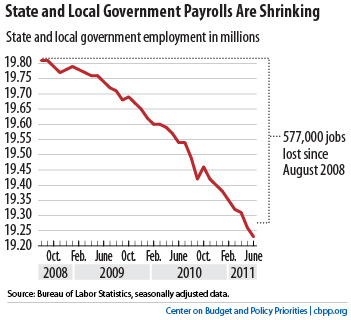
State & Local Job Losses Mount
Michael Leachman of the Center on Budget and Policy Priorities points out that current state and local job losses are the largest since 1955.
Around The Dial – July 11, 2011
Economic policy reports, blog postings, and media stories of interest:
- Laura Tyson argues for additional fiscal stimulus.
- Naked Capitalism says the Justice Dept. is “defining deviancy away.”
- Economix points out “the cost of austerity.”
- The Winston-Salem Journal reports on the work of the Golden Leaf Foundation.
- The New York Times reports on the “invisible” unemployed.
- Economist’s View wonders “how close are we to a second recession?”
 Email Sign-Up
 RSS Feed