

Around The Dial – July 7, 2011
Economic policy reports, blog postings, and media stories of interest:
- Bethany McLean comments on the winners and losers from QE2.
- David Leonhardt explains how big business is part of the deficit problem.
- Christina Romer argues for tax changes as part of any deficit deal.
- Brad DeLong describes life in “the liquidity trap.”
- Joseph Stiglitz sees an “ideological crisis” of Western capitalism.
NC Unemployment Claims: Week of 6/18
For the benefit week ending on June 18th, 11,204 North Carolinians filed initial claims for state unemployment insurance benefits, and 107,881 individuals applied for state-funded continuing benefits. Compared to the prior week, there were fewer initial and continuing claims. These figures come from data released by the U.S. Department of Labor.
Averaging new and continuing claims over a four-week period — a process that helps adjust for seasonal fluctuations and better illustrates trends — shows that an average of 11,480 initial claims were filed over the previous four weeks, along with an average of 108,019 continuing claims. Compared to the previous four-week period, the averages of initial and continuing claims were slightly lower.
One year ago, the four-week average for initial claims stood at 12,600 and the four-week average of continuing claims equaled 154,539.
While the number of claims has dropped over the past year so has covered employment. Last week, covered employment totaled 3.7 million, down from 3.8 million a year ago.
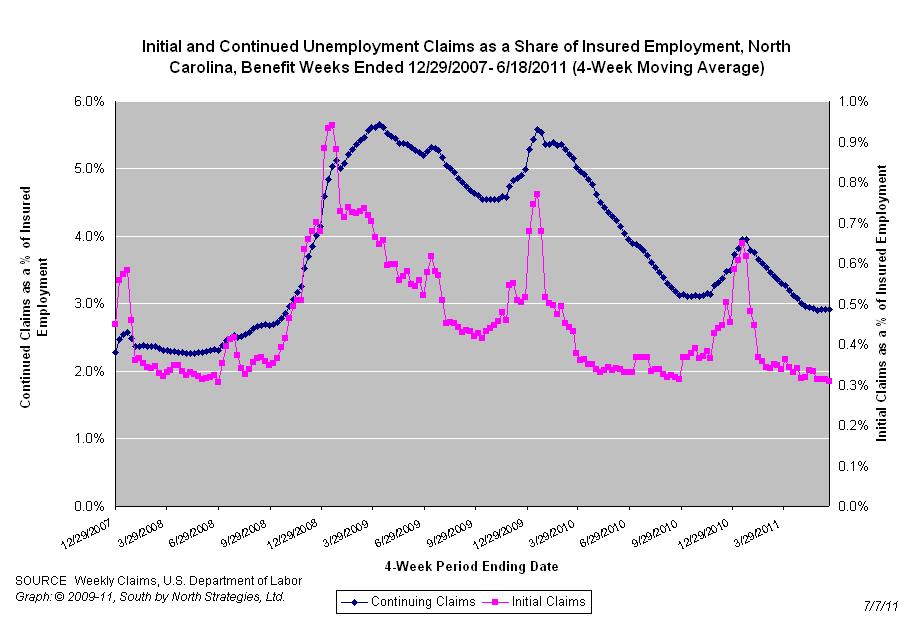 The graph (right) shows the changes in unemployment insurance claims (as a share of covered employment) in North Carolina since the recession’s start in December 2007.
Both new and continuing claims appear to have peaked for this cycle, and the four-week averages of new and continuing claims have fallen considerably. Yet continuing claims remain at an elevated level, which suggests that unemployed individuals are finding it difficult to find new positions.
Service Activity In The South Atlantic: June 2011
From the Federal Reserve Bank of Richmond’s latest survey of service-sector activity in the South Atlantic (District of Columbia, Maryland, North Carolina, South Carolina, Virginia and West Virginia):
The latest survey by the Federal Reserve Bank of Richmond showed a slowdown in service sector activity. Retail sales dipped overall and big-ticket sales suffered another drop, despite an uptick in shopper traffic. Inventories declined in June, according to retail merchants. Non-retail services providers’ revenues also decelerated. Looking ahead six months, retailers expected the weakness would persist, while contacts at services firms remained optimistic.
…
Turning to labor, retail hiring flattened and average retail wages fell in June. Hiring at services firms was also nearly flat. Average wages at non-retail establishments rose only slightly compared to a month ago.
…
Price changes in the broad service sector almost matched May’s pace. Within the sector, prices climbed more rapidly at retail businesses, but the pace slowed somewhat at services firms. For the six months ahead, survey respondents at retail and non-retail services firms anticipated prices would advance more quickly than they had expected in May.
Around The Dial – July 6, 2011
Economic policy reports, blog postings, and media stories of interest:
- Simon Johnson calls out “Europe’s naked banks.”
- Brad DeLong offers the “confessions of a financial deregulator.”
- Paul Krugman discusses the debt ceiling debate.
- Marshall Auerback sees “extend and pretend” at work in the Eurozone.
- Economix describes “the wageless, profitable recovery.”
Manufacturing In The South Atlantic: June 2011
From the Federal Reserve Bank of Richmond’s latest survey of manufacturing activity in the South Atlantic (District of Columbia, Maryland, North Carolina, South Carolina, Virginia and West Virginia):
Manufacturing activity in the central Atlantic region firmed somewhat in June after stalling in May, according to the Richmond Fed’s latest survey. The index of overall activity steadied as a slightly positive reading for new orders coupled with solid employment growth offset a slightly negative reading for shipments. Other indicators were mixed, however. District contacts reported more moderate weakness in backlogs and capacity utilization, but noted that delivery times and finished goods inventories grew at a somewhat quicker pace.
…
Looking ahead, manufacturers in June were more optimistic about their future business. Survey contacts at an increasing number of firms looked for solid growth in shipments, capacity utilization, new orders and capital expenditures over the next six months.
 Email Sign-Up
 RSS Feed