Labor Force Participation (Or Not)
Economix blogs about projected changes to the share of the working-age population participating in the labor force.
The [Congressional Budget Office] report observes that the participation rate peaked at about 67 percent during the late 1990s and in 2000, since that’s when baby boomers were in their prime working-age years of 25 to 54. Women had also been entering the labor force at a rapid clip.
…
But since then the share of women who choose to work has fallen. In fact, it’s now at the lowest level in nearly 20 years. Meanwhile baby boomers are reaching retirement age and dropping out of the labor force. Additionally, the share of people under age 25 who are working or looking for work has also fallen.
Around The Dial – March 23
Economic policy reports, blog postings, and media stories of interest:
- Robert Reich tries to set straight the jobs debate.
- Jonathan Cohn checks in on health reform, one year later.
- The Washington Post reports on policies for boosting graduation rates.
- Heleen Mees notes the flaws of labor market deregulation.
- The Baseline Scenario notes the flaws of health care incentives.
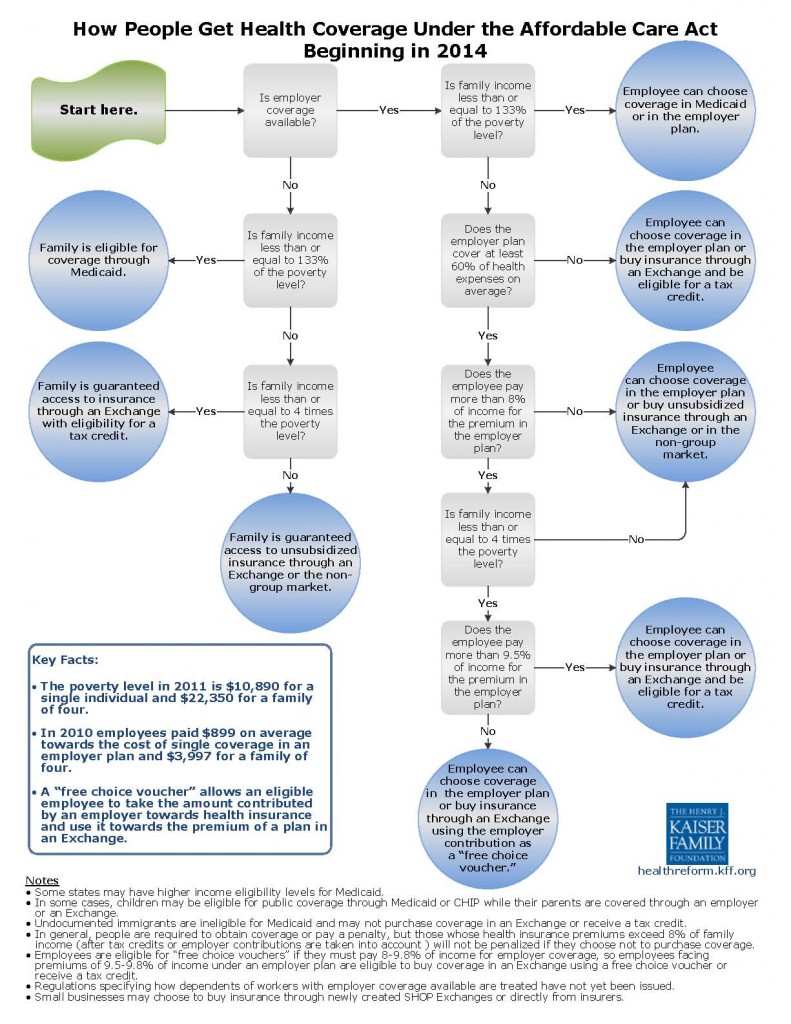
The Road To Coverage
The Kaiser Family Foundation neatly diagrams how individuals will obtain health insurance coverage once the Affordable Care Act takes full effect.
No Time For TABOR
The N.C. Budget & Tax Center looks at how the adoption of a TABOR legislation that caps state spending growth to the sum of inflation and population growth would impact North Carolina.
The proposed TABOR legislation before the General Assembly would cap growth of state General Fund appropriations to population growth plus inflation. The TABOR formula fails to take into account that the costs of certain services, such as health care and education, grow faster than inflation. In addition, TABOR ignores demographic shifts, such as the increasing share of North Carolina’s population made up of elderly residents and college students. Therefore, the “population plus inflation” formula is not an appropriate way to measure the cost of providing basic government services and would ensure perpetually insufficient funding.
…
Had North Carolina implemented TABOR in 1993, the TABOR formula would have reduced North Carolina’s cumulative investment in public structures by more than $35 billion between fiscal year 1993 and the current fiscal year. In fiscal year 2008, state policymakers would have had to cut state appropriations by 23 percent to meet the TABOR limit.
Around The Dial – March 22
Economic policy reports, blog postings, and media stories of interest:
- Ezra Klein looks at health reform, one year later.
- Robert Shiller goes bubble spotting.
- Felix Salmon mulls what to do about second liens.
- The News & Observer reports on passenger rail in North Carolina.
- Bob Herbert considers the problems of public education.
 Email Sign-Up
 RSS Feed