

The State of State Finances
Off the Charts says that it is too soon to know if state finances have “turned the corner.”
The combination of sluggish revenue growth, diminishing federal aid, and rising costs means that states will face their biggest fiscal challenges ever next fiscal year, which starts next July in most states. Already, states are projecting $112 billion in shortfalls for fiscal year 2012, as we reported earlier this month, and we expect that figure to grow.
…
In short, the worst is far from over. States are going to need to put everything on the table when they write next year’s budgets — and that should probably include changing state tax codes in order to replace some of the recession-induced revenue loss.
The (Savage) Wars of Austerity
Robert Skidelsky is pessimistic about the outcome to the austerity wars.
We can learn from the experience of the 1930’s. A rising tide lifts all boats; a receding one ignites a Hobbesian war of each against all.
…
This brings us back to the premature withdrawal of fiscal stimulus. With aggregate demand depressed in Europe and the US, governments turn naturally to export markets to relieve unemployment at home. But all countries cannot simultaneously run trade surpluses. The attempt to achieve them is bound to lead to competitive currency depreciation and protectionism.
…
As Keynes wisely remarked, “If nations can learn to provide themselves with full employment by their domestic policy…there would no longer be a pressing motive why one country need force its wares on another or repulse the offerings of its neighbor.” Trade between countries “would cease to be what it is, namely a desperate expedient to maintain employment at home by forcing sales on foreign markets and restricting purchases.” It would become, instead, “a willing and unimpeded exchange of goods and services in conditions of mutual advantage.”
…
In other words, today’s turmoil over currencies and trade is a direct result of our failure to solve our employment problem.
Around The Dial – Oct. 19
Economic policy reports, blog postings, and media stories of interest:
- Felix Salmon offers a mortgage bond scandal FAQ.
- Economix maps underwater mortgages between 2000-09.
- Economist’s View expresses doubts about QE2.
- The Associated Press reports on the cost of flight delays.
Temporary Census Hiring In Brief
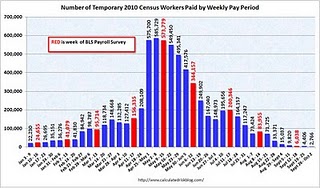
Calculated Risk created a nice graph (below) showing the trends in temporary census hiring over 2010.
The pattern unfortunately mirrors the national employment trends observed so far this year. The climb in temporary hiring earlier in the year contributed to job growth and helped bring down the unemployment rate. Recent reductions, however, have detracted from job growth and have done little to help bring down unemployment. As of the beginning of October, virtually all temporary positions with the Census Bureau had ended.
One Budget Graph To Rule Them All
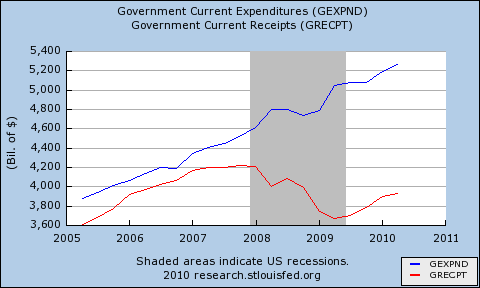
Courtesy of Paul Krugman, below is one graph that explains the recent rise in the federal deficit. The culprit: a severe drop in tax revenues caused by the recession.
 Email Sign-Up
 RSS Feed