Around The Dial – September 3
Economic policy reports, blog postings, and media stories of interest:
- Paul Krugman looks at what we’ve learned about economic policy.
- Economix considers some of the details of health insurance reform.
- The Washington Post reports on potential new economic policies.
- Robert Kuttner offers a case for more aggressive economic policies.
A Weak National Jobs Report for August
CHAPEL HILL (September 3, 2010) – The national employment report for August contained little good news. Last month, employers eliminated 54,000 more payroll positions than they added. An expected fall in temporary census employment drove that decline; after accounting for it, the economy netted 60,000 positions, a level insufficient to either keep pace with workforce growth or re-absorb jobless individuals.
“The basic employment picture was unchanged in August,” said John Quinterno, a principal with South by North Strategies, Ltd., a research firm specializing in economic and social policy. “Payroll employment fell due to the ending of temporary census positions. When those jobs are excluded, the nation netted just 60,000 payroll positions, virtually all of which were in the private sector.”
In August, the nation’s employers shed 54,000 more payroll positions than they added. Losses occurred primarily in the public sector due to the elimination of 114,000 temporary census jobs. When census reductions are excluded, the economy netted 60,000 positions. One positive development was that payroll employment numbers for July were revised upwards; with the revision, the economy lost 54,000 jobs in July rather than the 131,000 positions initially reported.
The largest private-sector gains in August occurred in education and health services (+45,000), professional and business services (+20,000, with most of the gains occurring in the temporary help services sub-industry), and construction (+19,000). Manufacturing payrolls fell by 27,000 positions. Additionally, the public sector slashed 7,000 positions in addition to temporary census jobs.
“The August employment report offers little evidence that a meaningful labor market recovery is underway,” noted Quinterno. “The private-sector simply is not generating jobs at a level needed to accommodate all those individuals who wish to work.”
Weak conditions were reflected in the August household survey. Last month, 14.9 million Americans (9.6 percent of the labor force) were jobless and actively seeking work. Proportionally more adult male workers were unemployed than female ones (9.8 percent vs. 8 percent). Similarly, unemployment rates were higher among Black (16.3 percent) and Hispanic workers (12 percent) than among White ones (8.7 percent). The unemployment rate among teenagers was 26.3 percent.
Furthermore, newly available data show that 8.7 percent of all veterans were unemployed in August; the rate among veterans who had served since September 2001 was 9.4 percent.
“There currently is a great deal of unused labor in the American economy,” added Quinterno. “Compared to a year ago, the labor force is smaller, fewer people are employed, and the unemployment rate essentially is unchanged. Employers also have many options that they can use before hiring additional help, such as by giving hours to current employees on shortened schedules.”
Jobs remained hard to find in August. Last month, 42 percent of unemployed workers had been jobless for at least six months with the average spell of unemployment lasting for 33.6 weeks. Many other individuals stopped looking, and counting those individuals and those working part-time on an involuntary basis brings the underemployment rate to 16.7 percent.
“The reduction in temporary census hiring over the summer exposed just how weak the labor market really is,” observed Quinterno. “While private employers are not slashing jobs at the ruthless pace of late 2008 and early 2009, they are not adding positions in any meaningful way. Many Americans who are ready, willing, and able to work are finding themselves boxed out of the job market.”
A Farewell Economic Address
From Christina Romer’s final speech as the chair of the Council of Economic Advisers …
The current recession has been fundamentally different from other postwar recessions. This is not my father’s recession. Rather than being caused by deliberate monetary policy actions, it began with interest rates at low levels. It is a recession born of regulatory failures and unsound practices that contributed to a housing bubble and eventually a full-fledged financial crisis. Precisely what has made it so terrifying and so difficult to cure is that we have been in largely uncharted territory. An all-out financial meltdown in the world’s largest economy and the center of the world’s financial system is something the world has experienced only once in the past century — in the 1930s. Thus, the President took office in the midst of a recession of historic proportions, but for which history provided little guidance.
Yet a great deal of work still needs to be done …
That the economy remains as troubled as it is despite aggressive action reflects the fact that this has not been a normal recession. Just as the downturn was uncharted territory, so is its recovery. Because the recession began with interest rates at low levels, we can’t just have interest rates fall and housing, investment, and other interest-sensitive sectors come roaring back as they typically do in recoveries. Rather, because of overbuilding in housing and commercial real estate during the bubble, construction is likely to remain subdued for some time.
…
Indeed, the economy faces numerous headwinds not normally present in recoveries. In addition to the oversupply of housing, households have been through a searing crisis that is likely to make them more prudent for years to come — in much the same way that the Great Depression gave rise to a generation of high savers and cautious investors. Likewise, the decline in wealth is likely to lead to increased saving to replenish retirement accounts and pay off debt. Such saving and prudence are healthy for the economy in the long run, but in the near term they mean that consumer spending will likely be less robust than before the crisis.
Around The Dial – September 2
Economic policy reports, blog postings, and media stories of interest:
- Mark Thoma asks how to insulate fiscal policy from congressional gridlock.
- Robert Reich reports on world economic fundamentals.
- Economix checks in on Ireland’s austerity experiment.
- Karl Case looks at the state of the housing market.
NC Unemployment Claims: Week of 8/14
For the benefit week ending on August 14th, 12,352 North Carolinians filed initial claims for state unemployment insurance benefits, and 129,185 individuals applied for state-funded continuing benefits. Compared to the prior week, there were fewer initial and continuing claims. These figures come from new data released by the U.S. Department of Labor.
Averaging new and continuing claims over a four-week period — a process that helps adjust for seasonal fluctuations and better illustrates trends — shows that an average of 12,699 initial claims were filed over the previous four weeks, along with an average of 133,208 continuing claims. Compared to the previous four-week period, there were more initial and fewer continuing claims.
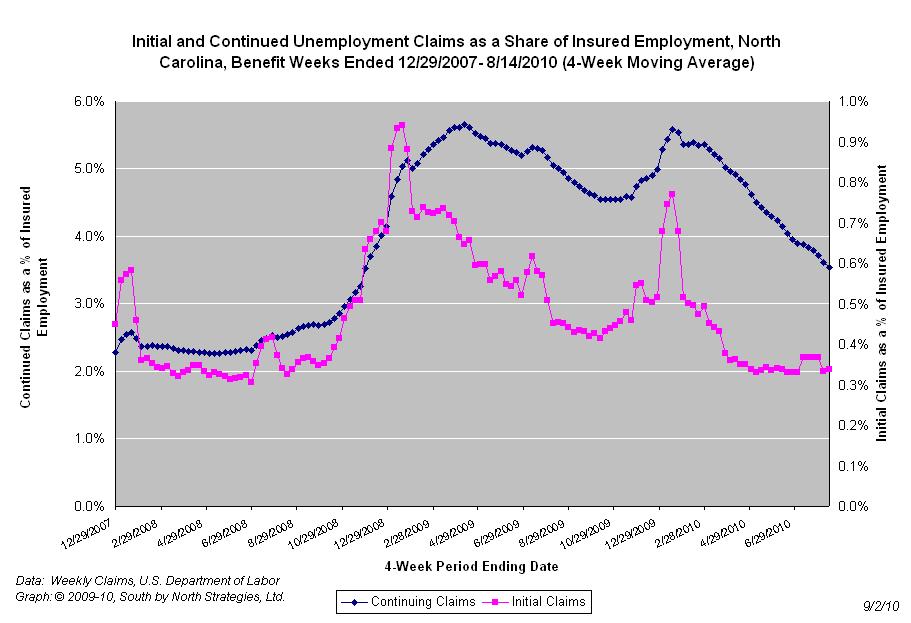 One year ago, the four-week average for initial claims stood at 18,150 and the four-week average of continuing claims equaled 200,226.
While the number of claims has dropped over the past year, so has covered employment. Last week, covered employment totaled 3.8 million, down from 4 million a year ago.
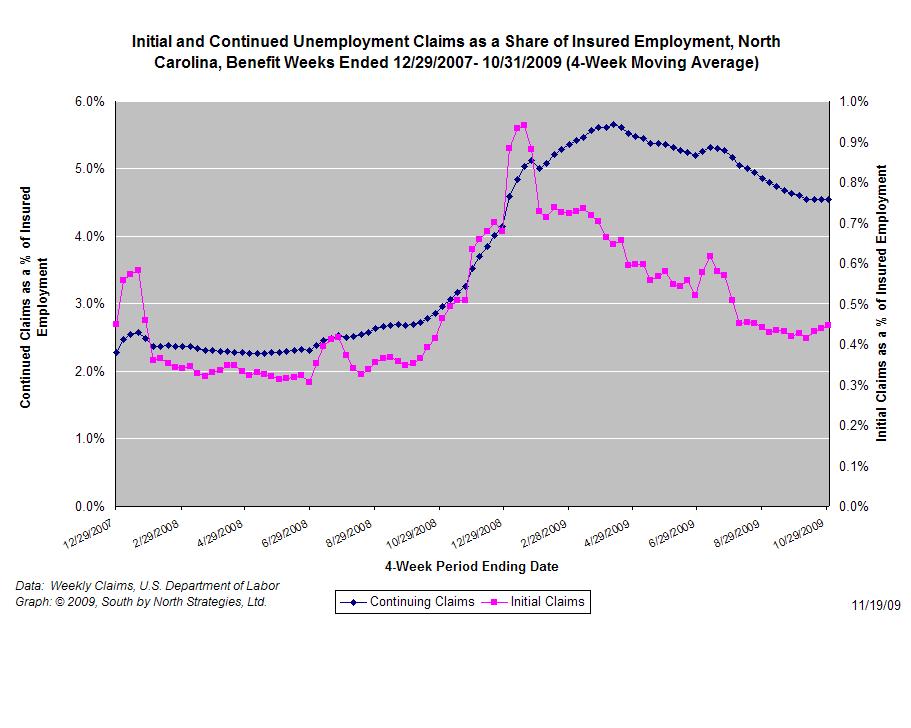
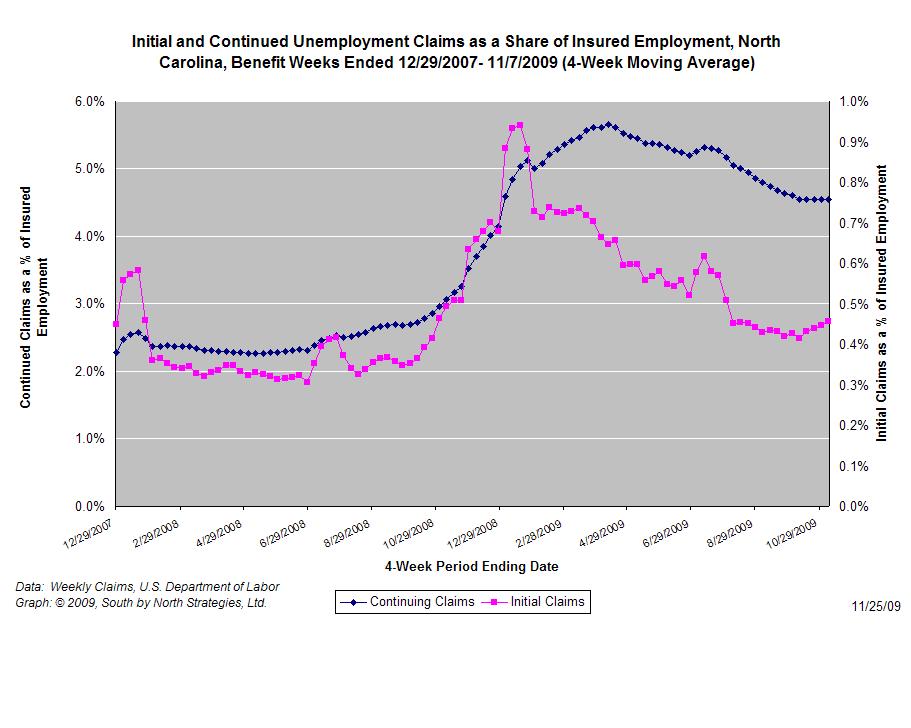
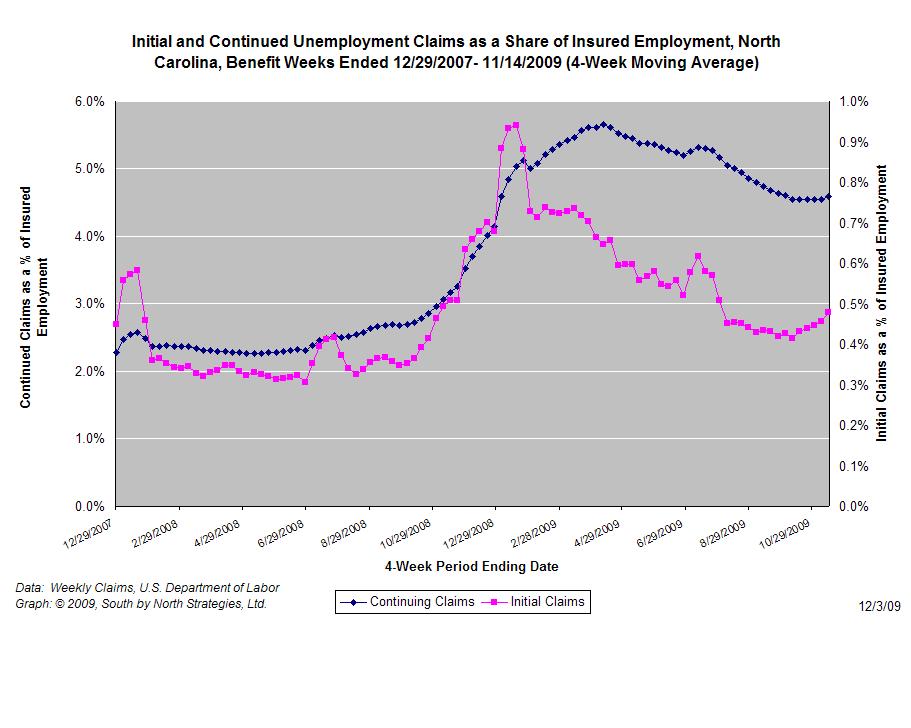
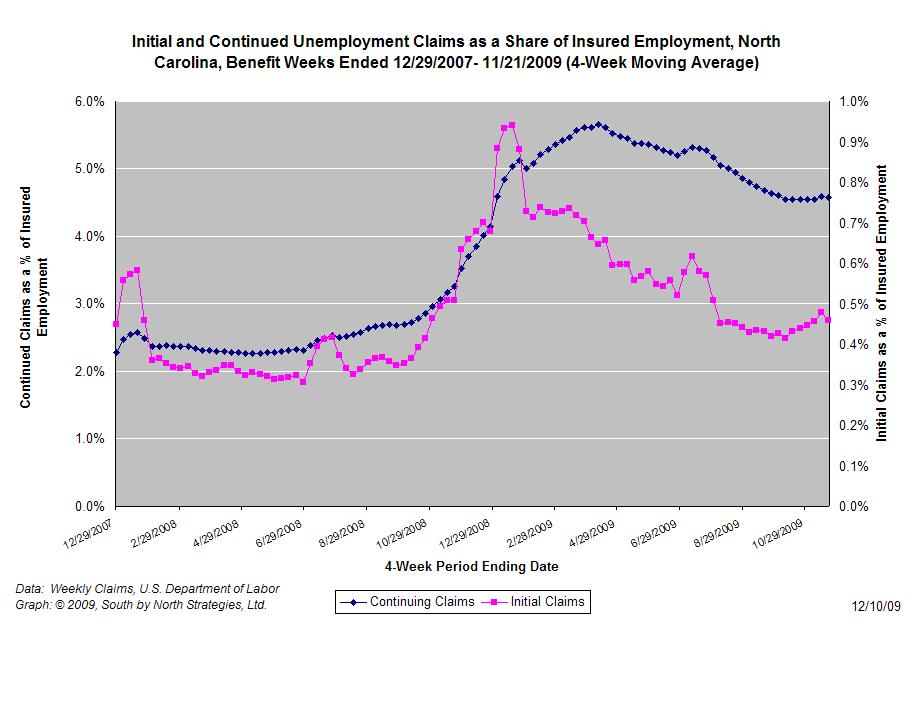
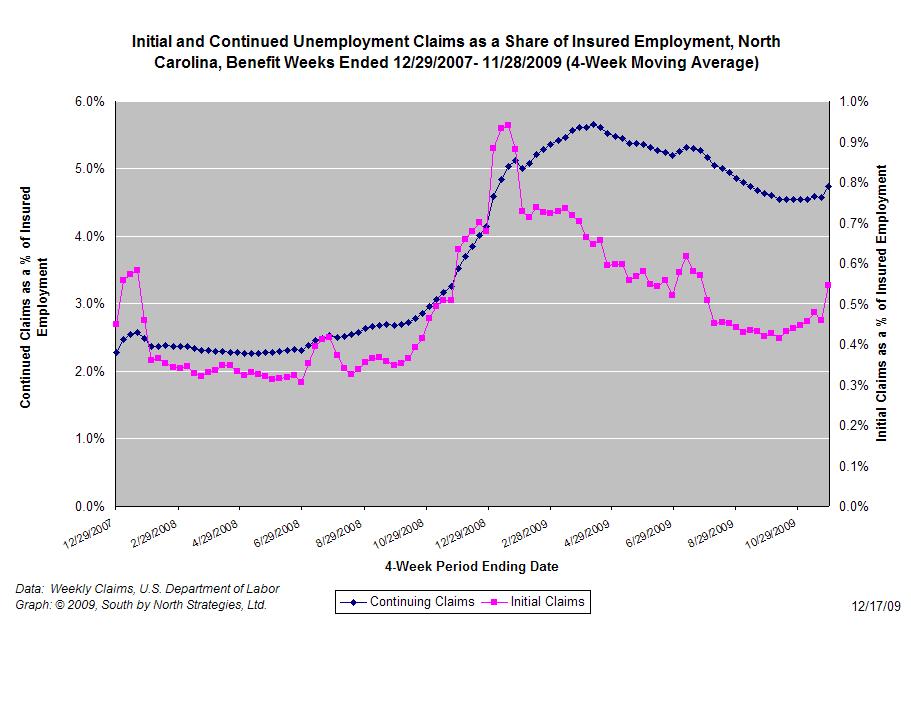
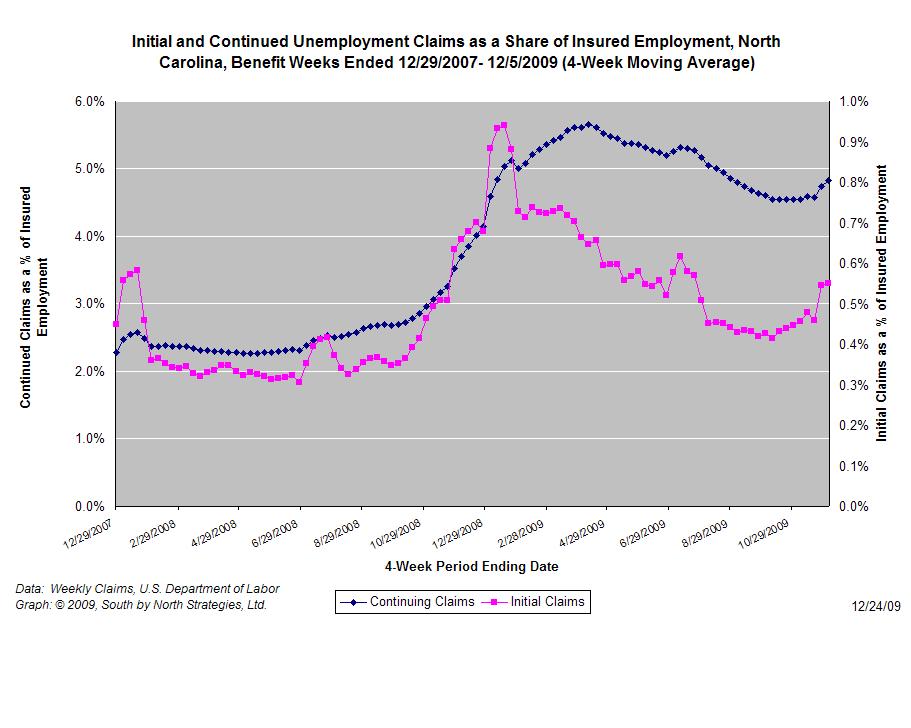
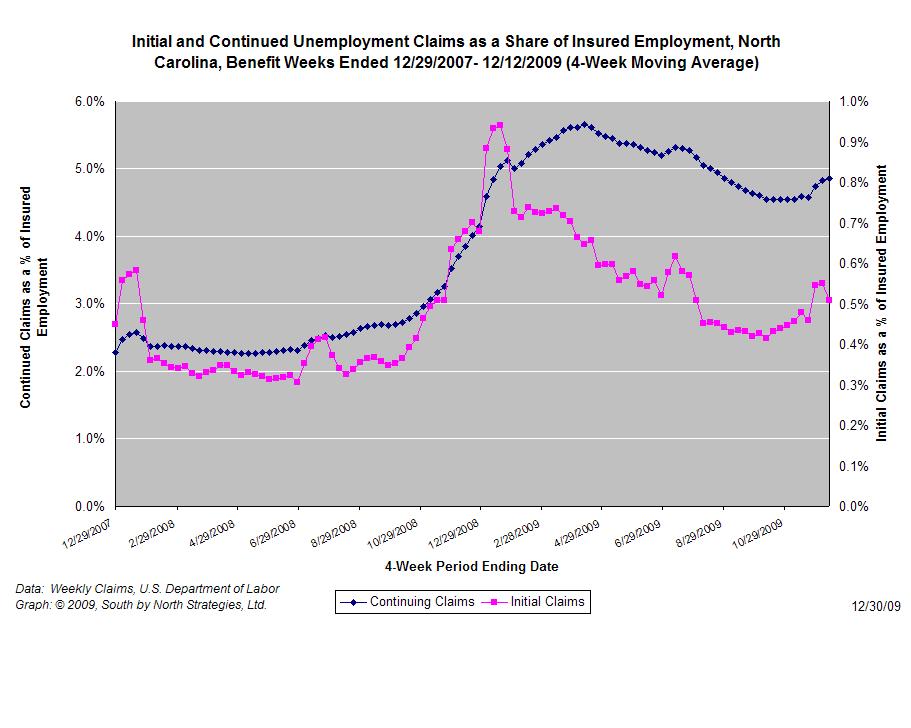
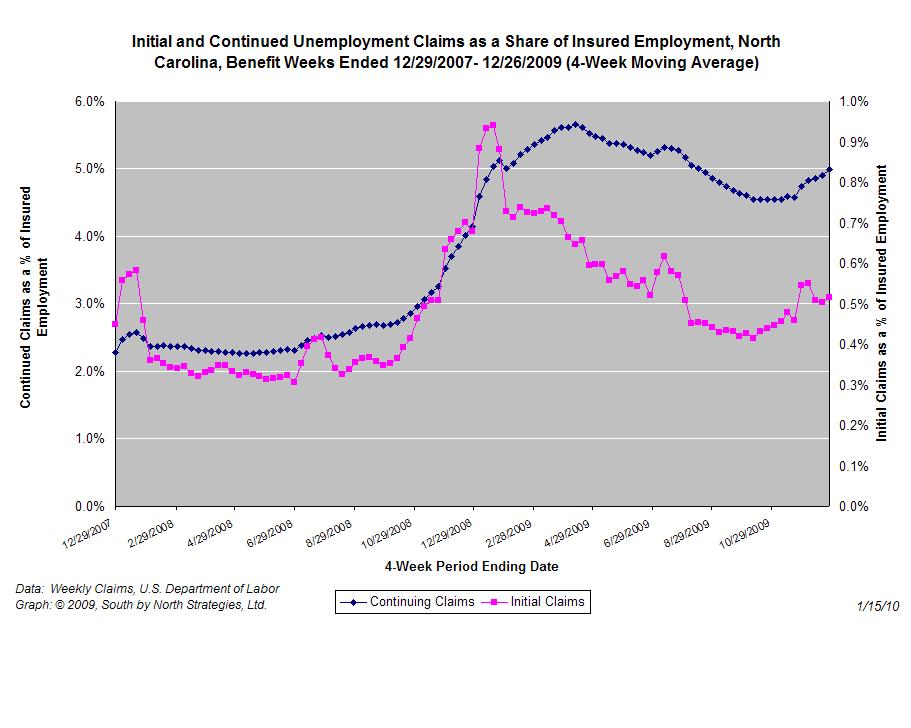
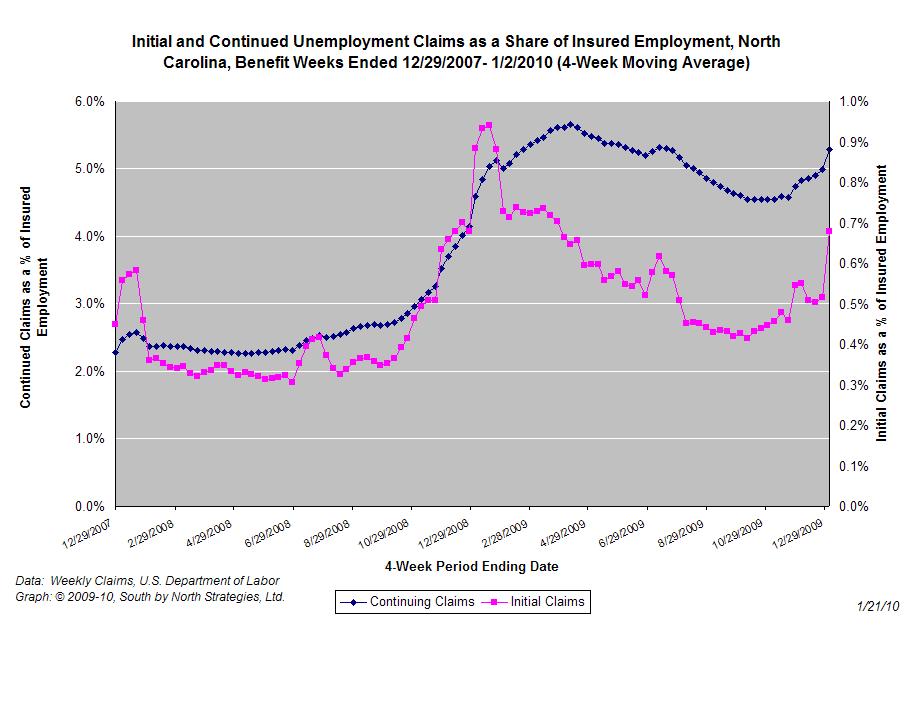
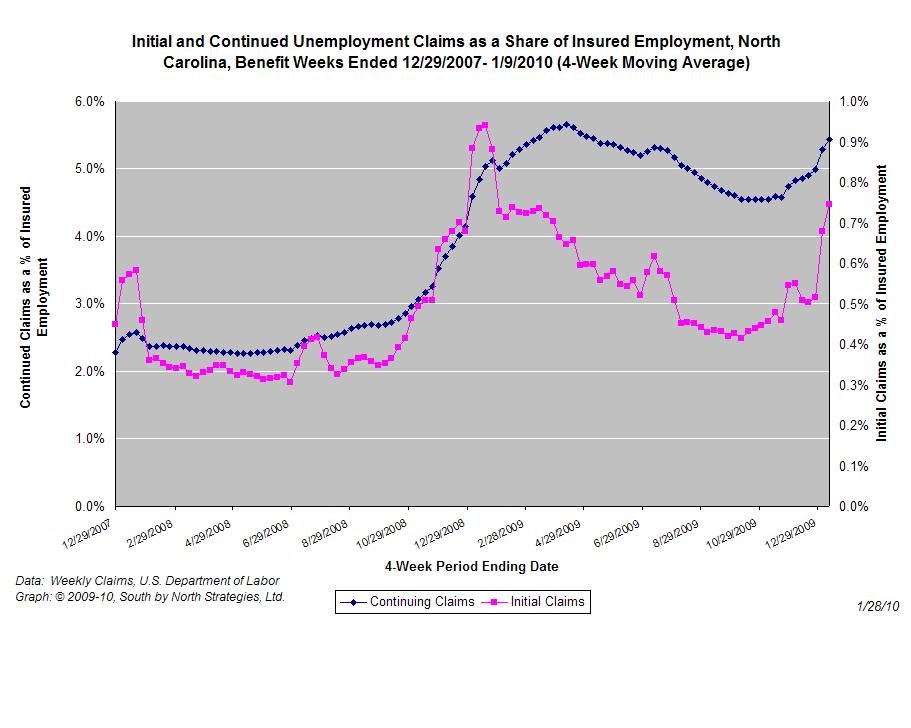
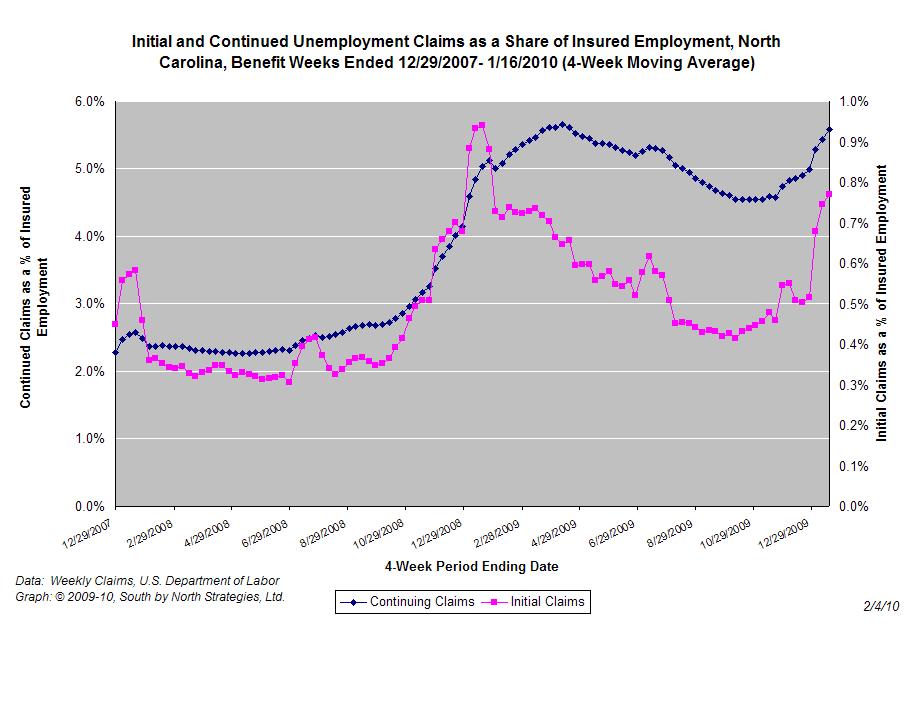
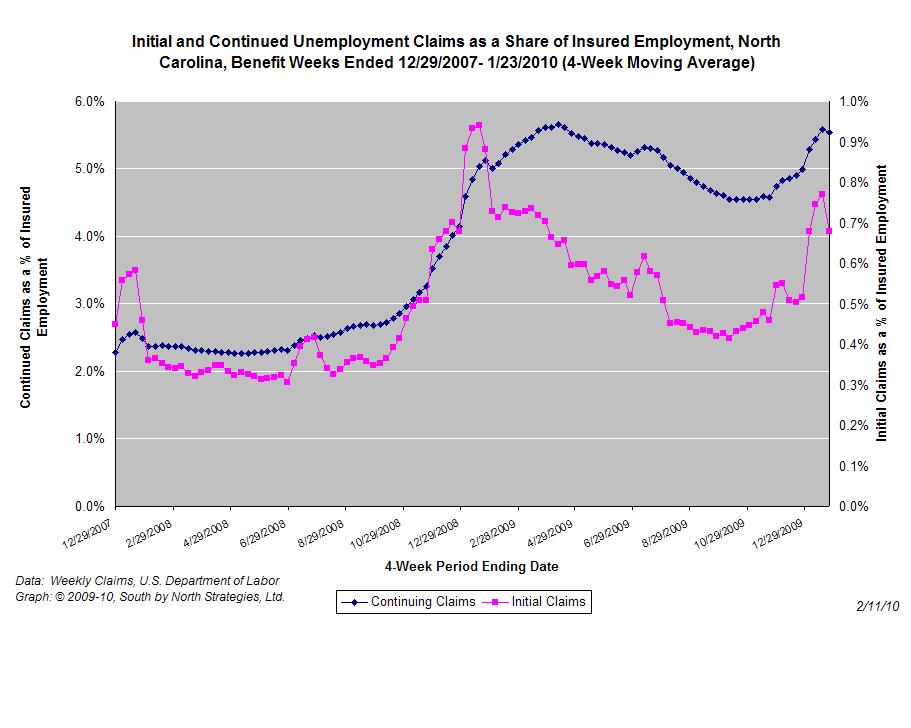
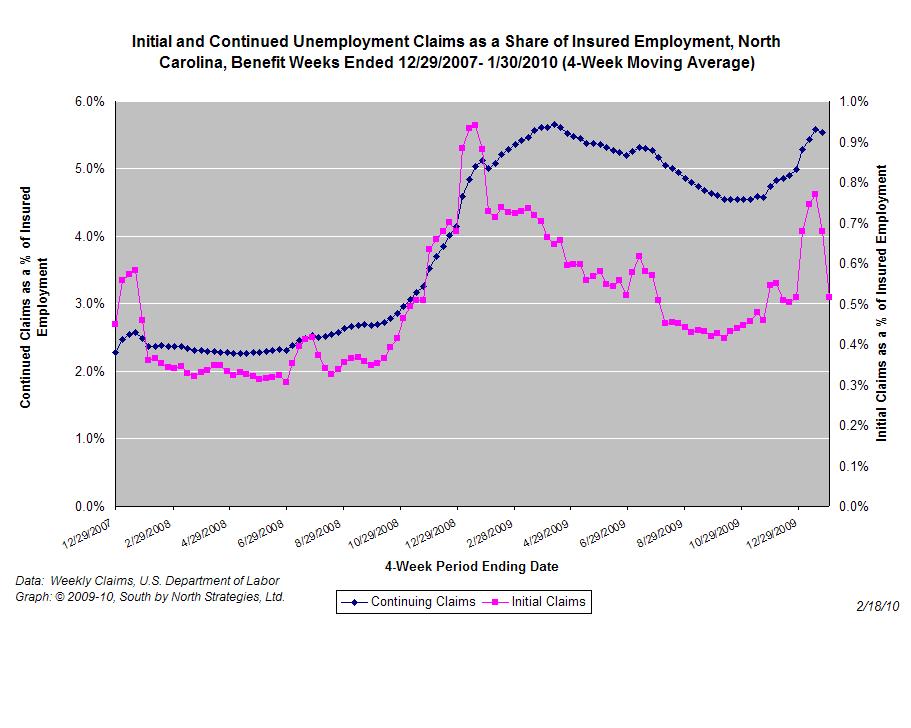
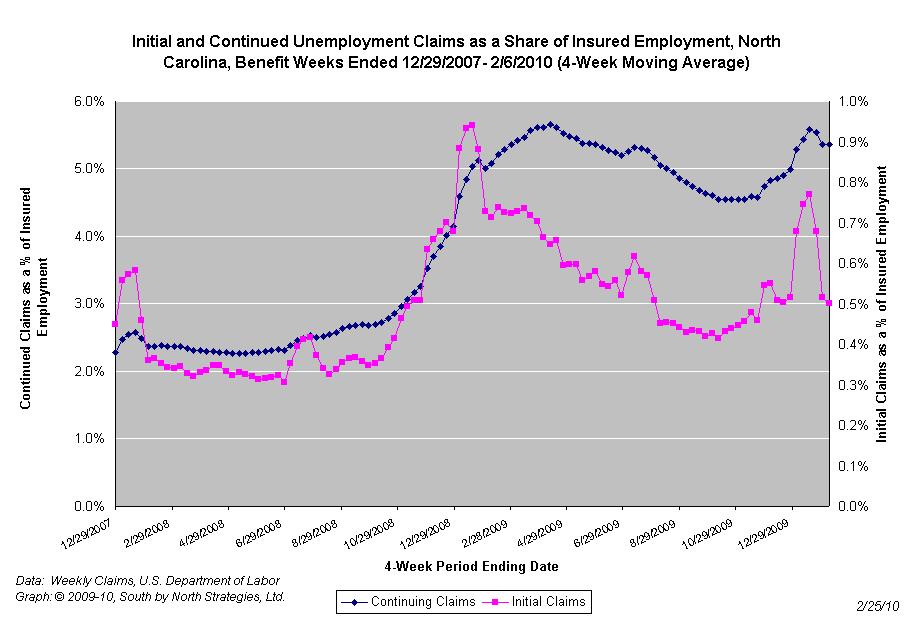
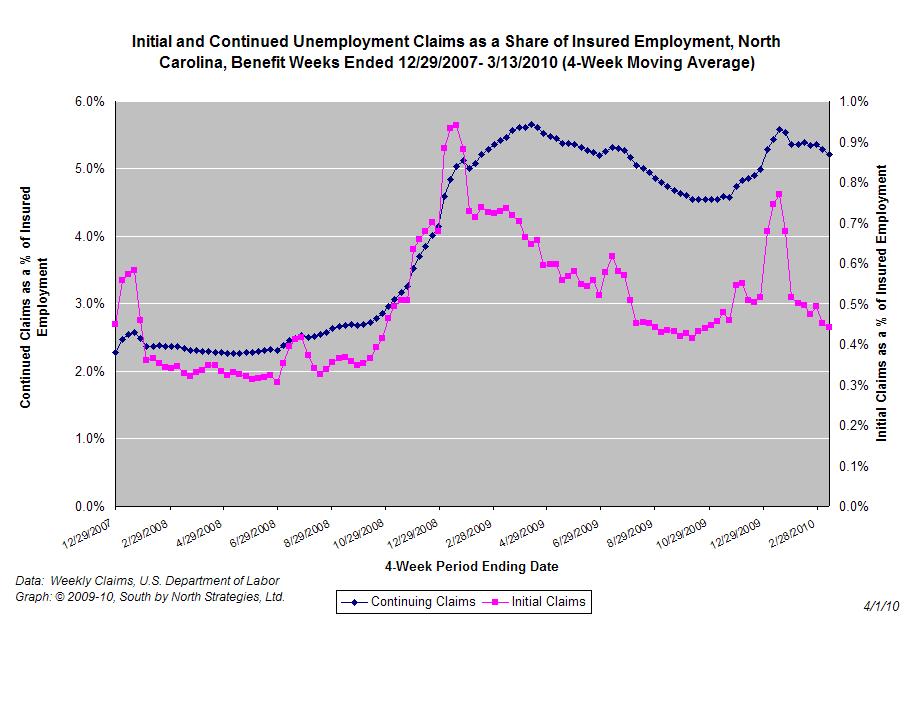
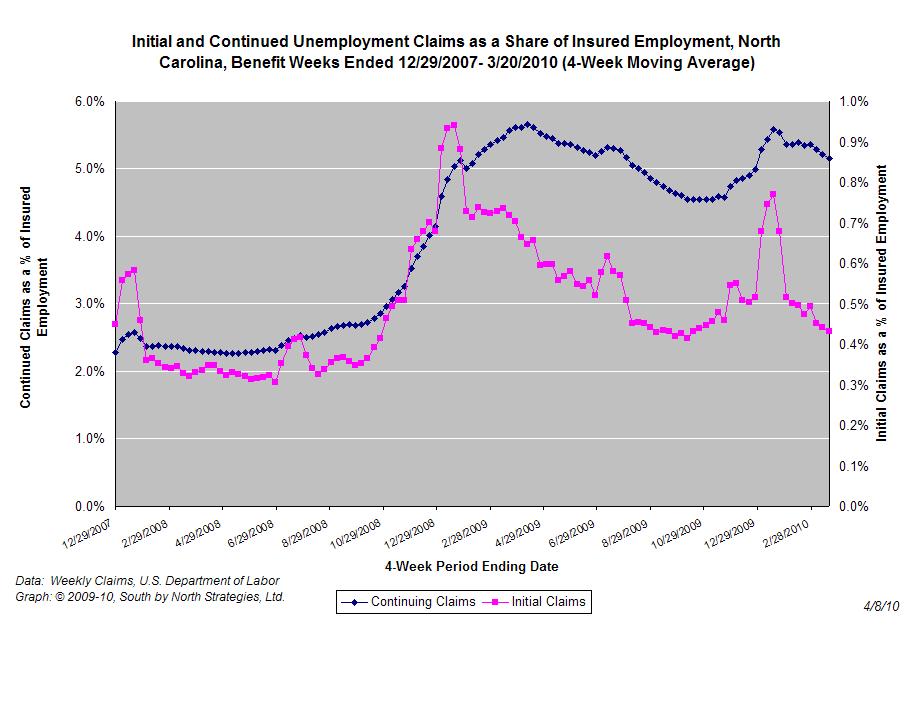
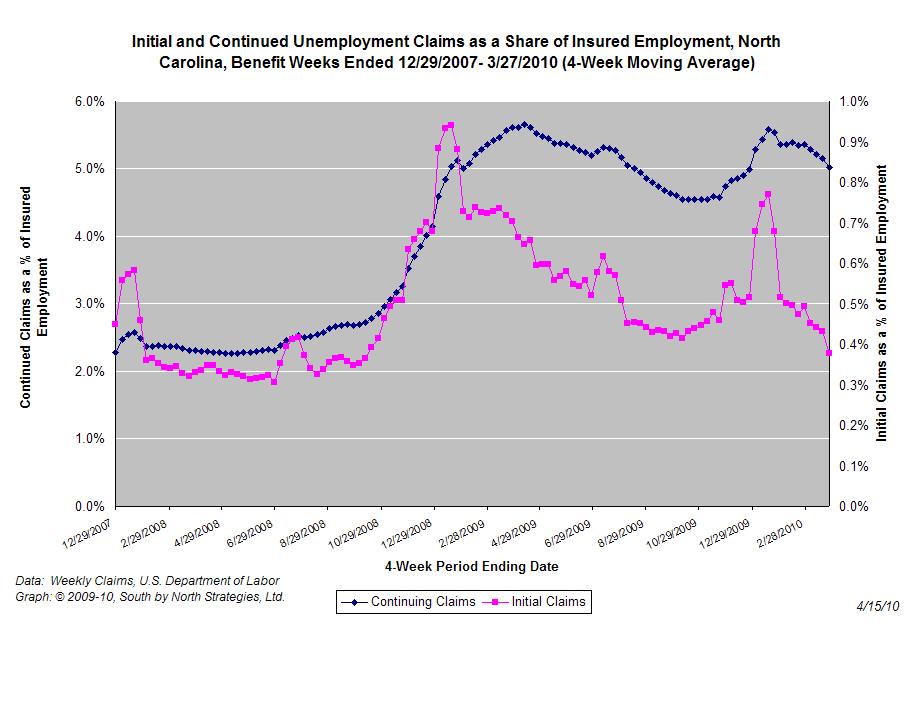
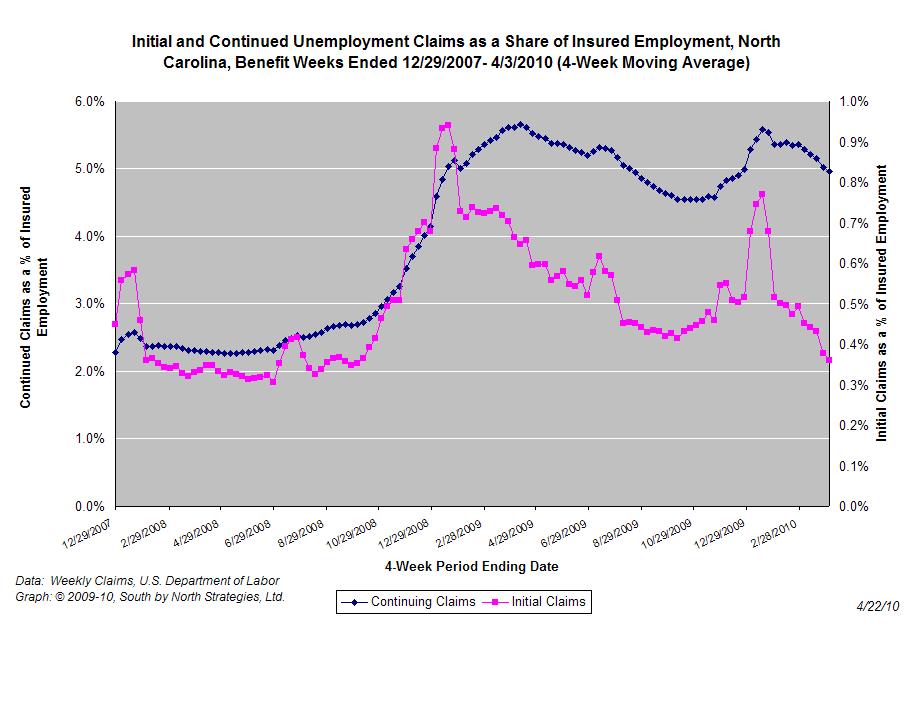
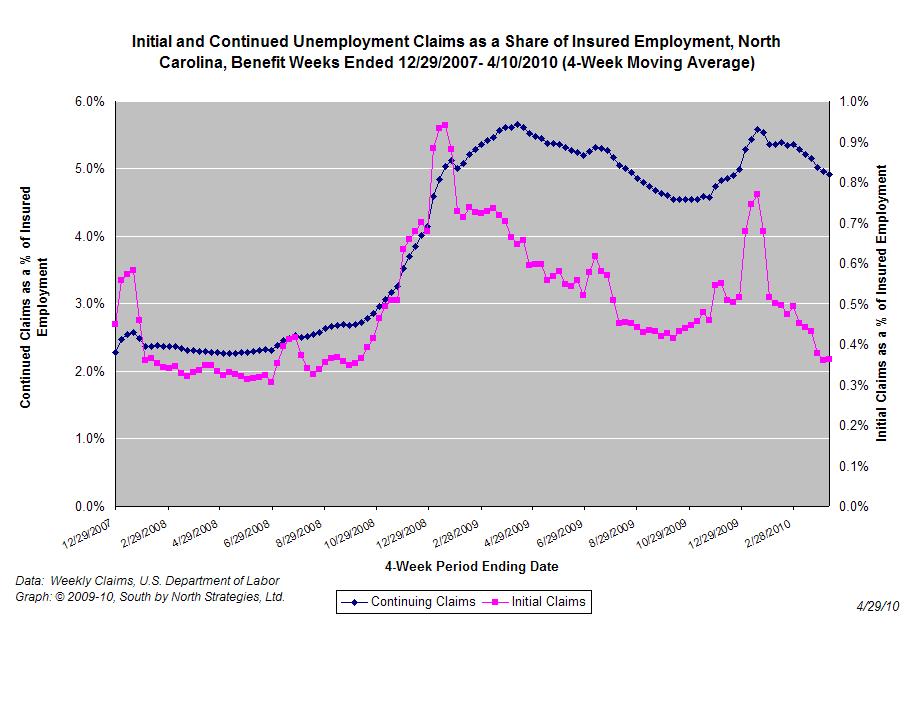
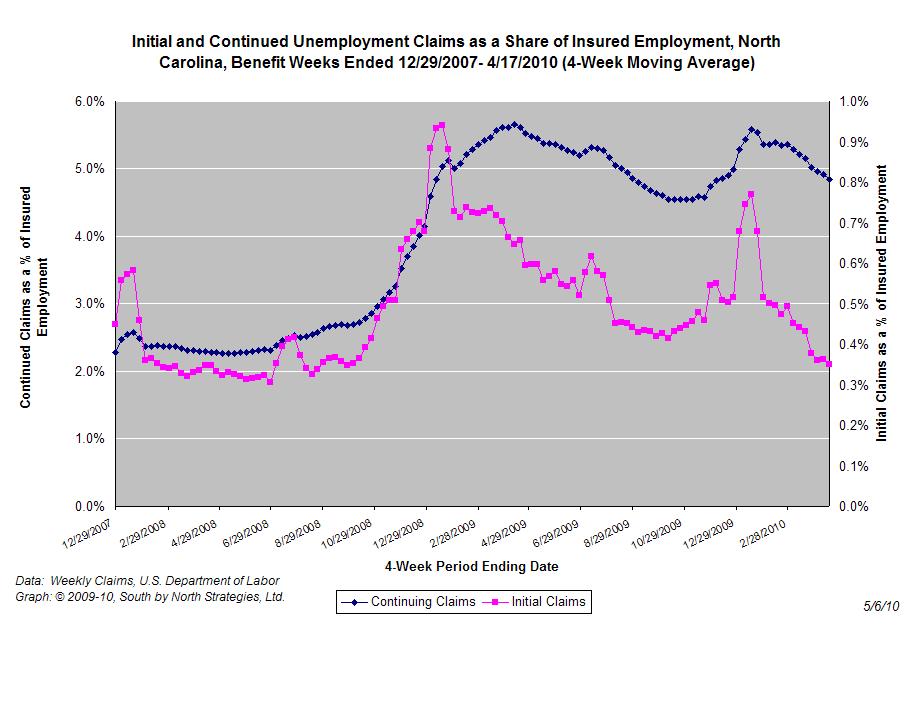
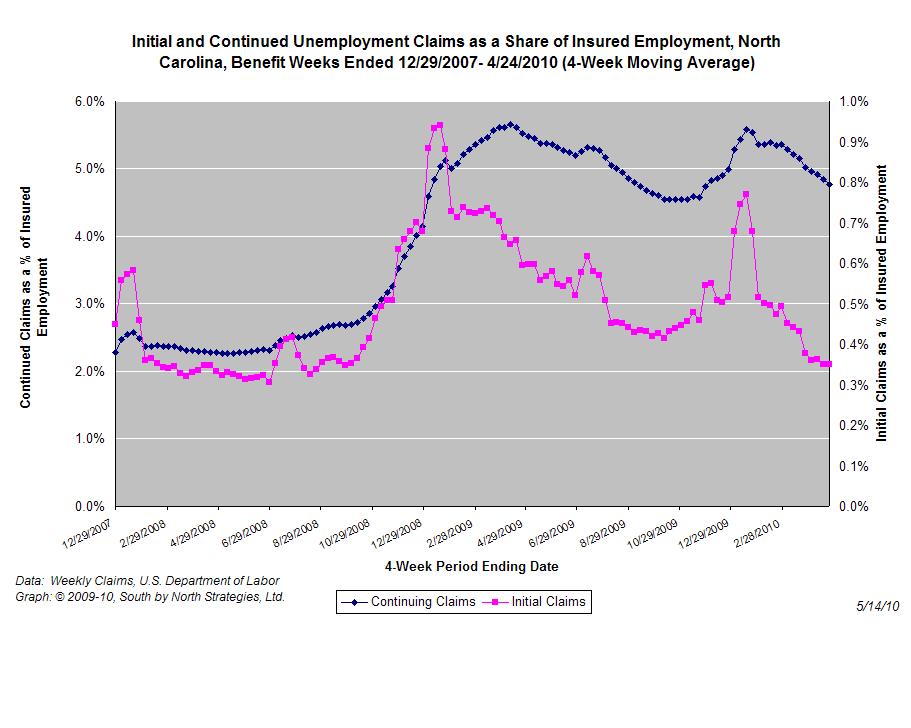
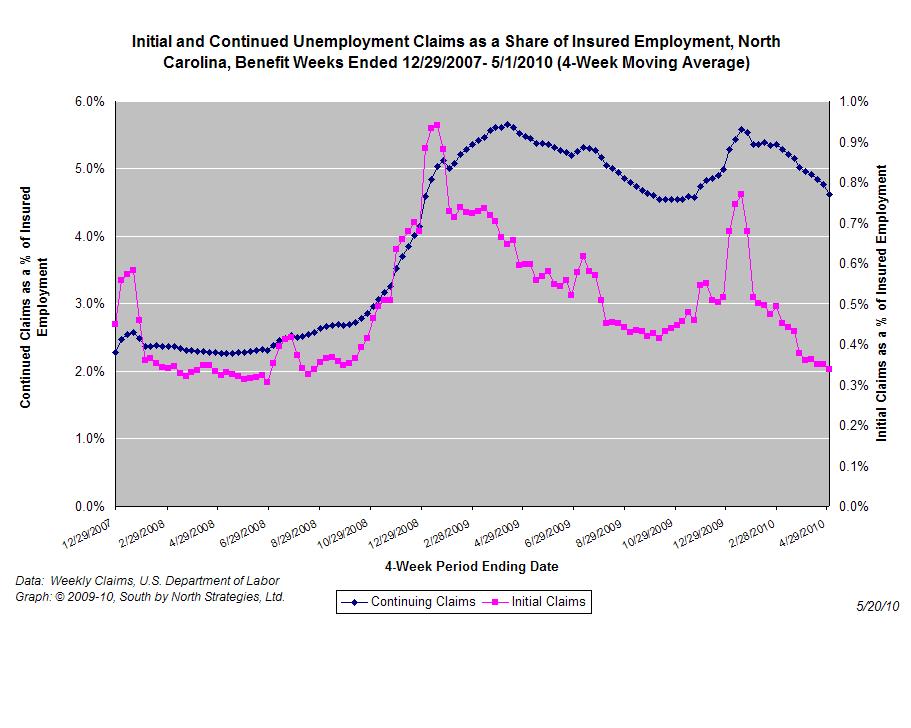
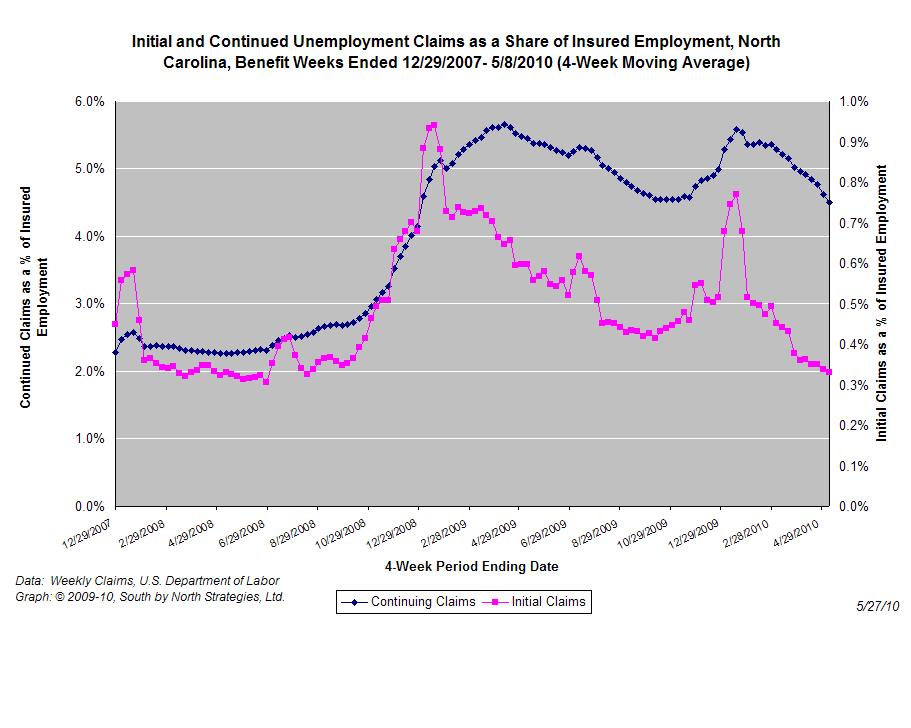
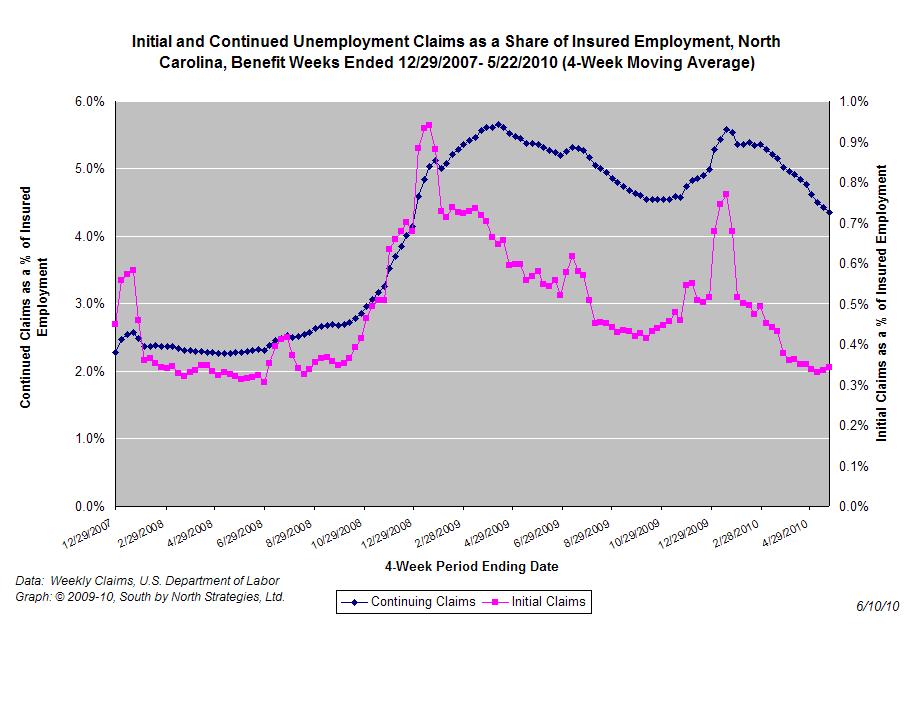
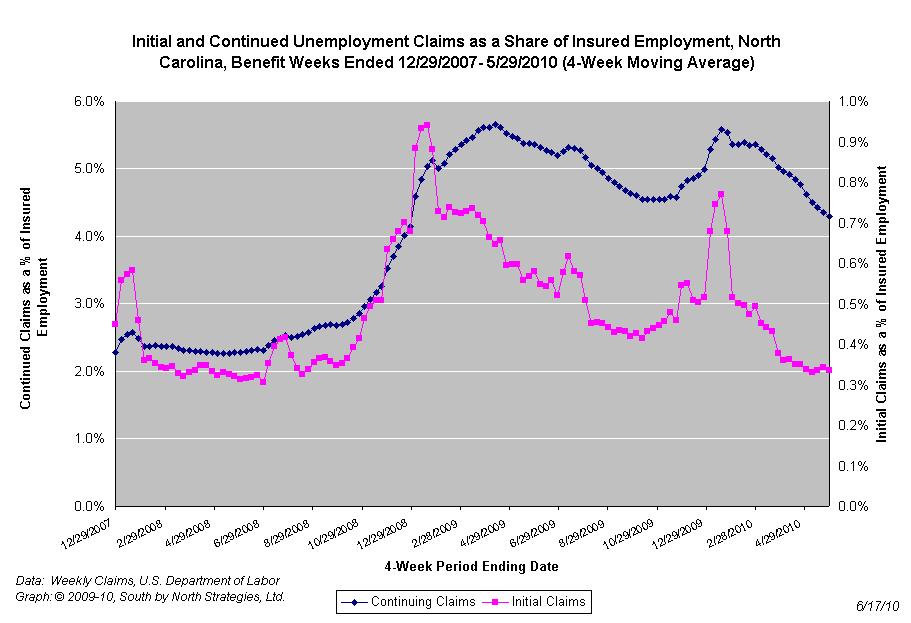
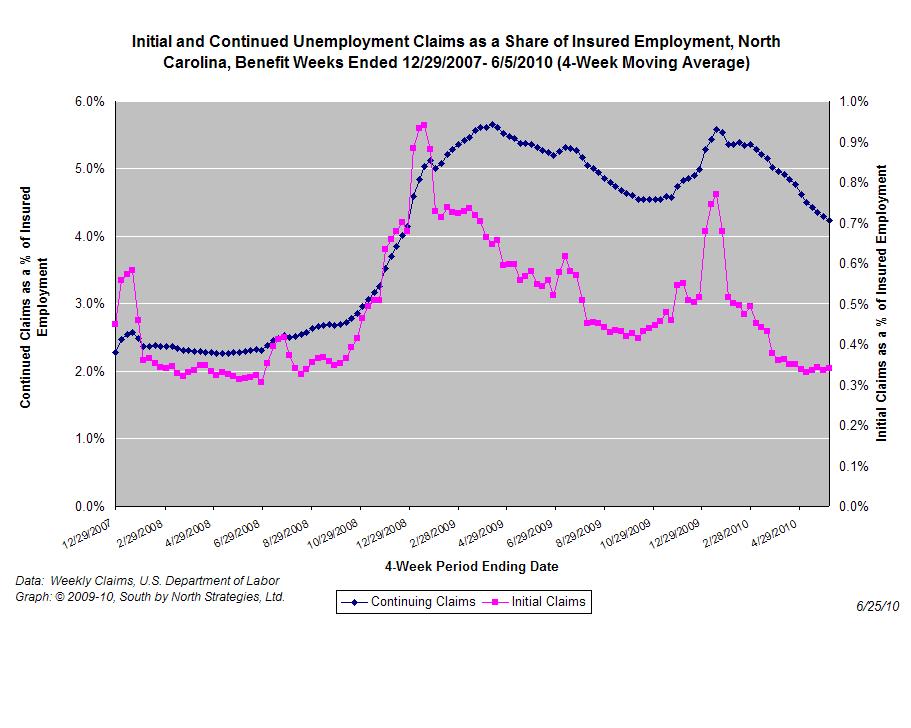
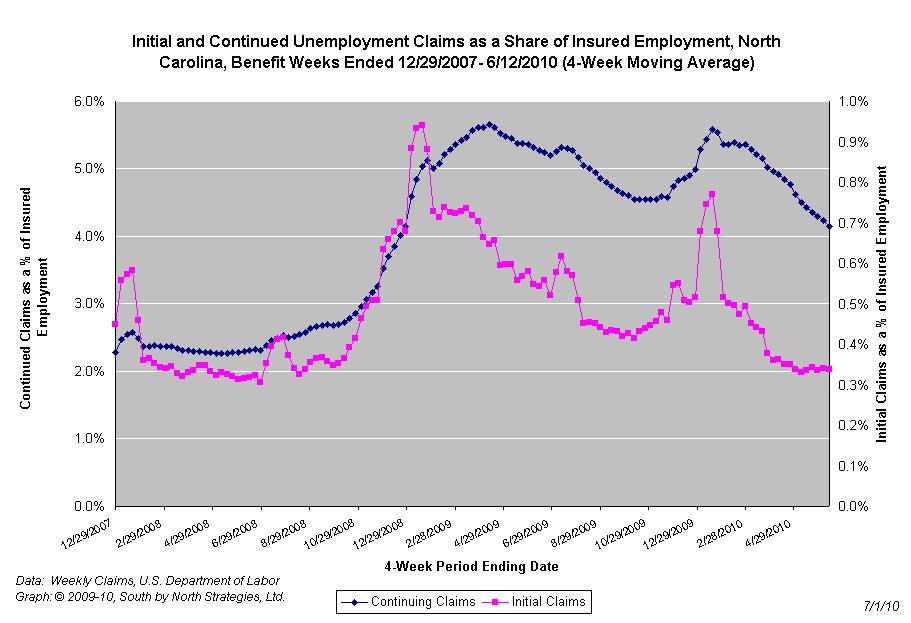
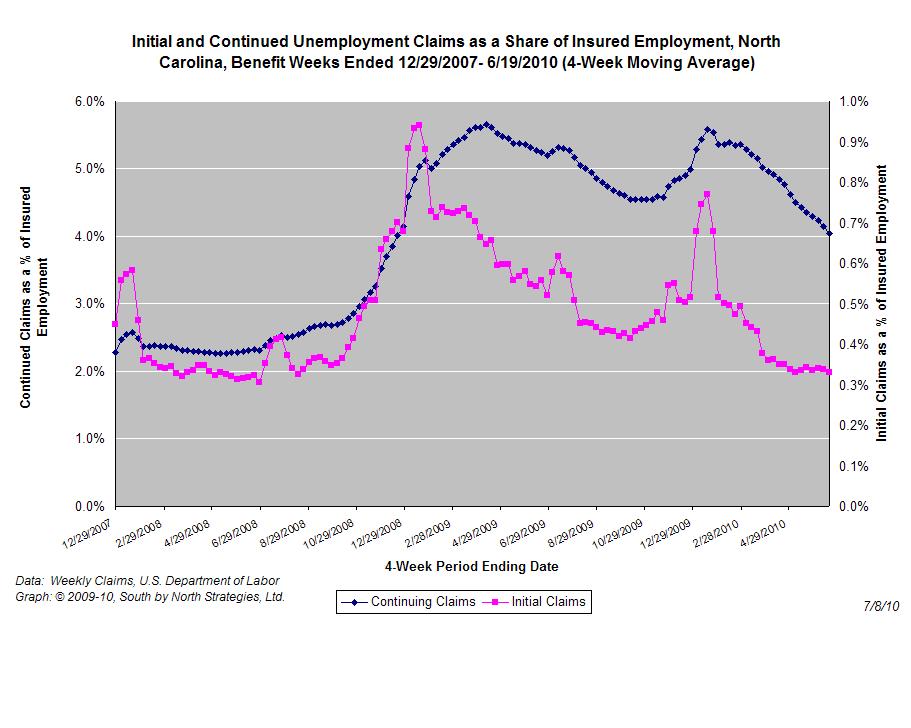
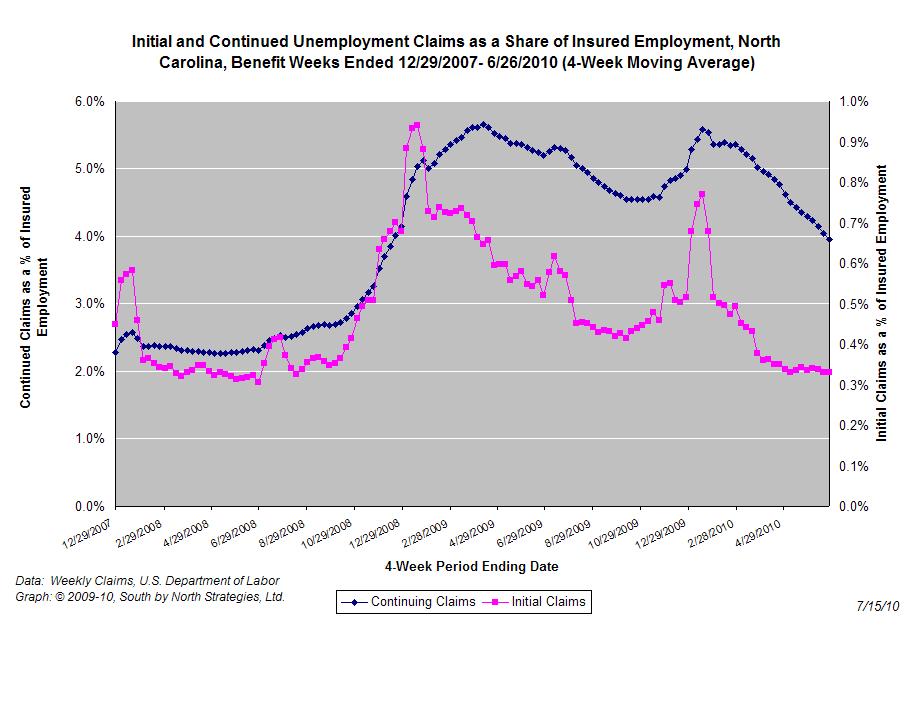
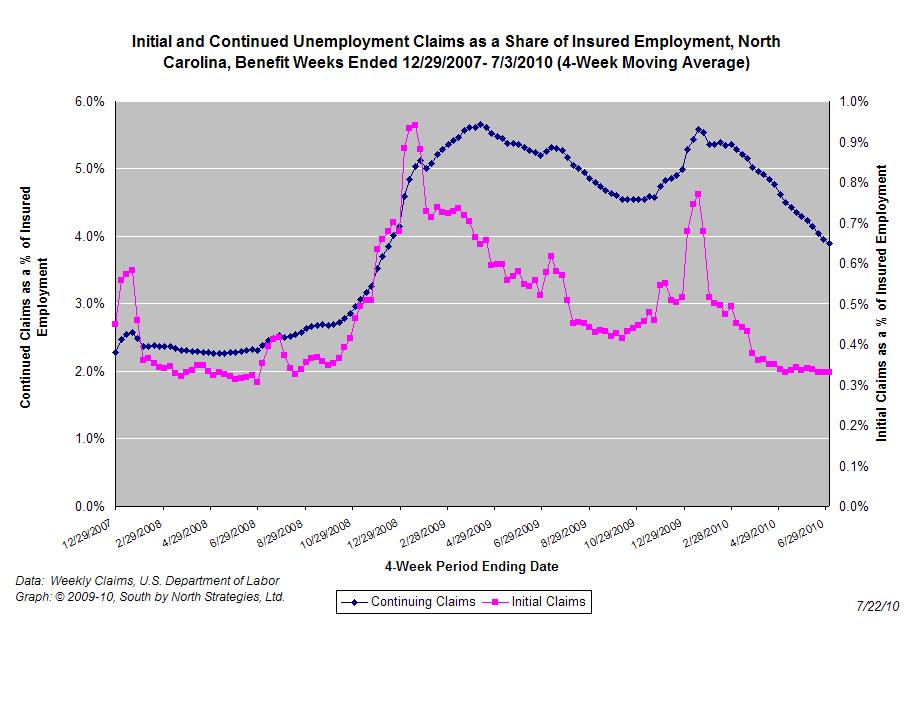
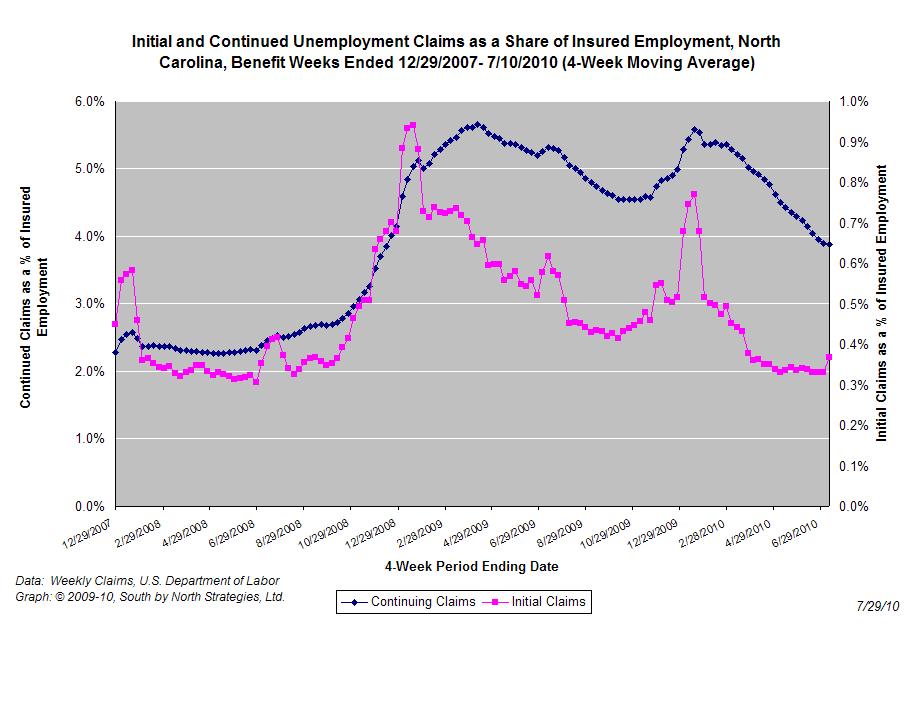
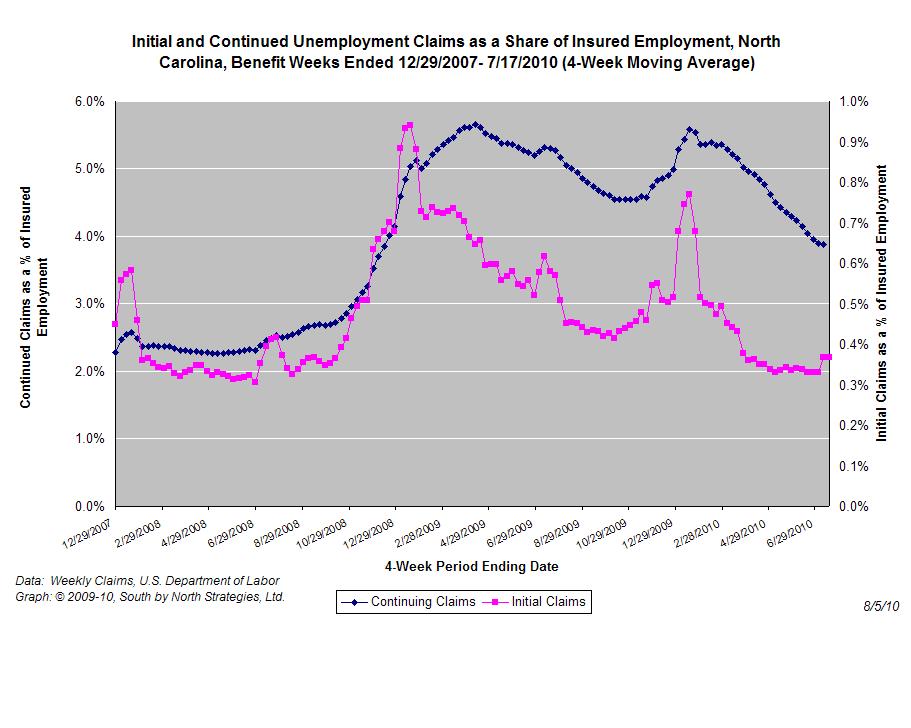
The graph (right) shows the changes in unemployment insurance claims (as a share of covered employment) in North Carolina since the recession’s start in December 2007.
Both new and continuing claims appear to have peaked for this business cycle, and the four-week averages of new and continuing claims have fallen considerably. Yet continuing claims remain at an elevated level, which suggests that unemployed individuals are finding it difficult to find new positions.
Also, little change has occurred within recent months. Since April 2010, the four-week average of initial claims consistently has ranged between 13,987 and 12,541.
 Email Sign-Up
 RSS Feed