NC Unemployment Claims: Week of 7/3
For the benefit week ending on July 3rd, 13,608 North Carolinians filed initial claims for state unemployment insurance benefits, and 144,999 individuals applied for state-funded continuing benefits. Compared to the prior week, there were more initial and fewer continuing claims. (Note the filing week had one fewer day due to the July 4th holiday.) These figures come from data released today by the U.S. Department of Labor.
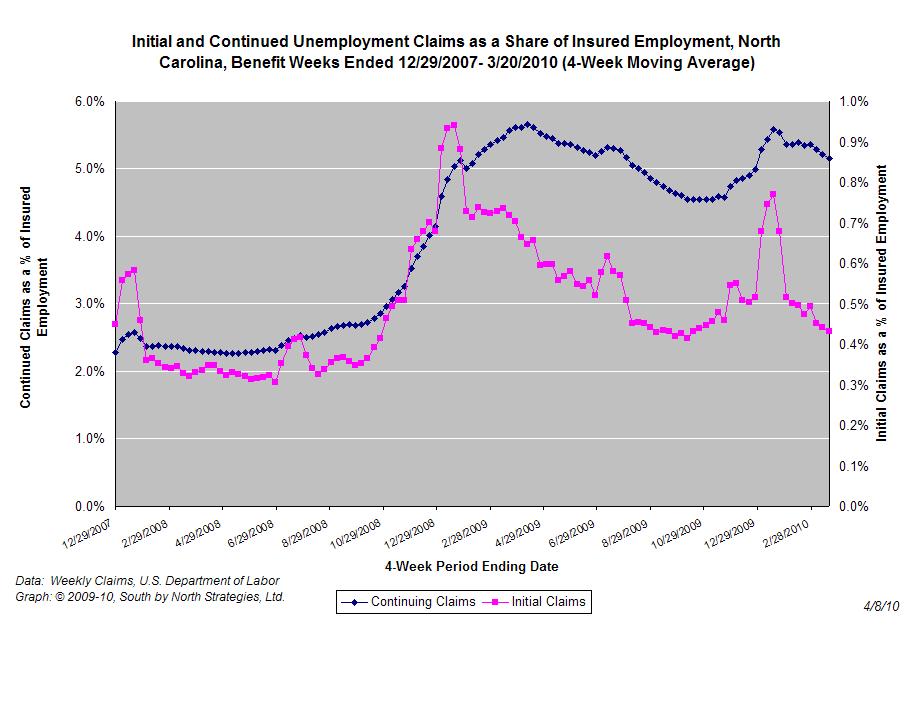
Averaging new and continuing claims over a four-week period — a process that helps adjust for seasonal fluctuations and better illustrates trends — shows that an average of 12,586 initial claims were filed over the previous four weeks, along with an average of 148,031 continuing claims. Compared to the previous four-week period, there were fewer initial and continuing claims.
 One year ago, the four-week average for initial claims stood at 23,219 and the four-week average of continuing claims equaled 211,613.
While the number of claims has dropped over the past year, so has covered employment. Last week, covered employment totaled 3.8 million, down from 4 million a year ago.
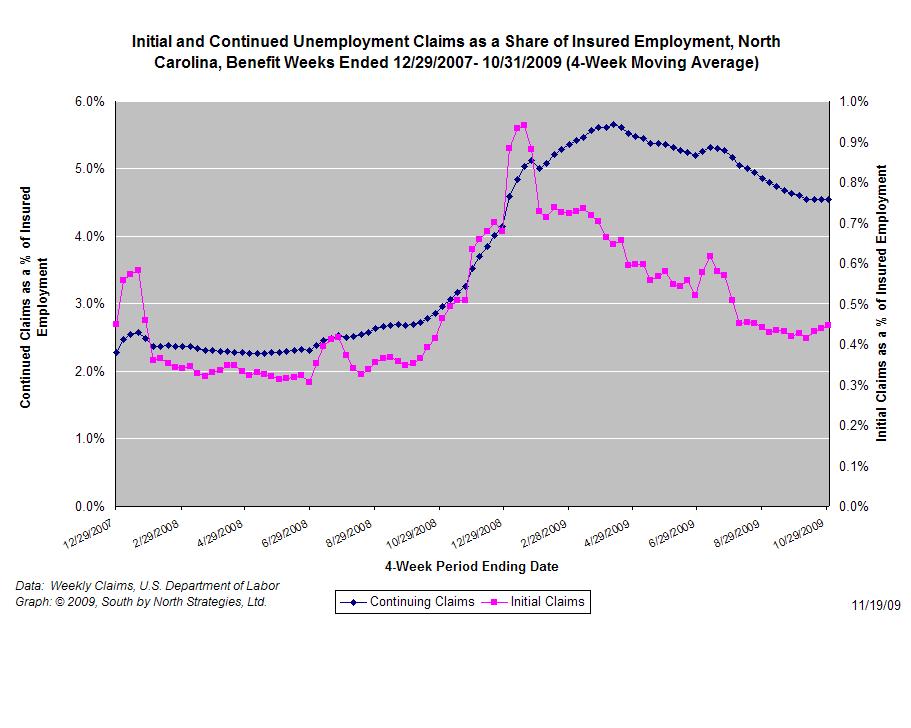
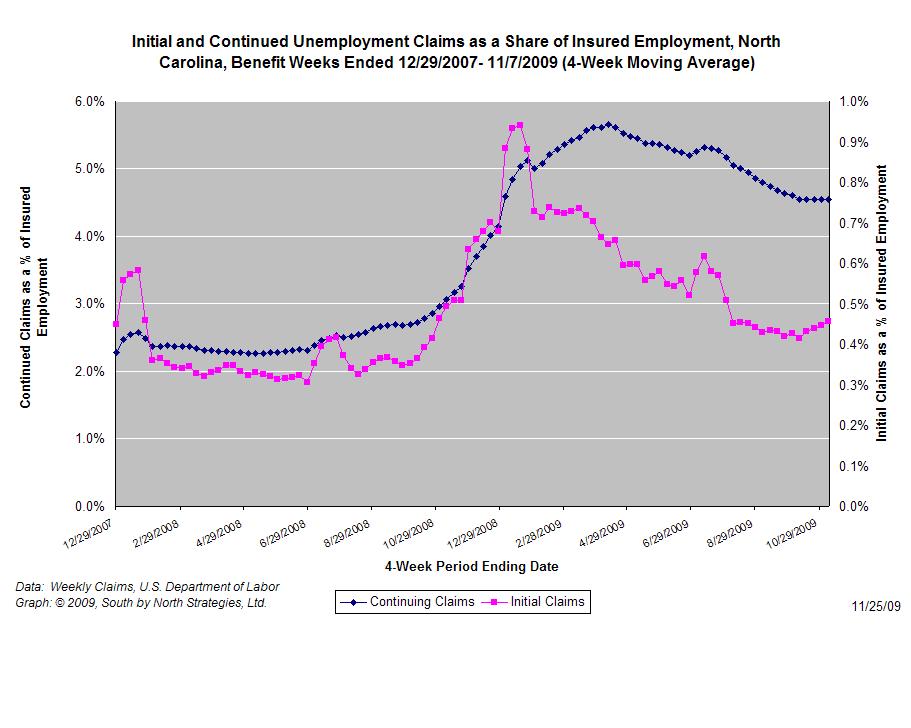
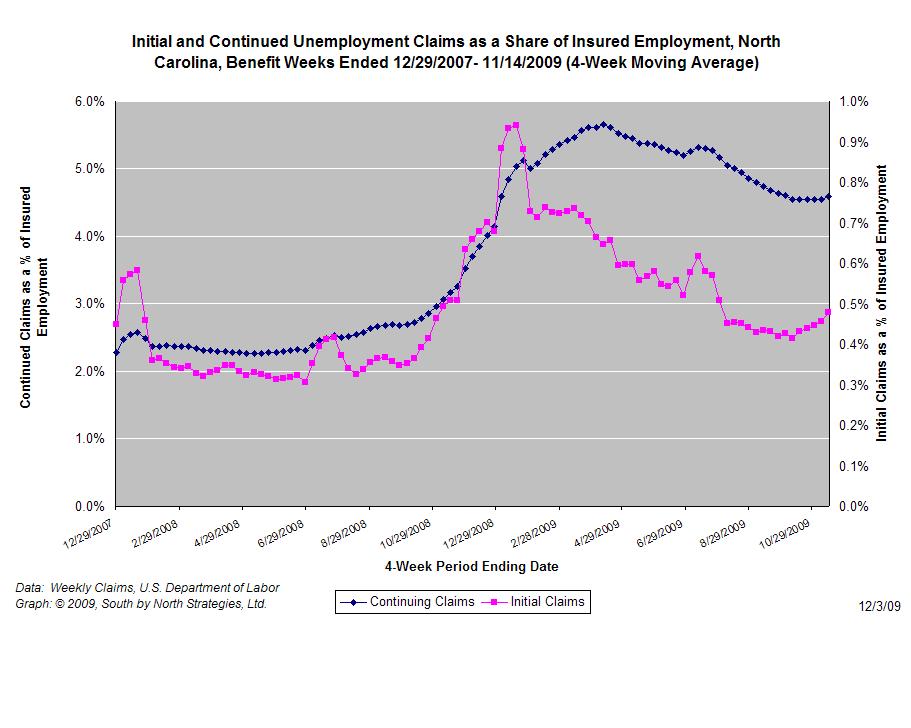
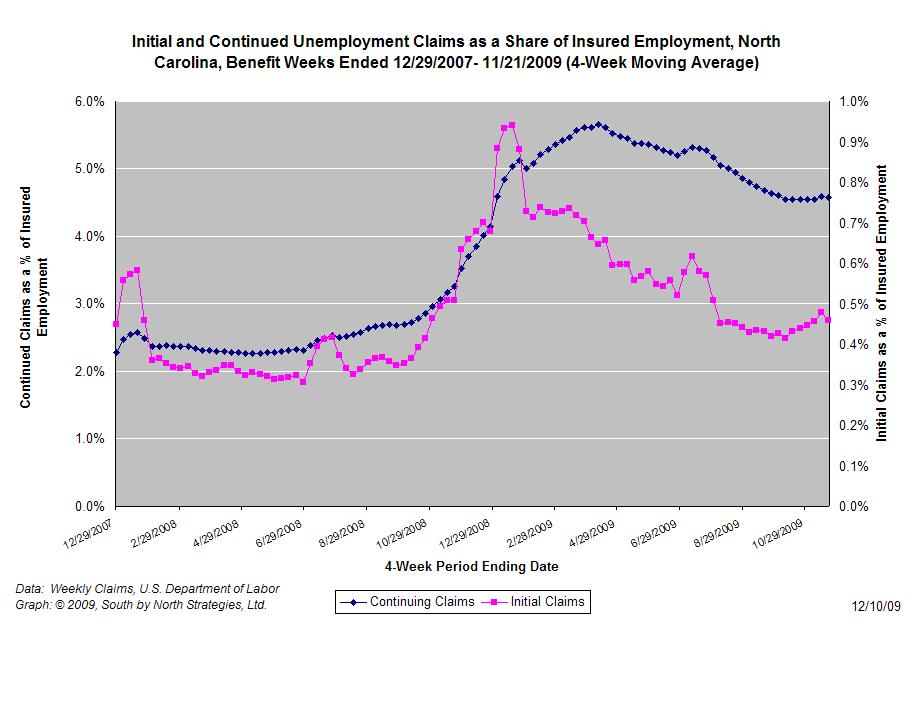
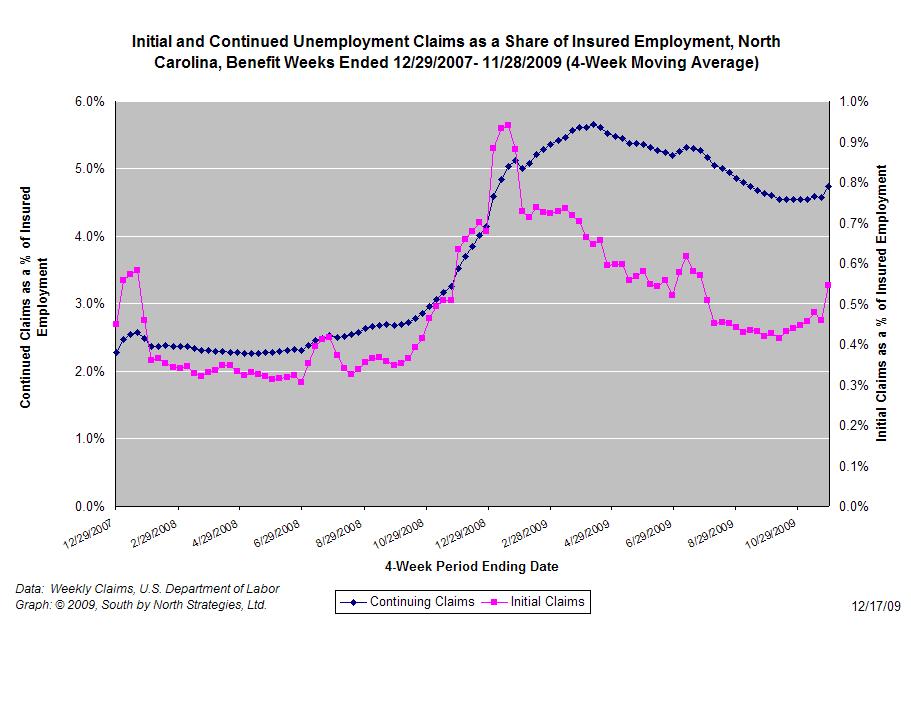
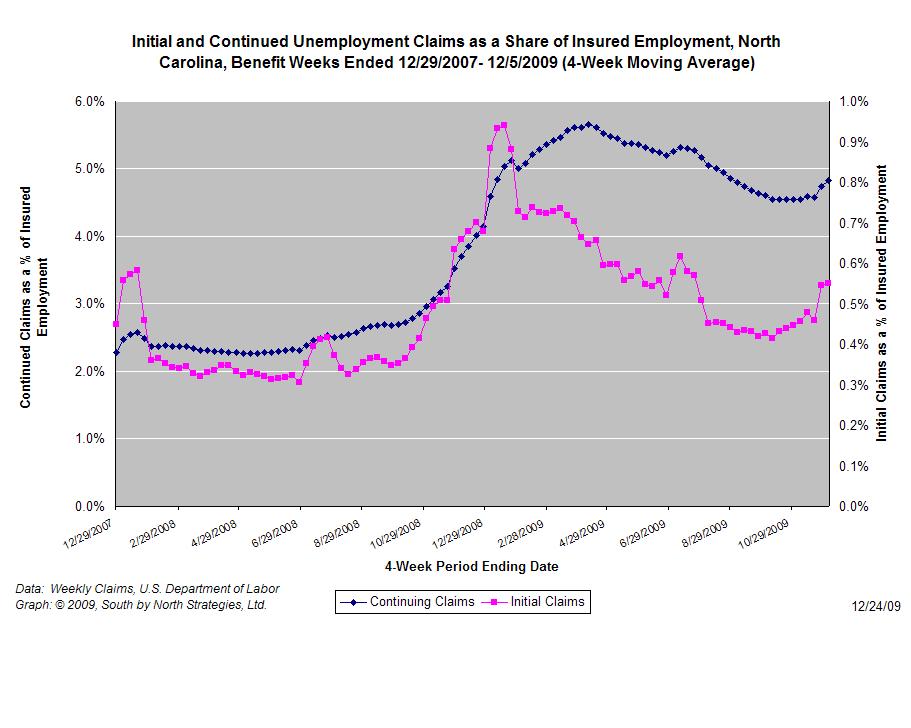
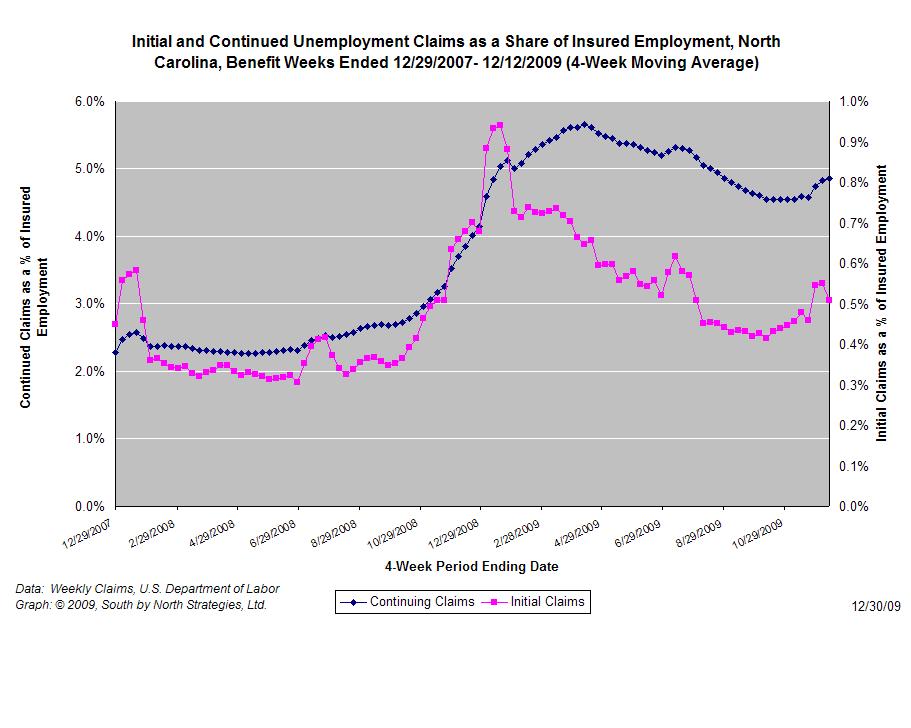
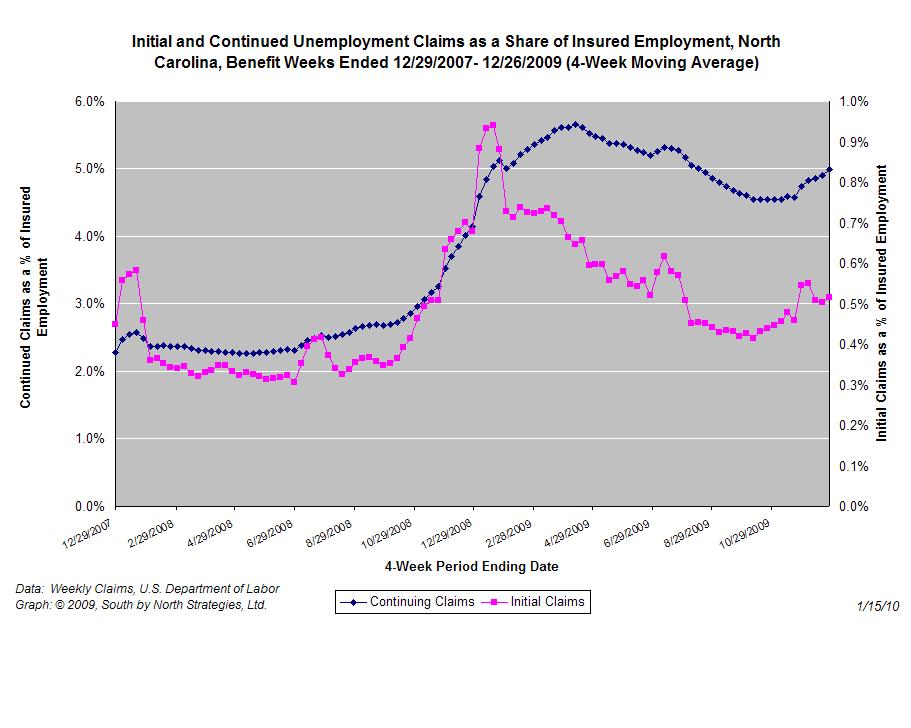
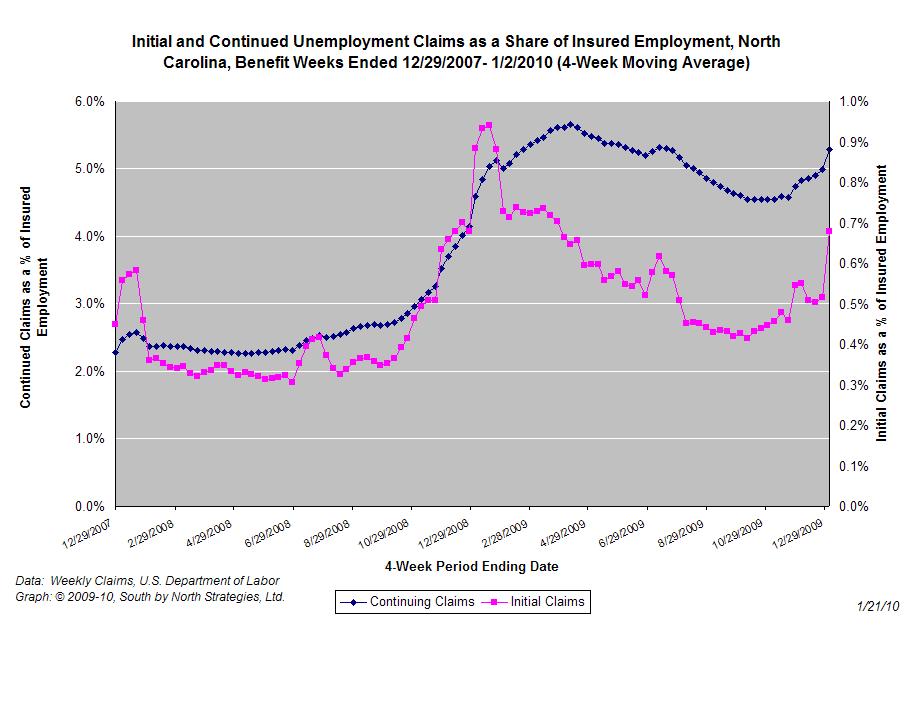
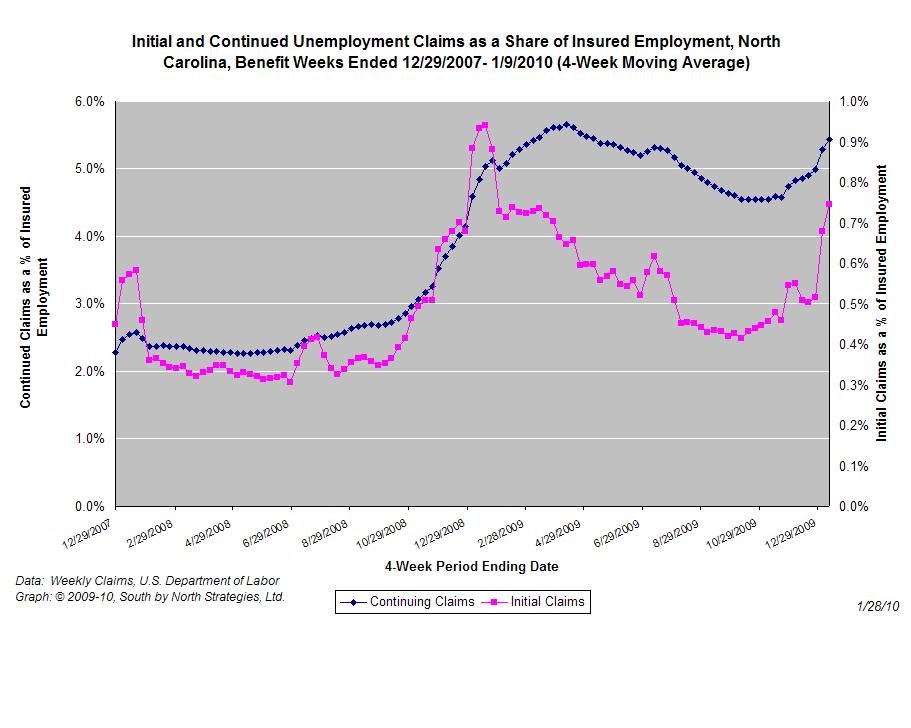
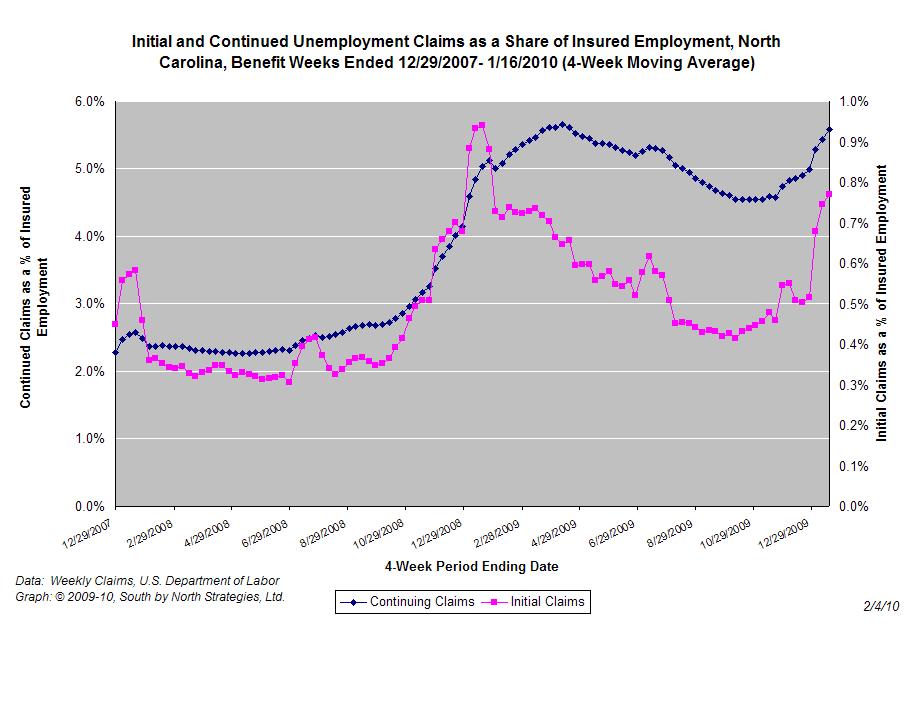
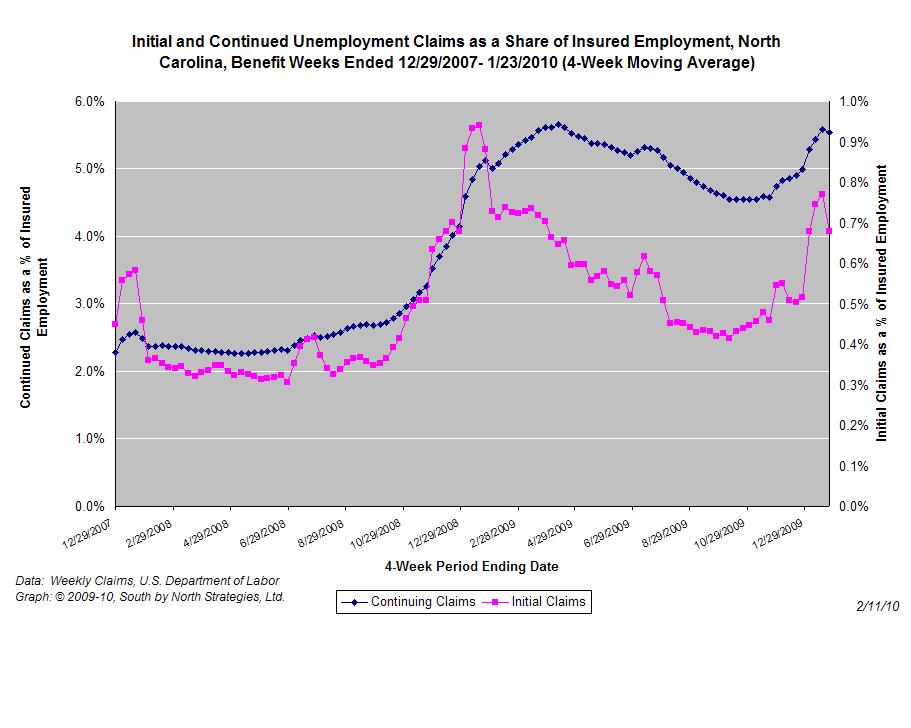
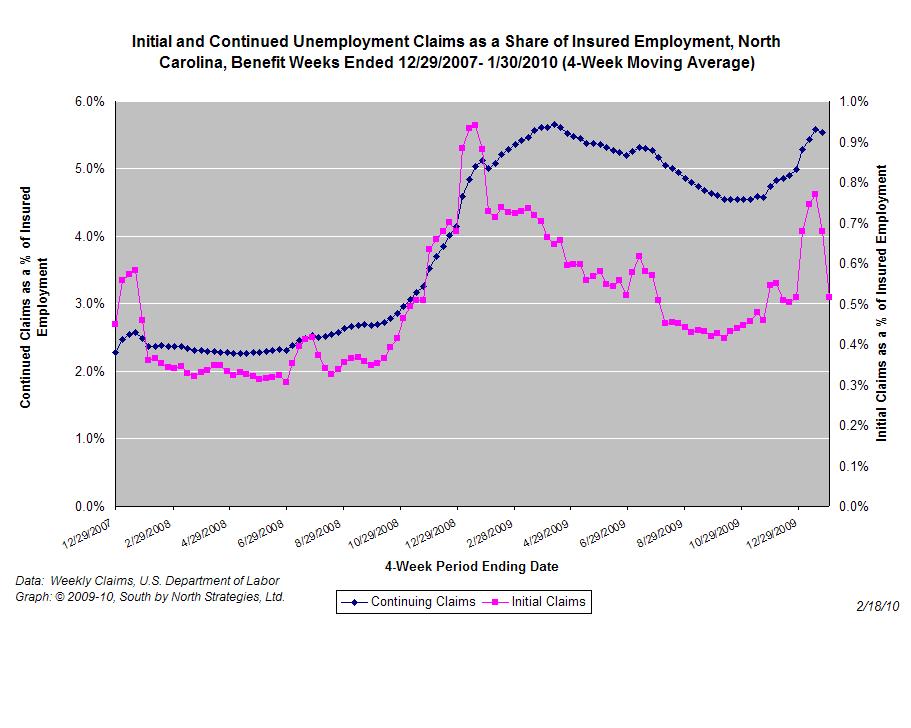
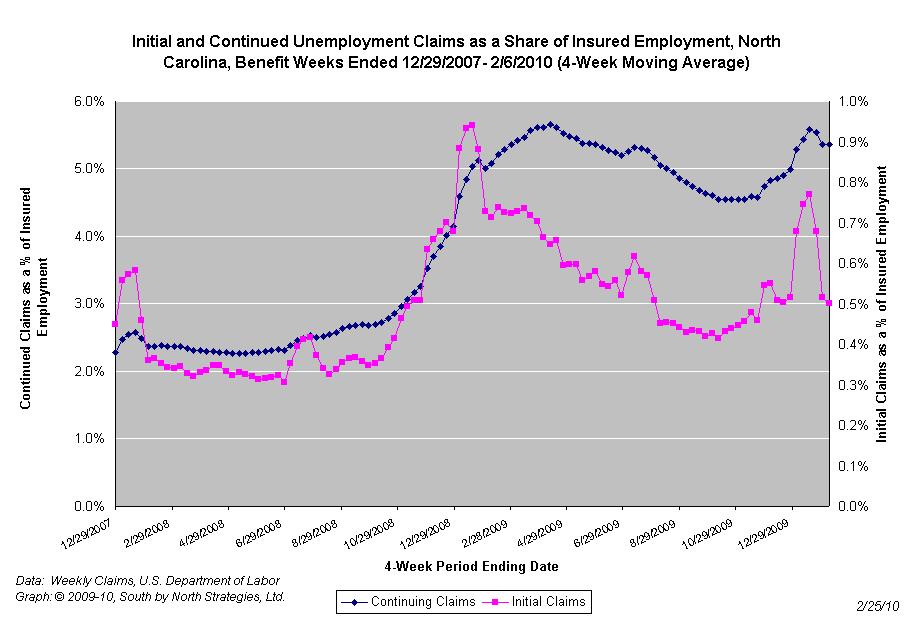
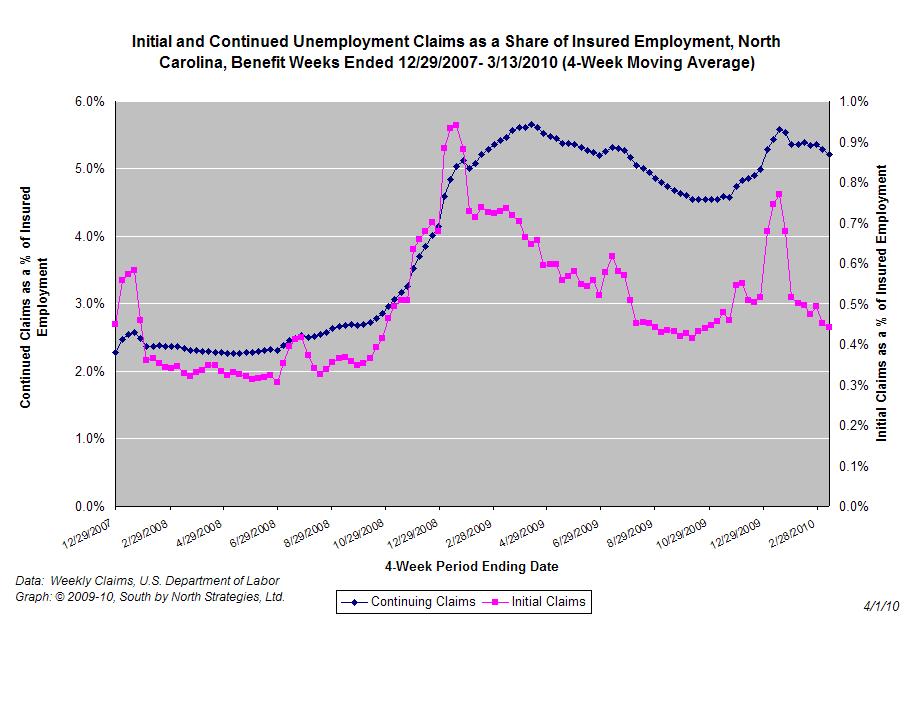
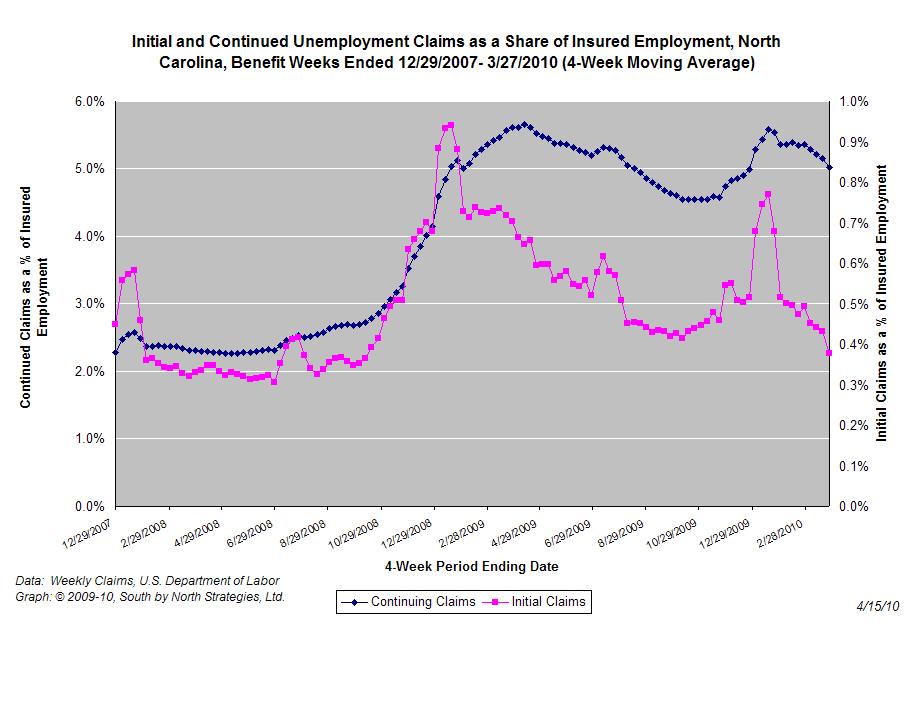
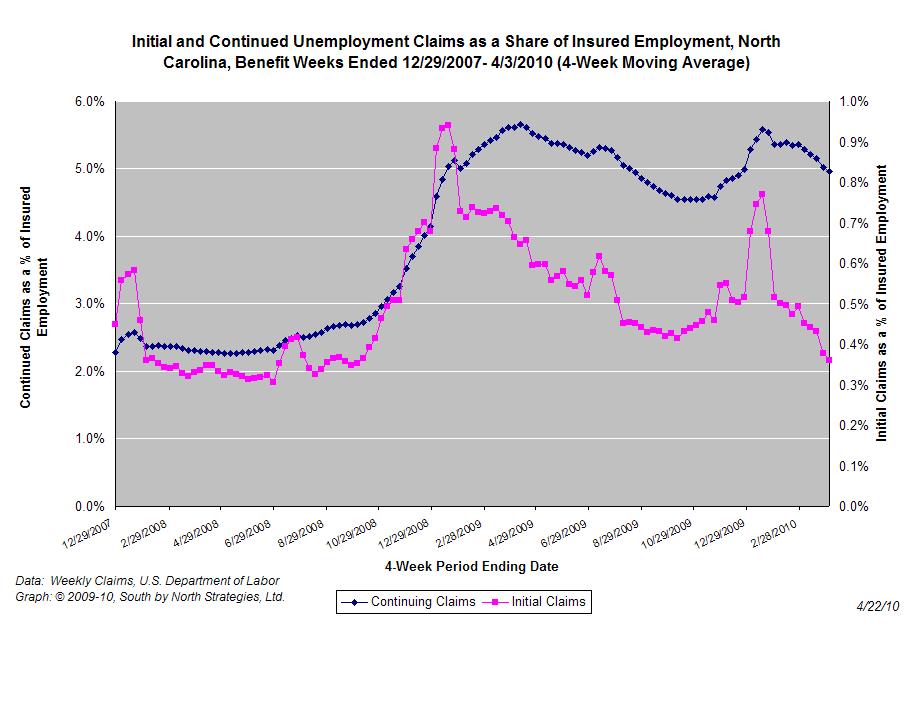
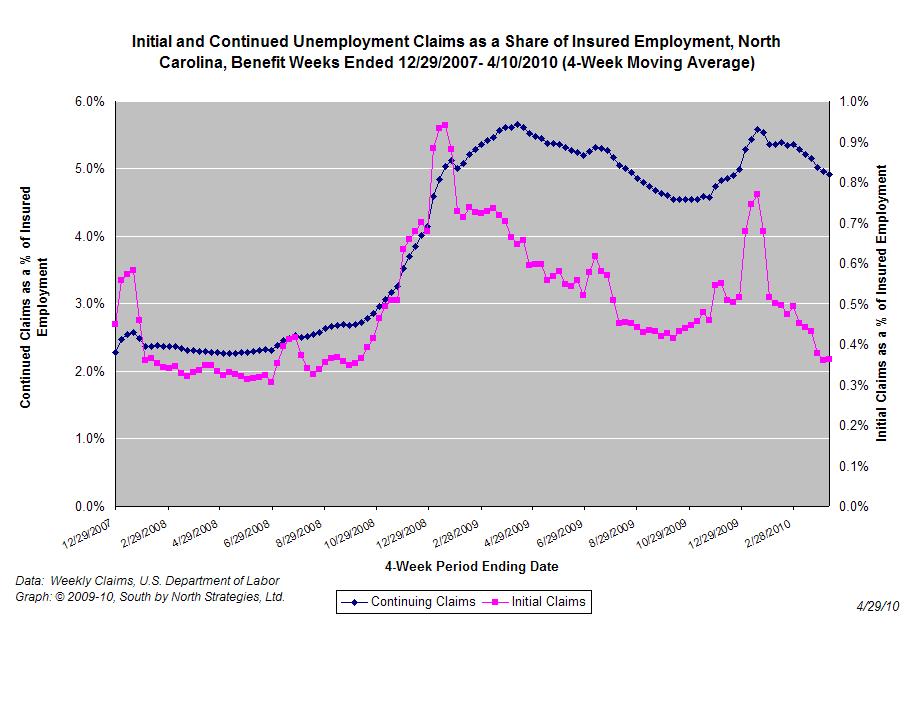
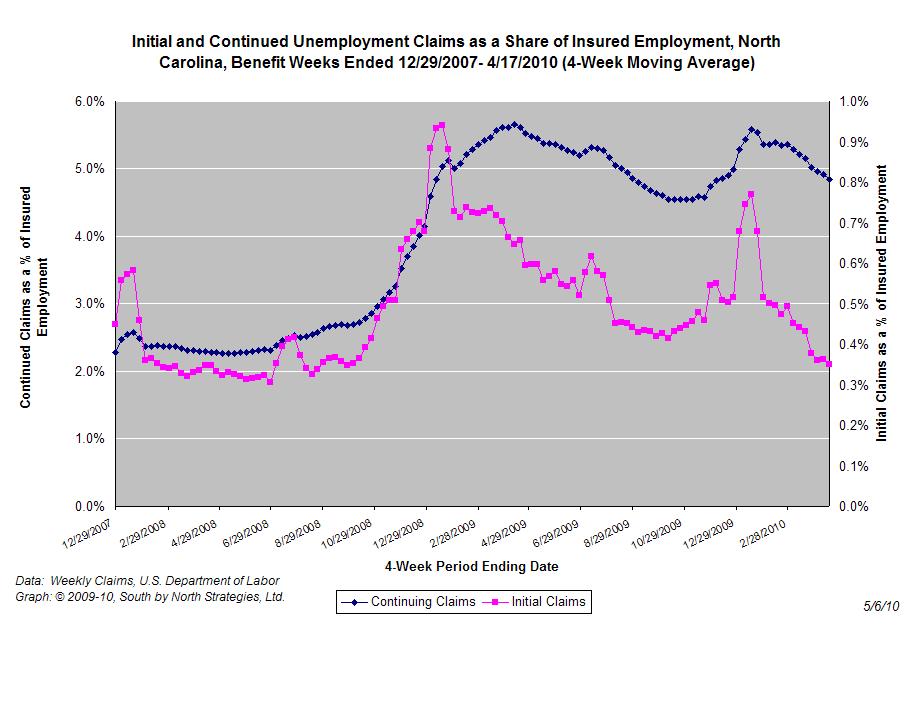
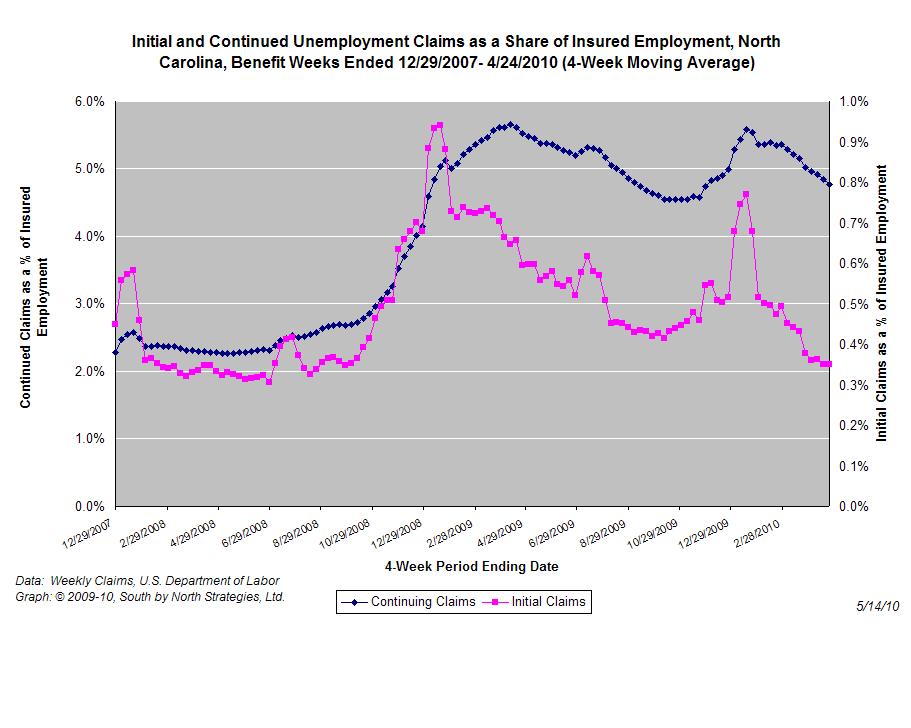
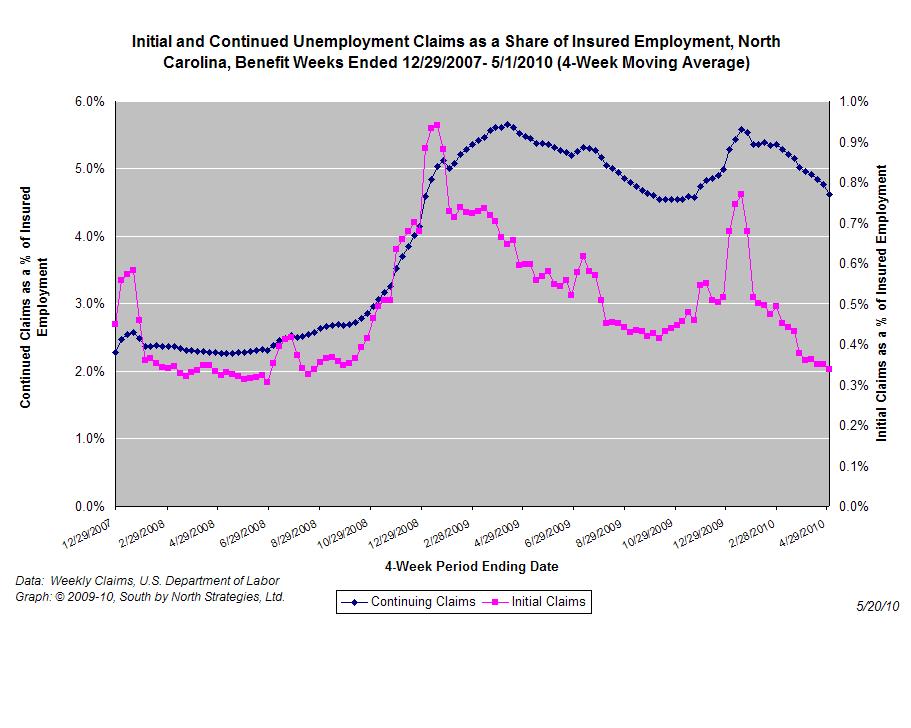
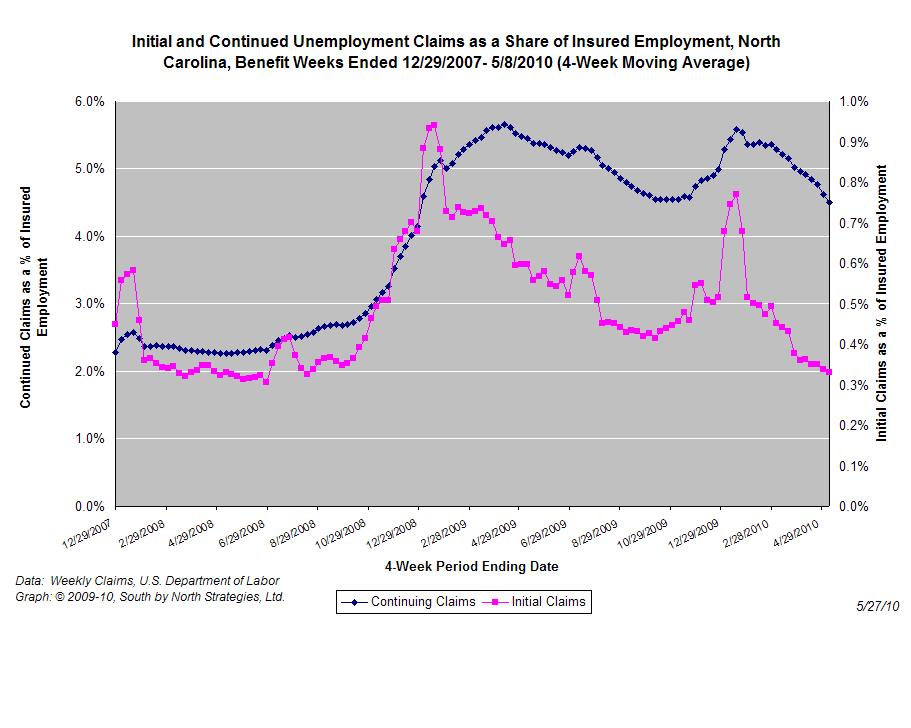
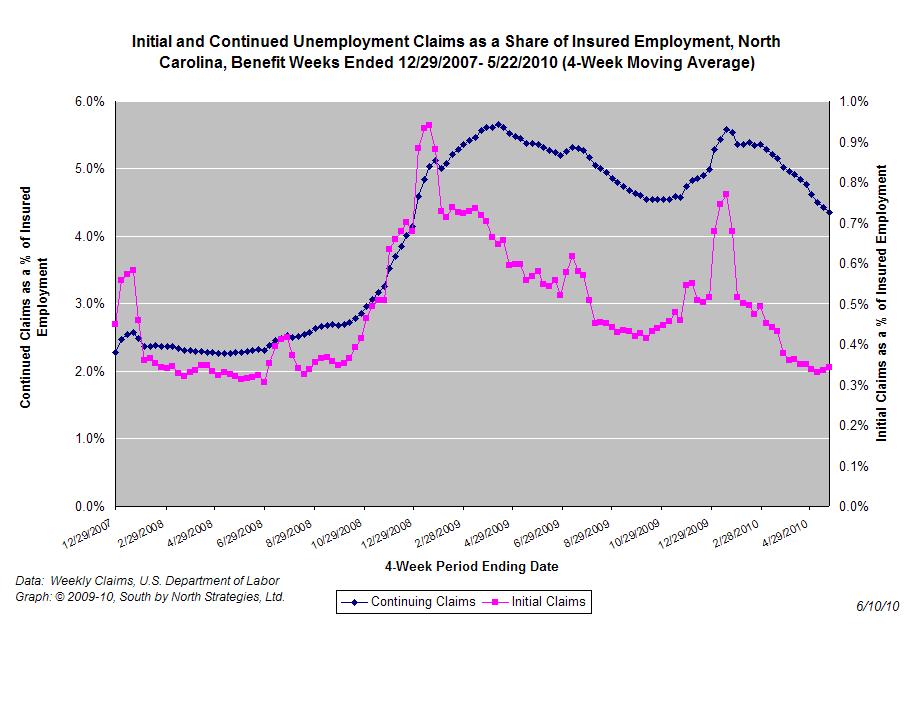
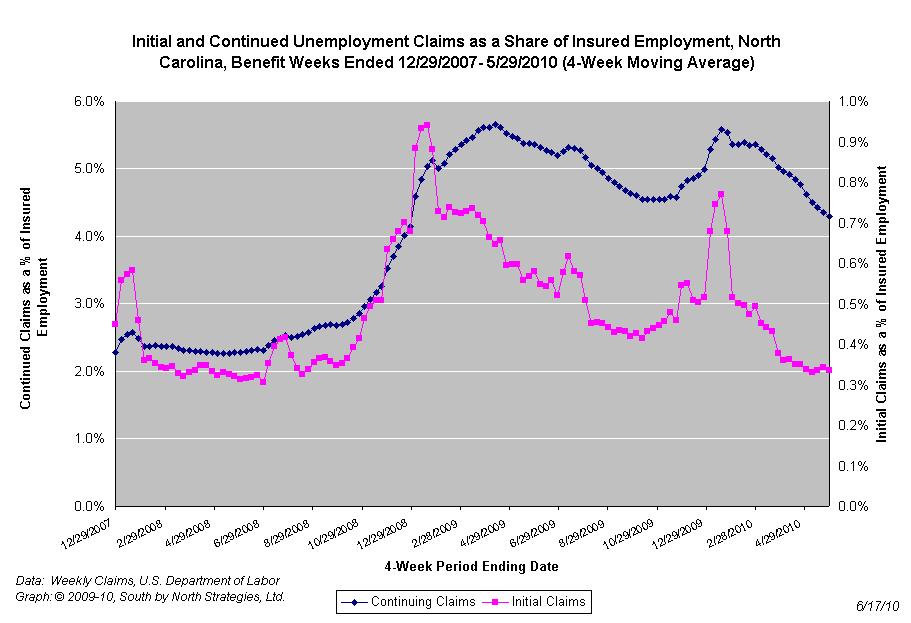
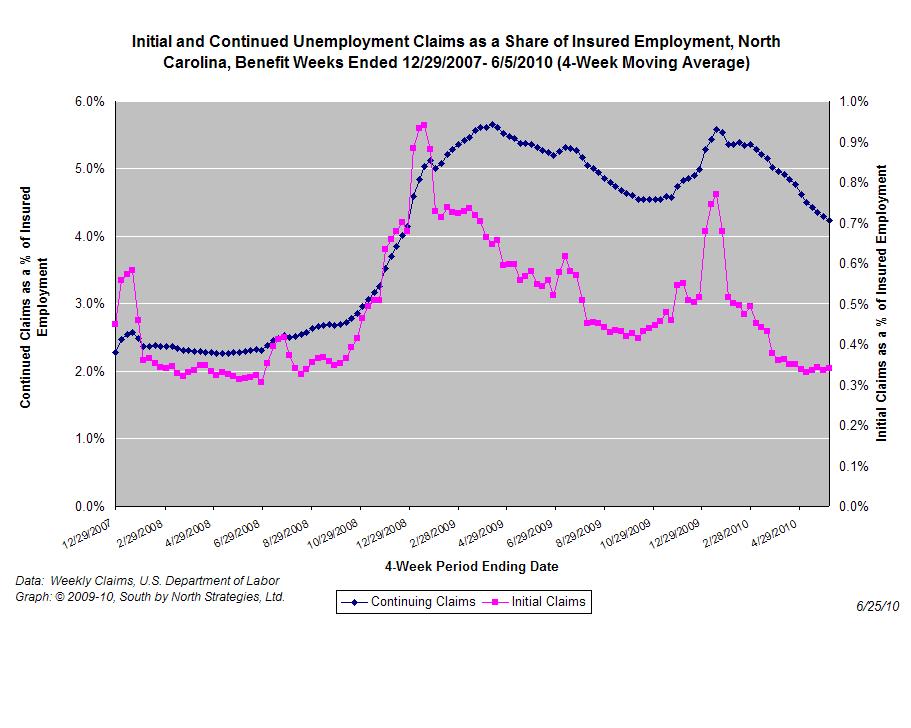
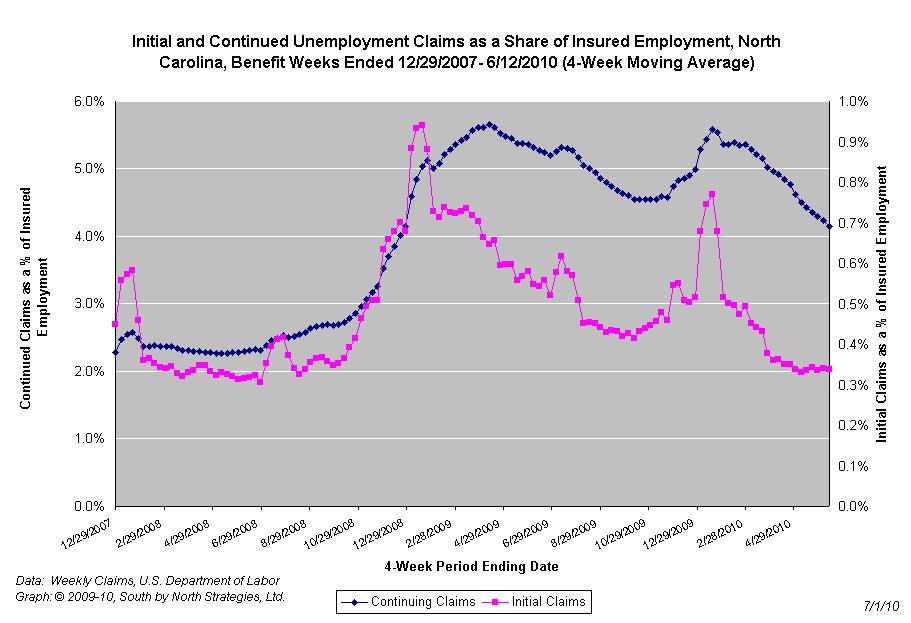
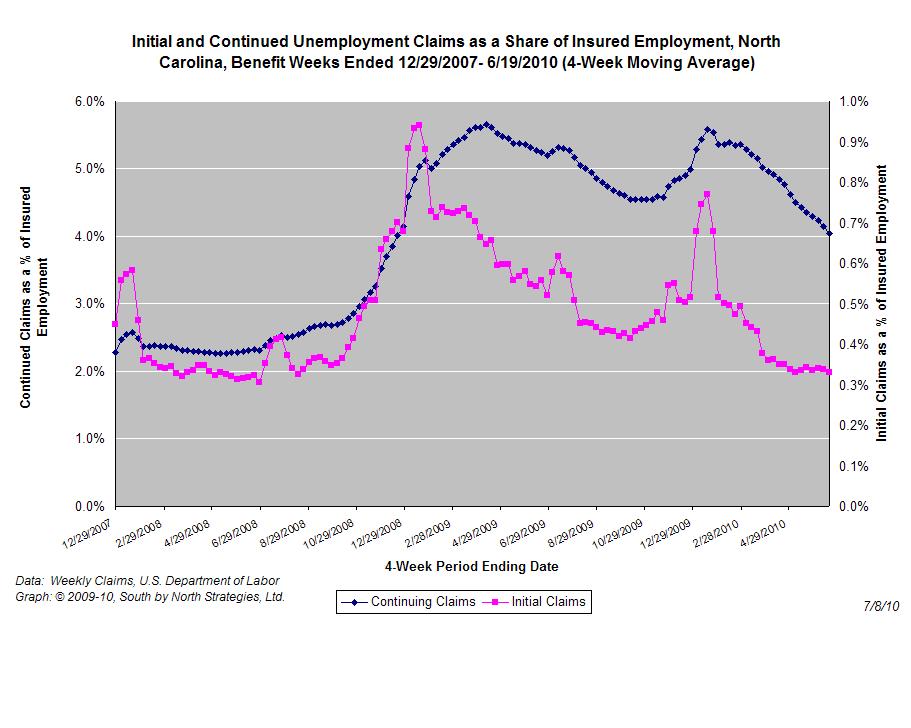
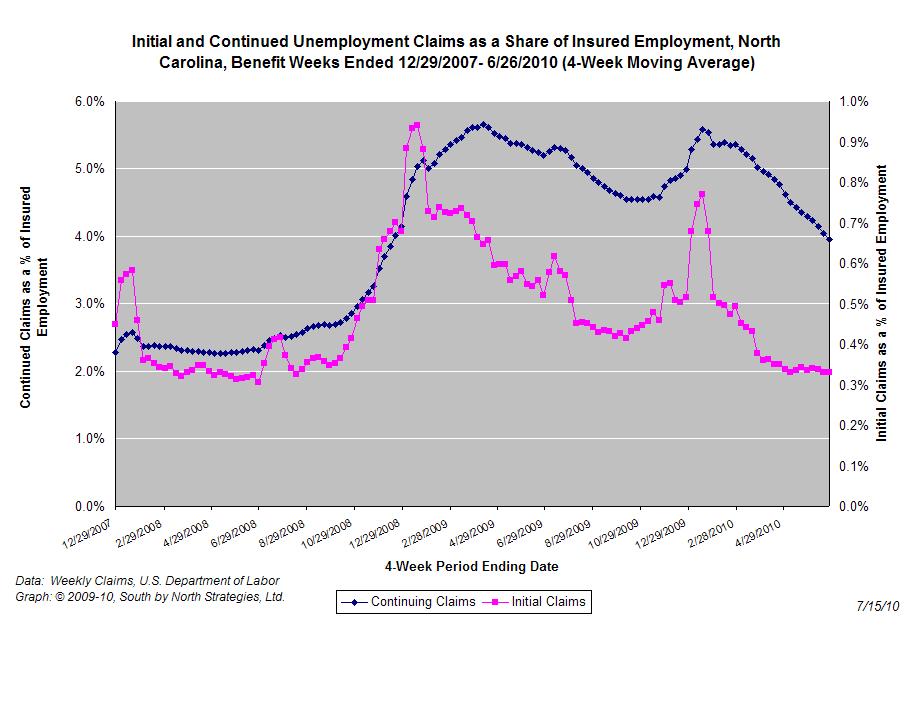
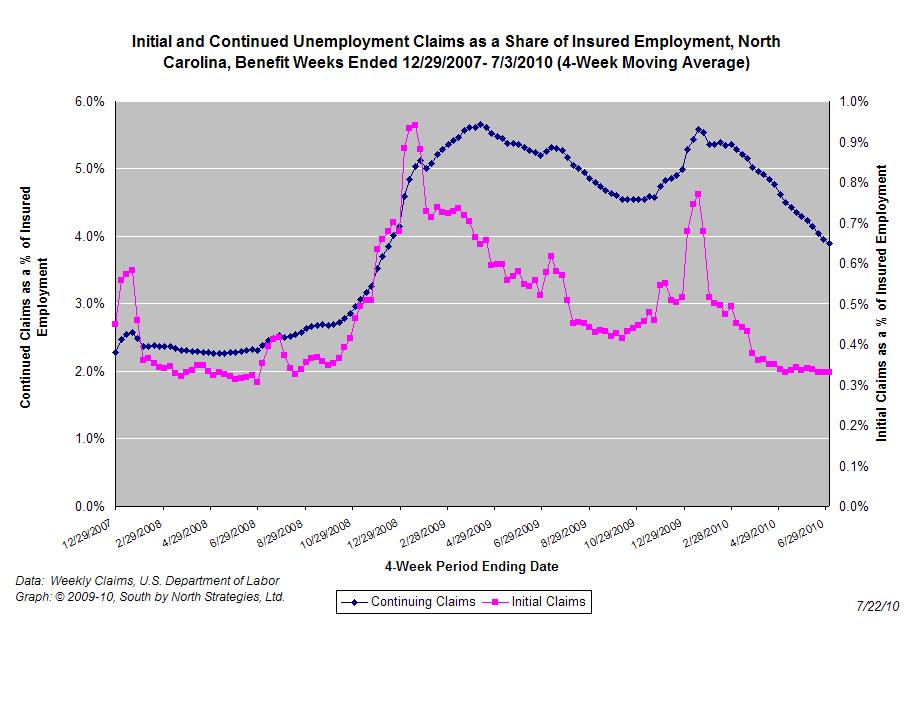
The graph (right) shows the changes in unemployment insurance claims (as a share of covered employment) in North Carolina since the recession’s start in December 2007.
Both new and continuing claims appear to have peaked for this business cycle, and the four-week averages of new and continuing claims have fallen considerably. Yet continuing claims remain at an elevated level, which suggests that unemployed individuals are finding it difficult to find new positions.
Old Mistakes Repeat Themselves
Writing for Project Syndicate, Robert Skidelsky asks what advocates of fiscal austerity must believe in order to make their policy proposals coherent. Concludes Skidelsky’ commentary:
The classical view of the economy, which [John Maynard] Keynes set out to demolish, is not only alive, but in recent years has been dominant, feeding the belief that competitive markets can be left to regulate themselves, will always provide as much employment as is wanted, and are immune to large-scale collapse. This also fuels opposition to government intervention, and to “stimulus” policies, which are supposedly redundant, if not harmful, since the events that require them cannot happen (but do).
—
Unless we start discussing economics in a Keynesian framework, we are doomed to a succession of crises and recessions. If we don’t, the next one will come sooner than we think.
Around The Dial – July 21
Economic policy reports, blog postings, and media stories of interest:
- Brad DeLong argues it is too soon to end the expansion.
- Marshall Auerback is not happy with the Treasury Department.
- The National Skills Coalition announces the passage of the SECTORS act.
- The Charlotte Observer reports on the ending of temporary census jobs.
- Calculated Risk analyses the performance of the federal HAMP program.
Good For Innovation?
Earlier this week, The News & Observer reported that Becton Dickinson, a maker of medical equipment,plans to open a distribution center in Johnston County. The company will receive a package of state and local subsidies potentially worth up to $2.3 million.
While new industry and jobs are welcome during a time of high unemployment, the deal reopens many of the longstanding debates surrounding business subsidies, such as those over the quality of subsidized jobs. Yet this package also raises questions about whether the decision is consistent with the state’s stated emphasis on entrepreneurship and innovation as drivers of long-term growth.
In this month’s cover story, The Washington Monthly describes how Becton Dickinson allegedly has used anticompetitive practices to keep small, entrepreneurial firms from brining innovative medical products — specifically syringes that reduce the risk of accidental needle-sticks — to market. Reports the article:
… In the case of syringes, the incumbent heavyweight has long been Becton Dickinson, or BD, a New Jersey–based company that controls 70 percent of the syringe market and has a lengthy history of trampling competitors. As early as 1960, BD was brought up on Justice Department charges for its anticompetitive practices …
…
As it turns out, [Thomas] Shaw’s retractable syringe hit just as these trends were converging. In fact, the year his product came onto the market, three of the nation’s largest GPOs [group purchasing organizations] merged to form a company called Premier, which managed buying for 1,700 hospitals, or about a third of all hospitals in the United States. Shortly thereafter, Premier signed a $1.8 billion, seven-and-a-half-year deal with Becton Dickinson. Under the agreement, member hospitals … had to buy 90 percent of their syringes and blood collection tubes from the company. Over the next two years, BD landed similar deals with all but one major GPO.
…
Meanwhile, as Shaw was fighting his battles hospital to hospital, Becton Dickinson was working to extend its hold on the nation’s GPOs. According to confidential documents filed as part of a whistleblower lawsuit, in 1999 BD paid $1 million to Novation, the only major GPO with which it hadn’t yet signed a sole-source contract, in return for a three-year sole-source deal …
Another recent take on the company’s supposed behavior towards smaller competitors is found in the recent book Cornered (chapter 6), authored by Barry Lynn of the New American Foundation.
Financial Reform And The Poor
A segment on the PBS NewsHour discussed what financial reform might mean for the poorest Americans.
 Email Sign-Up
 RSS Feed