NC Unemployment Claims: Week of 6/26
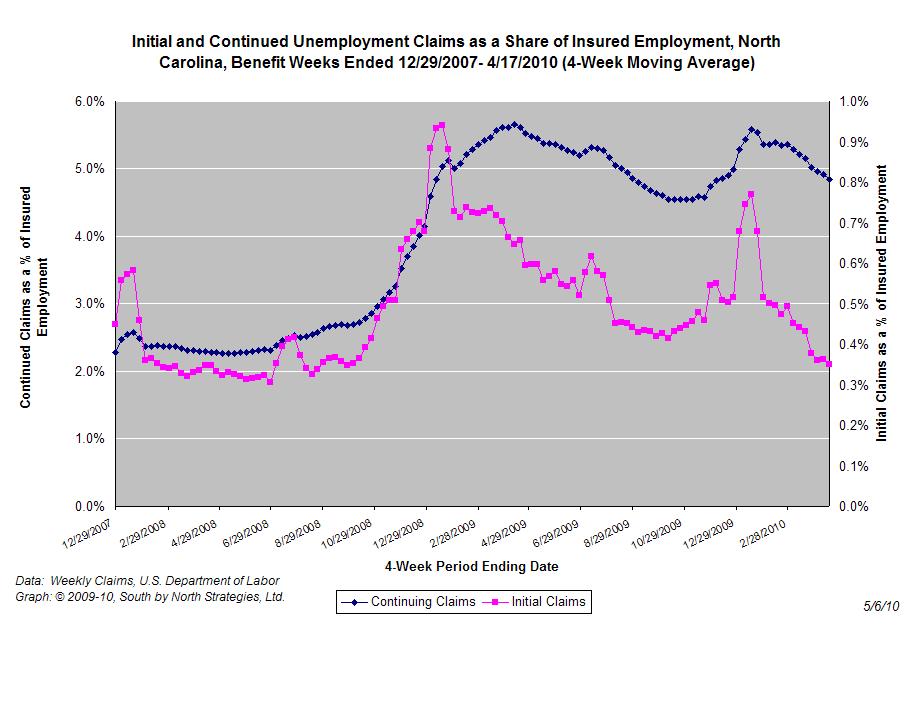
For the benefit week ending on June 26th, 12,053 North Carolinians filed initial claims for state unemployment insurance benefits, and 145,910 individuals applied for state-funded continuing benefits. Compared to the prior week, there were fewer initial and continuing claims. These figures come from data released today by the U.S. Department of Labor.
Averaging new and continuing claims over a four-week period — a process that helps adjust for seasonal fluctuations and better illustrates trends — shows that an average of 12,672 initial claims were filed over the previous four weeks, along with an average of 151,074 continuing claims. Compared to the previous four-week period, there were more initial and fewer continuing claims.
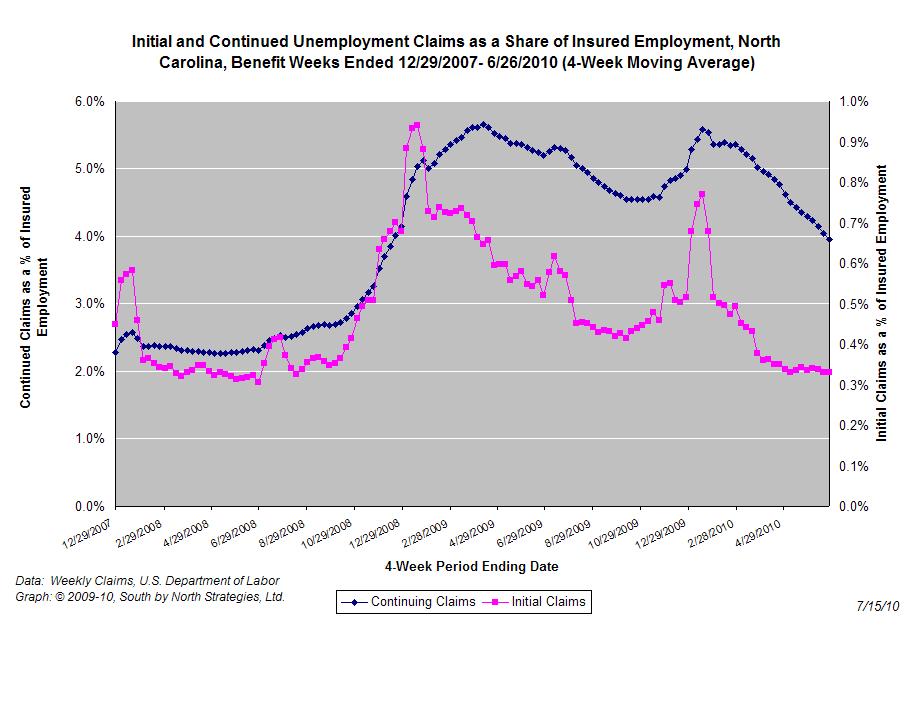 One year ago, the four-week average for initial claims stood at 20,936 and the four-week average of continuing claims equaled 209,367.
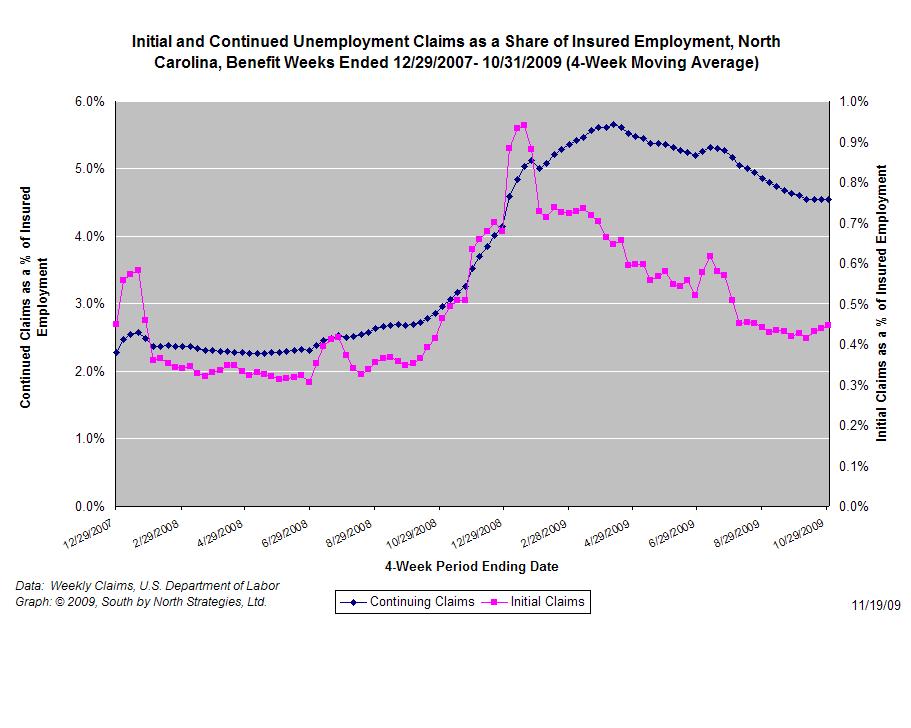
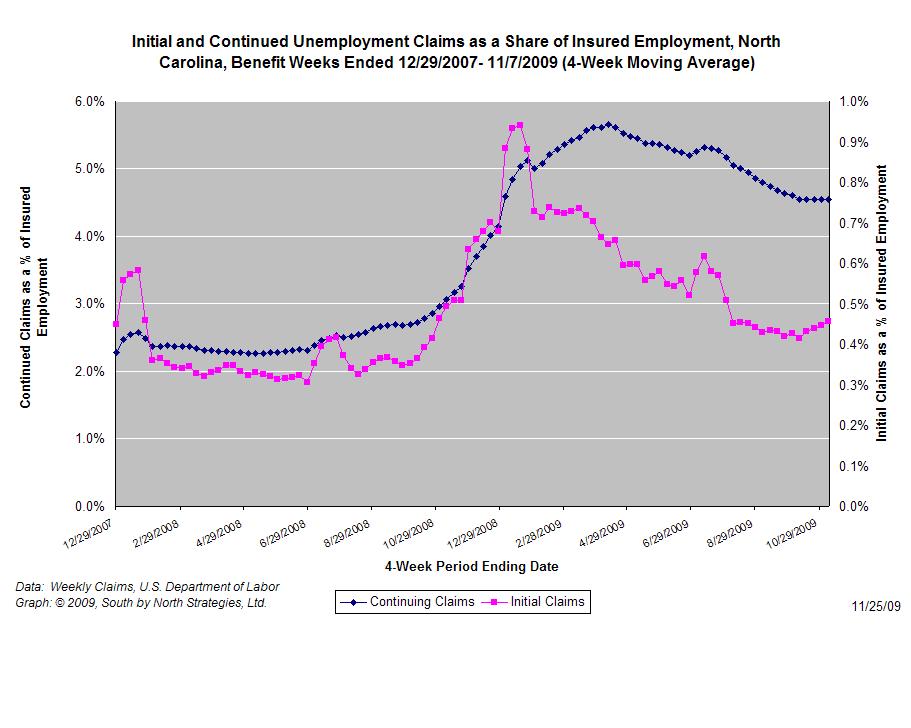
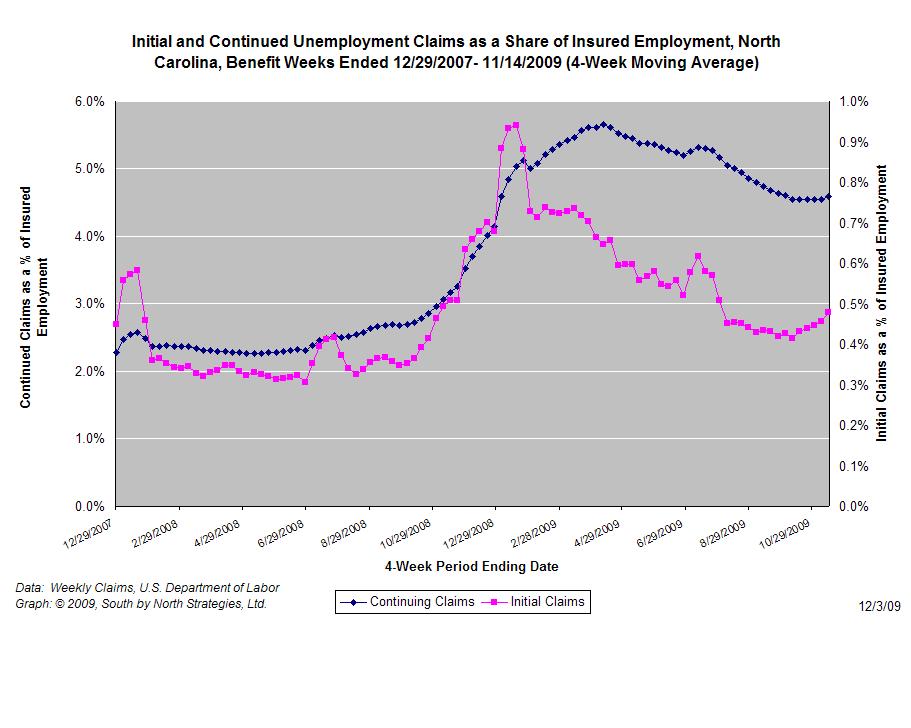
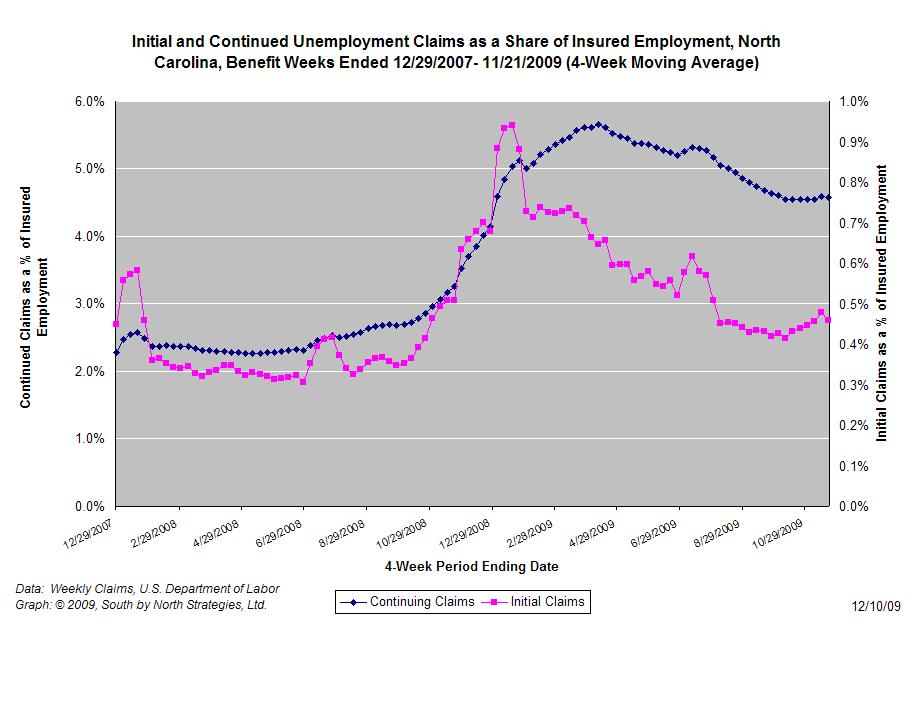
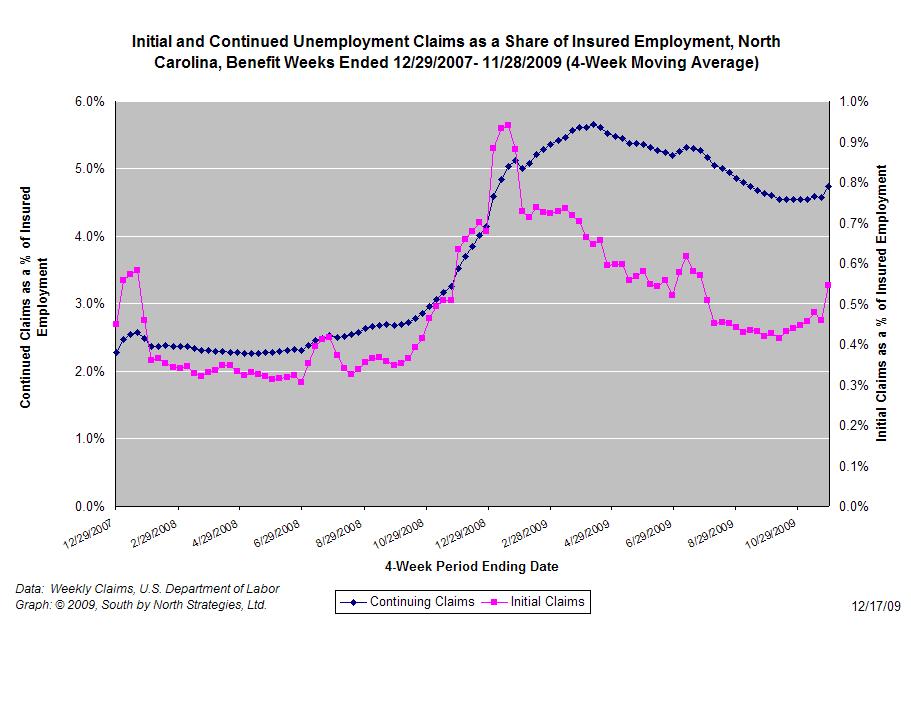
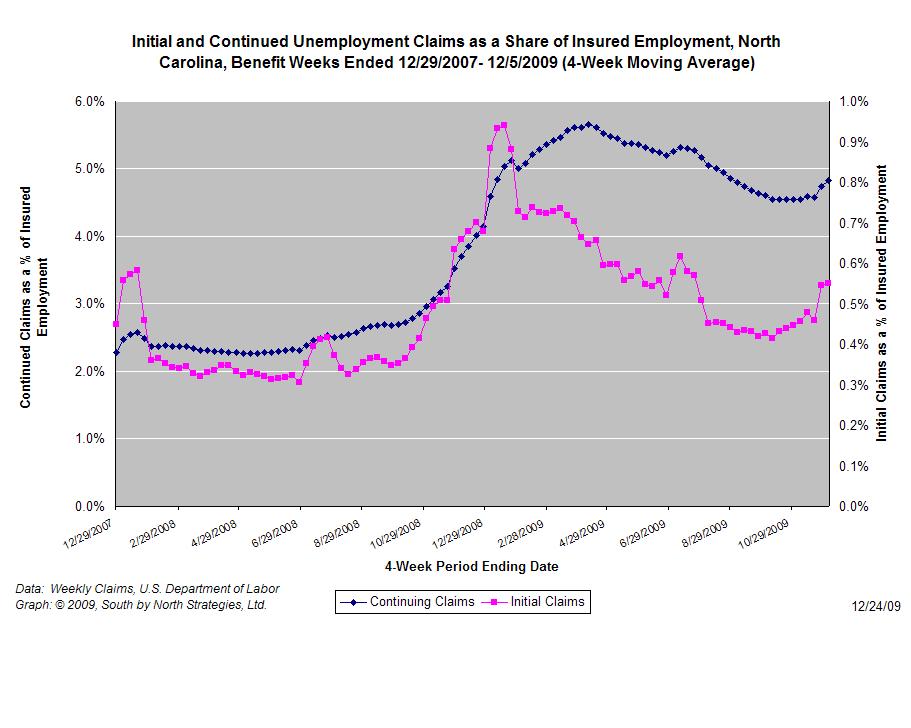
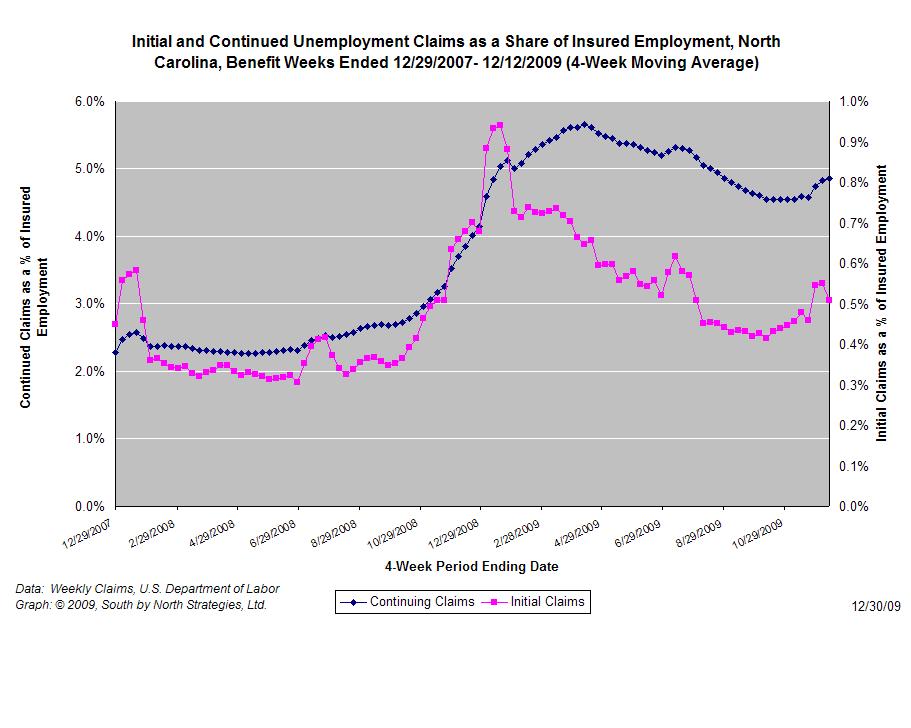
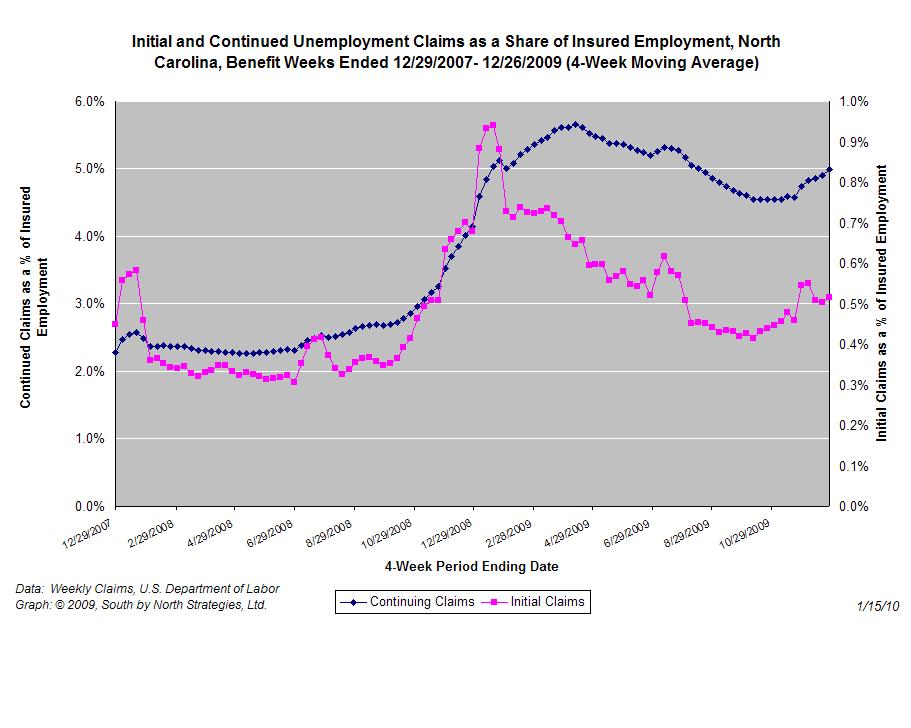
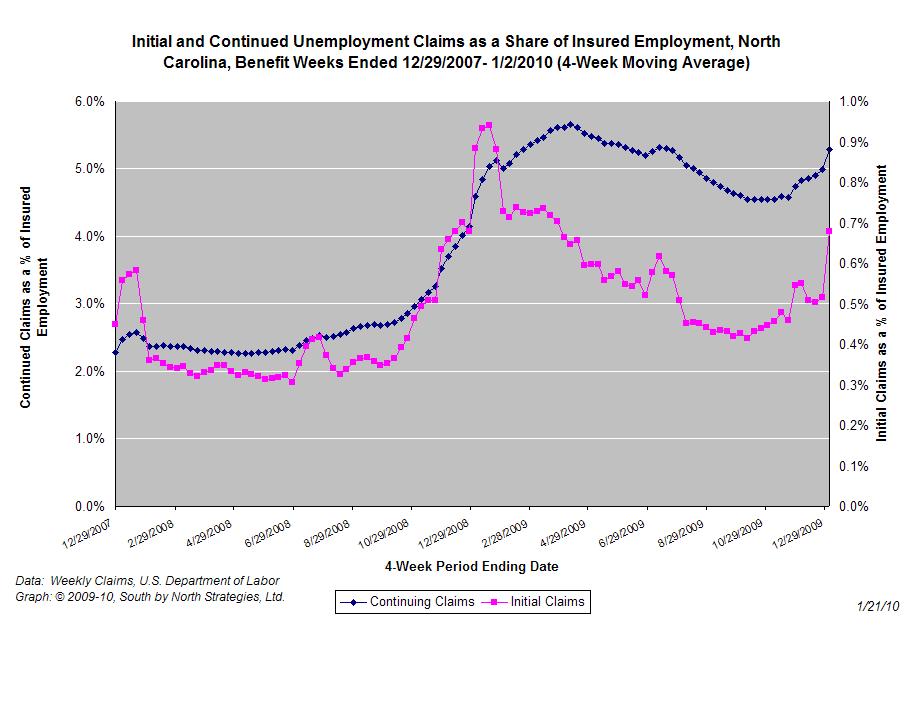
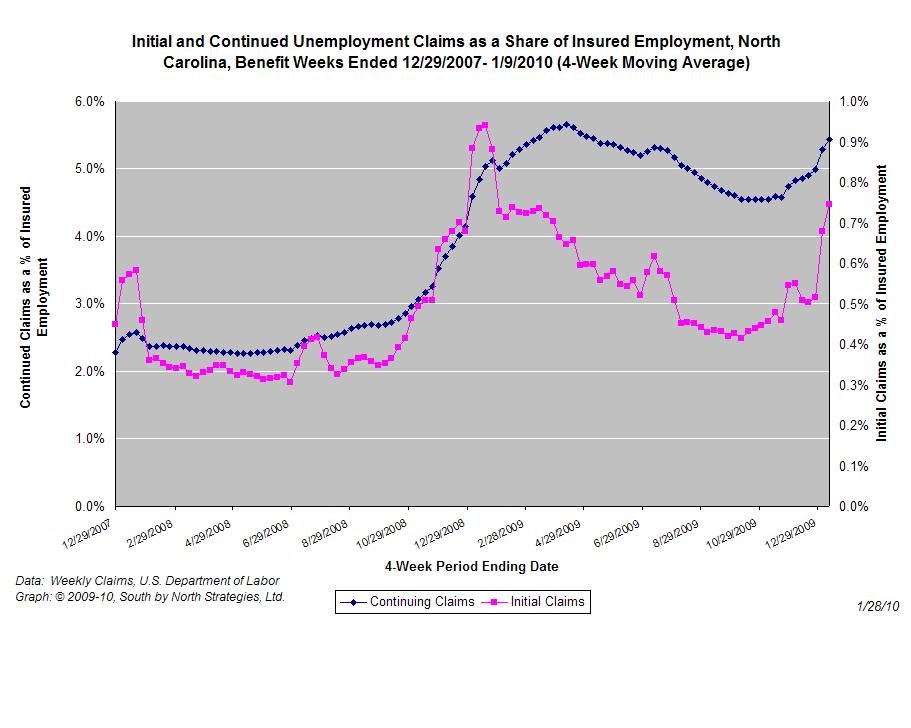
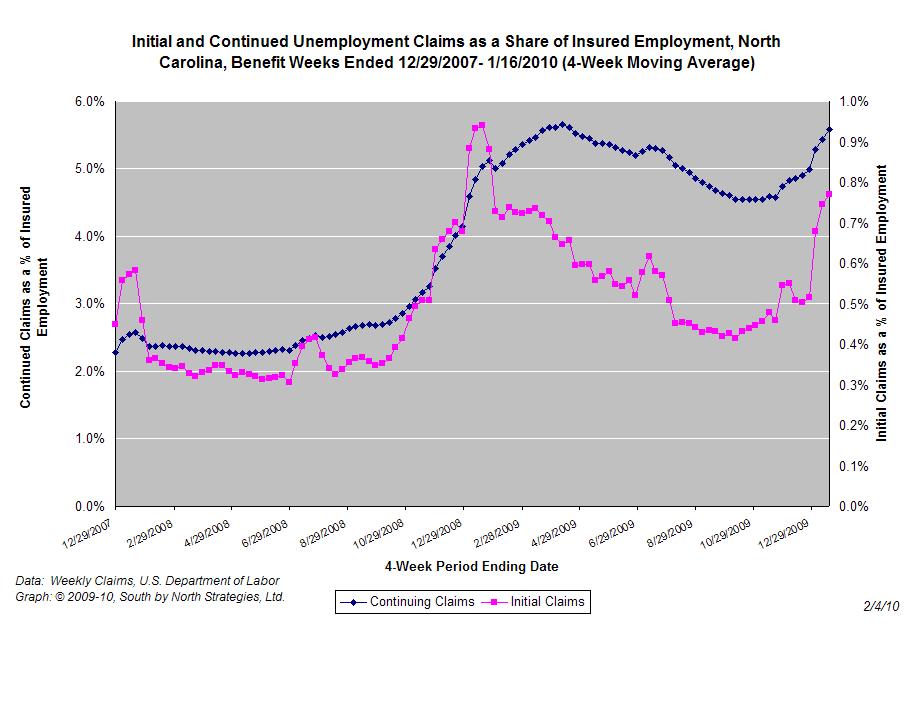
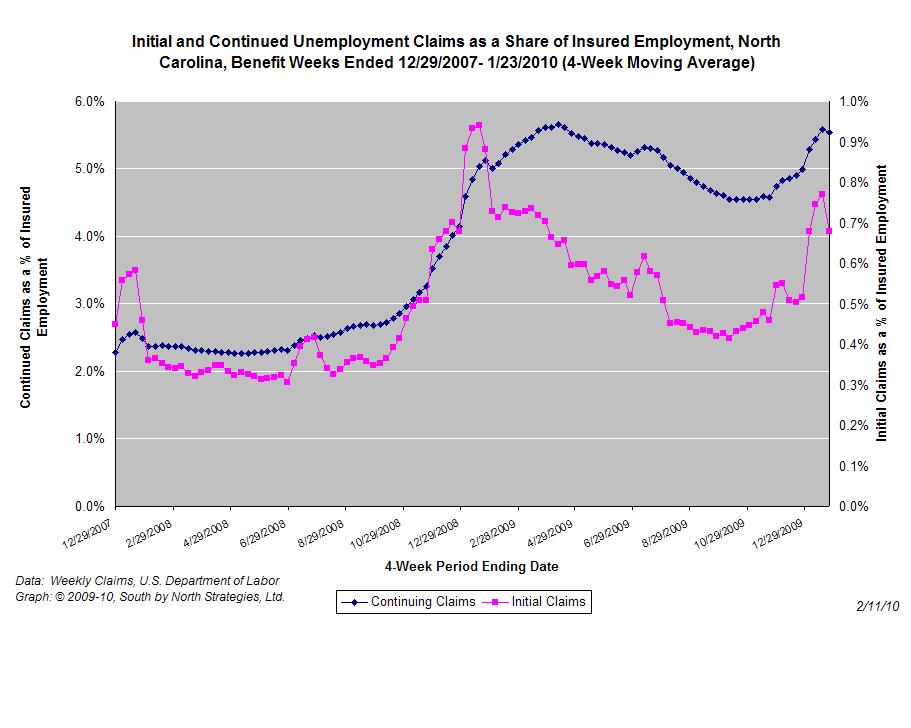
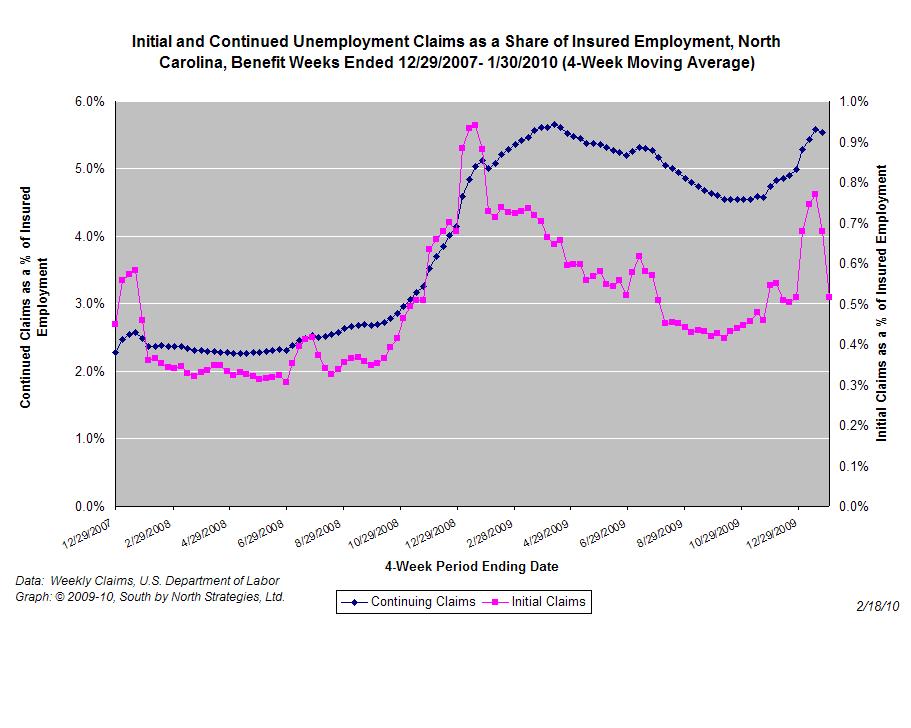
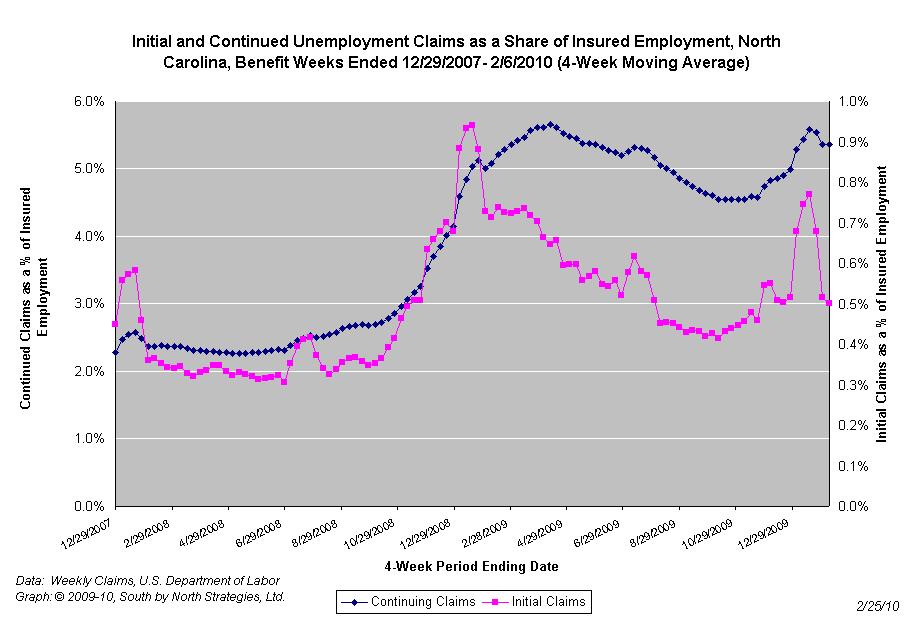
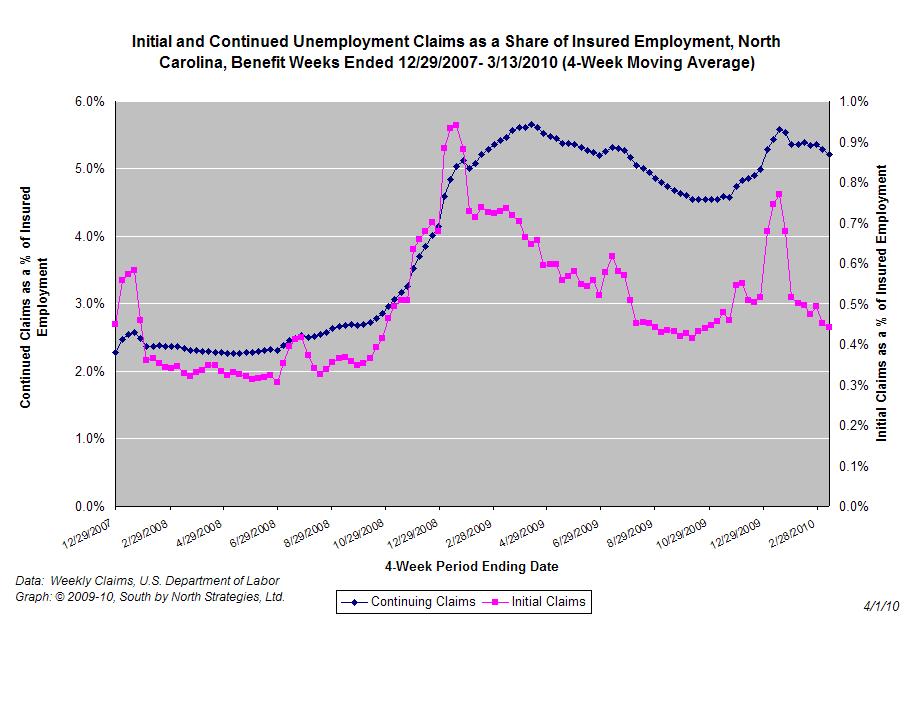
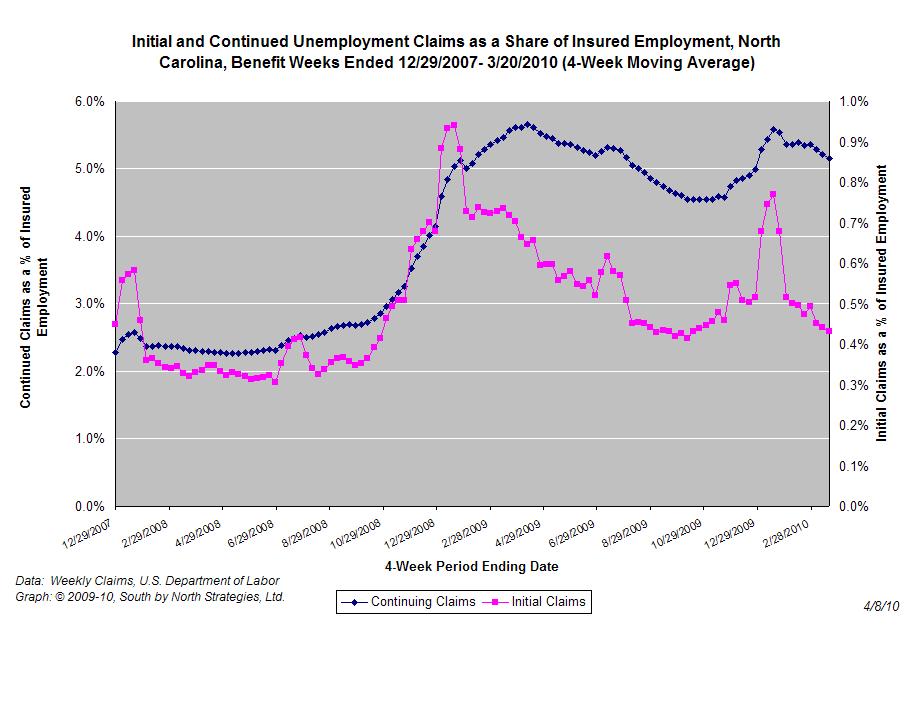
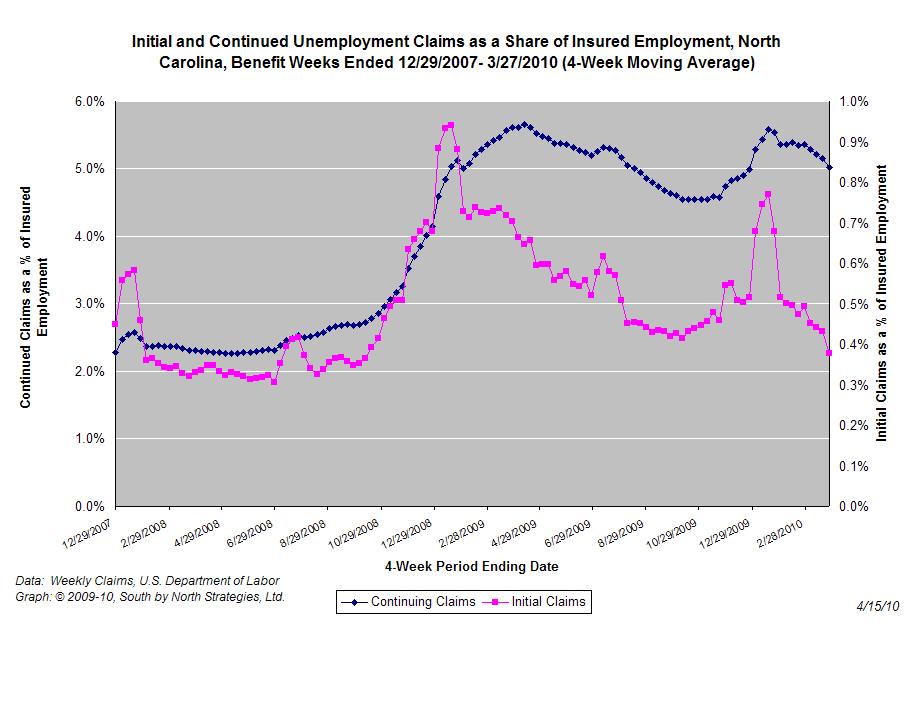
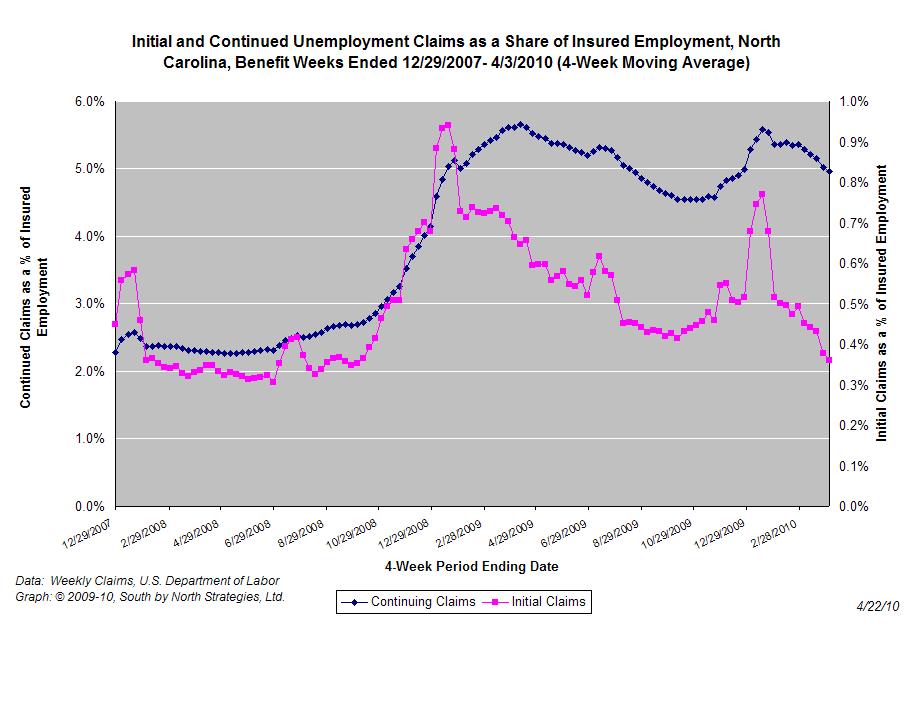
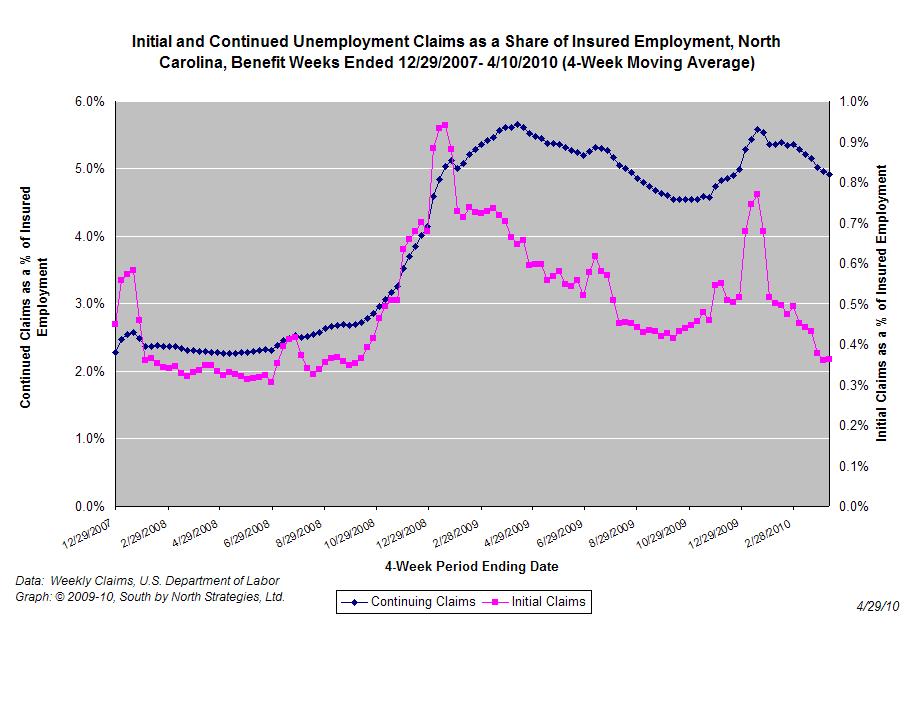
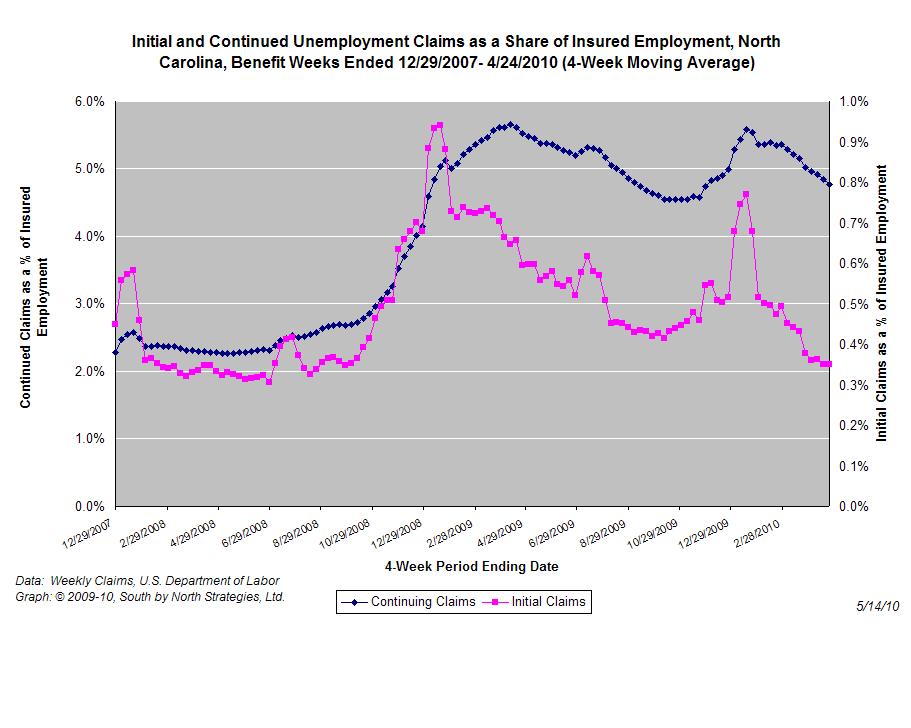
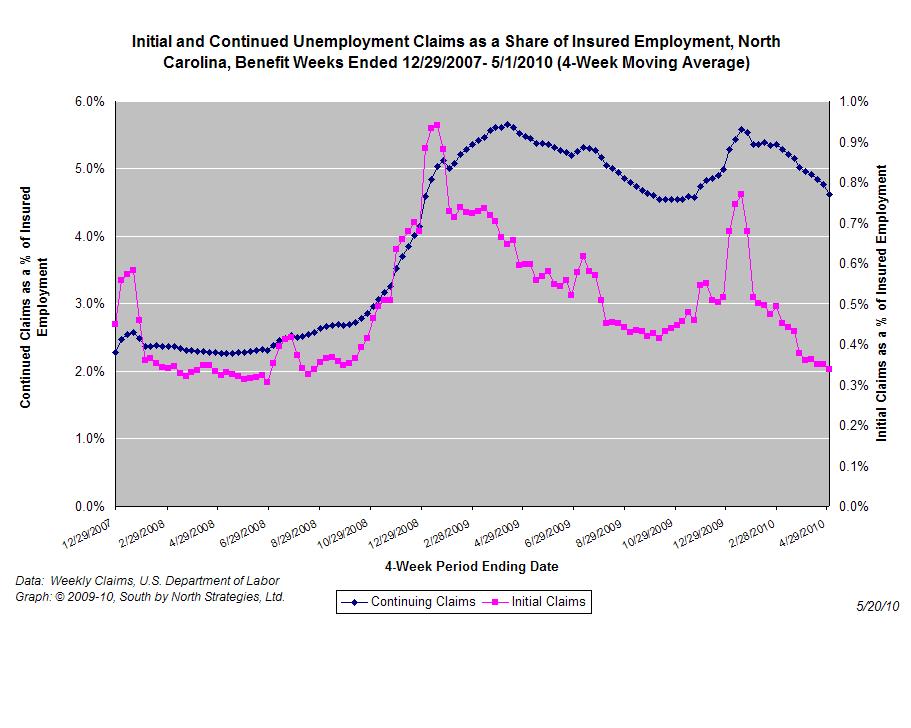
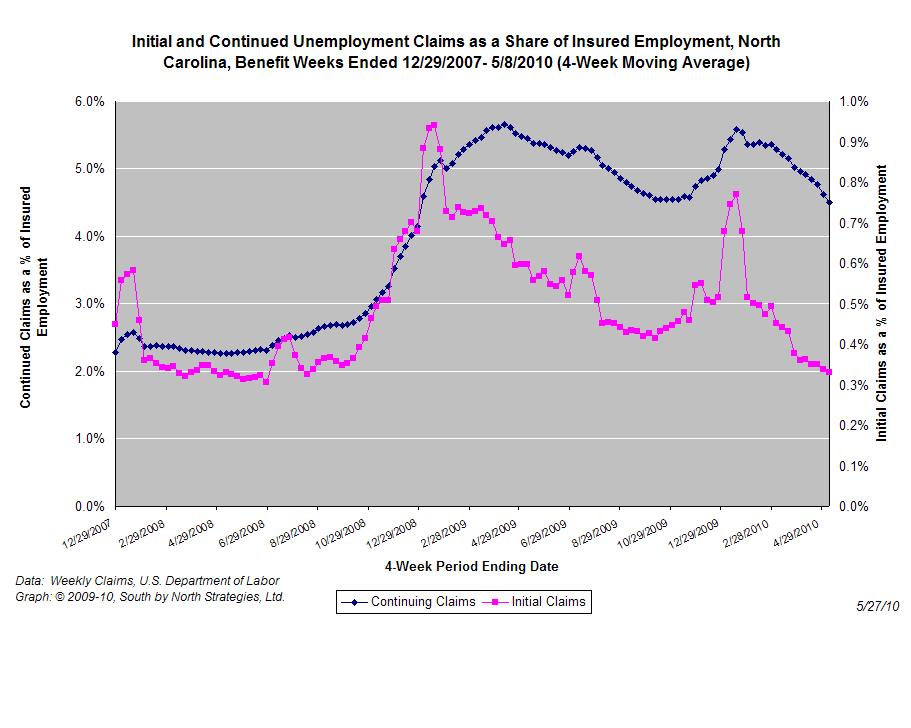
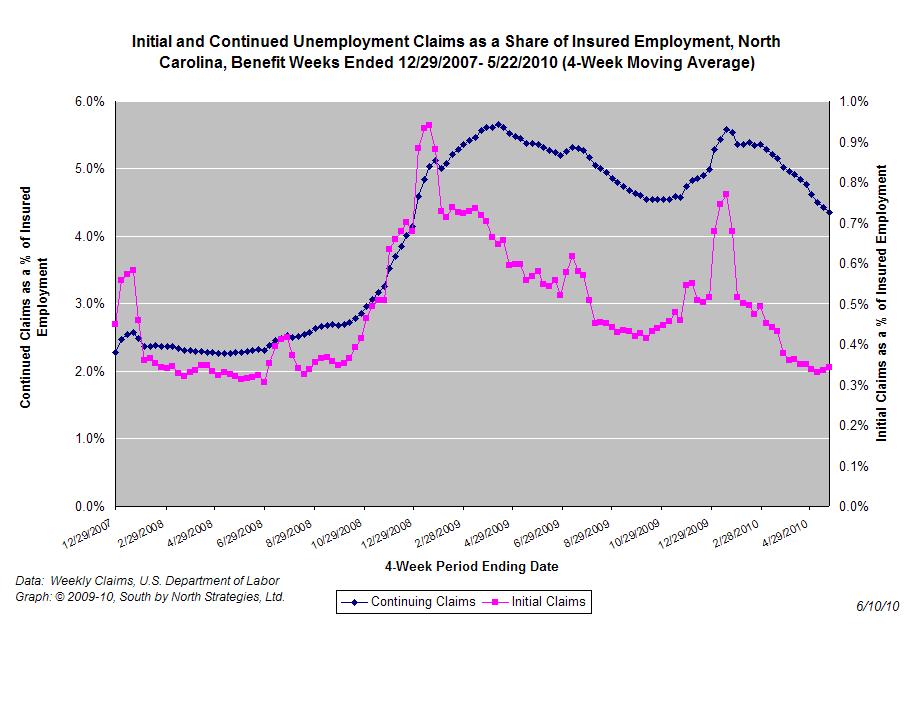
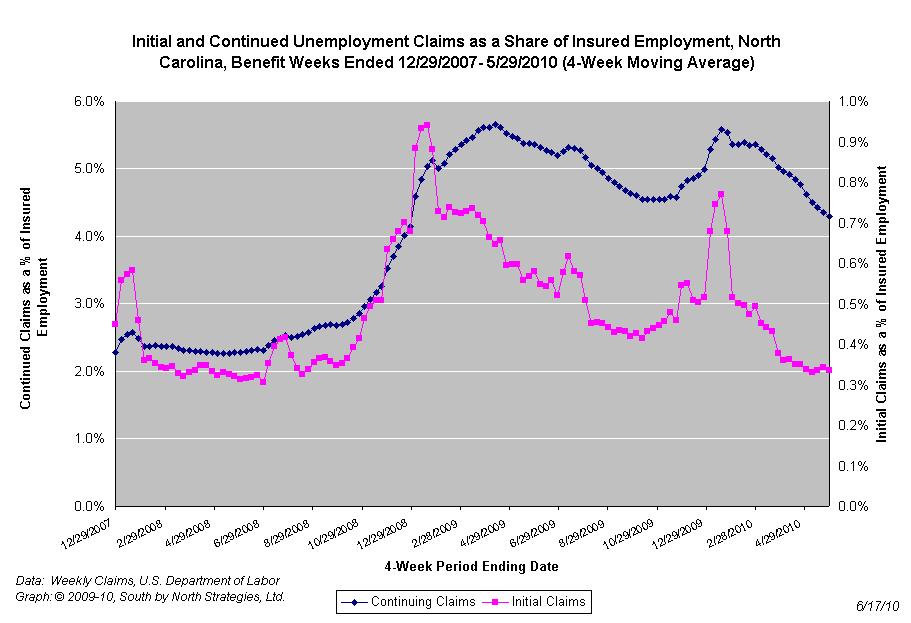
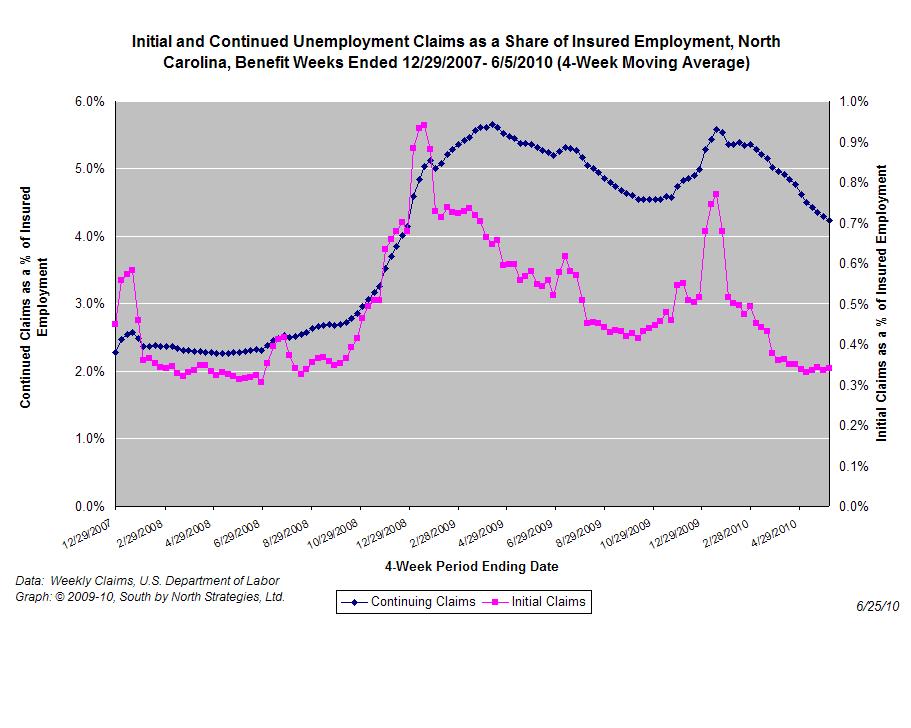
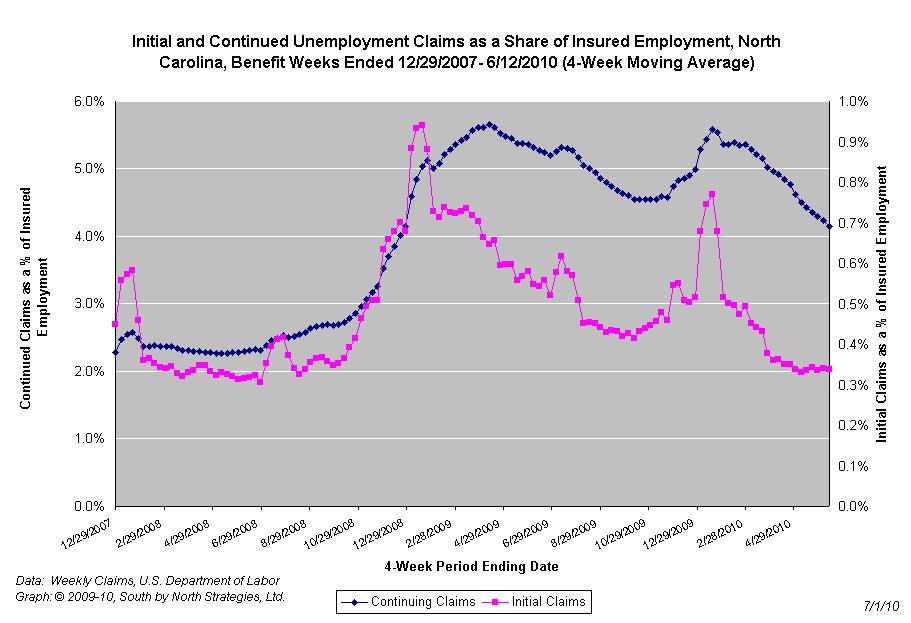
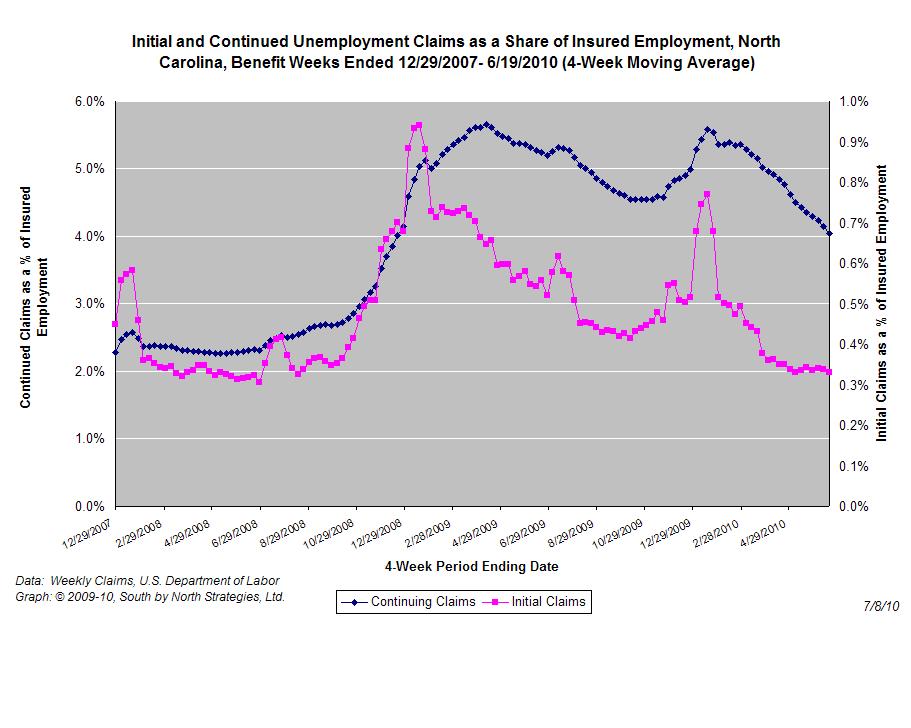
The graph (right) shows the changes in unemployment insurance claims (as a share of covered employment) in North Carolina since the recession’s start in December 2007.
Both new and continuing claims appear to have peaked for this business cycle, and the four-week averages of new and continuing claims have fallen considerably. Yet continuing claims remain at an elevated level, which suggests that unemployed individuals are finding it difficult to find new positions.
May Job Openings
The latest version of the Job Openings and Labor Turnover Survey conducted by the U.S. Bureau of Labor Statistics found that job openings remained scarce in May, the most recent month for which data are available.
There were 3.2 million job openings on the last business day of May 2010, the U.S. Bureau of Labor Statistics reported today. The job openings rate was little changed over the month at 2.4 percent. The hires rate (3.4 percent) was little changed and the separations rate (3.1 percent) was unchanged. This release includes estimates of the number and rate of job openings, hires, and separations for the total nonfarm sector by industry and geographic region.
–
Over the 12 months ending in May, the hires rate (not seasonally adjusted) rose for total nonfarm. The hires rate increased over the past 12 months in mining and logging, durable goods manufacturing, and federal government, and fell in wholesale trade. The hires rate increased over the year in the Midwest and South and was little changed in the other two regions.
From the Economic Policy Institute’s analysis of the May data:
But even at 4.7-to-one, there remains a severe shortage of jobs. The ratio of unemployed per job opening is still substantially higher than at the worst point in the last recession, when it never went above 2.8 unemployed workers per job opening. In 2007, before the recession started, the ratio averaged 1.5-to-one.
…
With so many unemployed workers per available job, people who find themselves out of work can be expected to remain unemployed for extremely long periods. In May, nearly half (46%) of this country’s unemployed workers had been unemployed for over six months, 20 percentage points above the previous high of 26.0%, set in the summer of 1983.
Around The Dial – July 14
Economic policy reports, blog postings, and media stories of interest:
- Economix discusses the pros and cons of federal aid to states.
- Calculated Risk analyzes the new national trade data.
- Macroblog wonders how close we are to deflation.
- The Washington Post reports on long-term unemployment.
- Robert Reich describes the roots of economic fragility.
Strategic Defaulters As Welfare Queens
Naked Capitalism asks why the issue of “strategic” housing defaults has been blown out proportion.
So why all this hysteria about strategic defaulters? If I were conspiracy-minded, I’d say this is a very clever push to stoke jealousy among what is left of the middle class to keep the focus off the way the banksters wrecked the economy, got lots of cash and prizes, and have every reason to repeat that profitable exercise. So focus public ire instead about the commies in our midst, um, the new welfare queens, aka various forms of alleged housing deadbeats. The immediate reason is that the more people are made to resent the breaks they fantasize their neighbors are getting, the more they will oppose deep principal mods, which historically is what banks always did when they had a borrower get in trouble who still had a remotely viable income.
…
Why would the banks oppose principal mods? It will force an end to extend and pretend, and when THAT happens, a lot of financial firms will be shown to be undercapitalized and in need of rescue or resolution (as we and others have pointed out repeatedly, Mike Konczal’s conservative analysis of second mortgage portfolios at the four biggest US banks, Bank of America, JP Morgan, Citigroup, and Wells Fargo, shows that they probably need another $150 billion in equity among them, and others contend the writedowns on seconds should be much more aggressive than Konczal assumed).
In The News: North Carolina’s Economy
Two recent articles in the Triangle Business Journal featured the work and perspectives of South by North Strategies, Ltd.
The first piece featured South by North Strategies’ midyear review of North Carolina’s economy.
“The idea of a recovery itself was way overblown,” says John Quinterno, the report’s author. “We hit a point last summer where the free-fall stopped, but that’s not the same as a rebound.” Looking back over the downturn, Quinterno says the state lost 254,000 jobs, or 6.1 percent of the payroll job base, between December 2007 and May 2010. Between April 2009 and April 2010, the Triangle lost 0.8 percent of its job base. The Triangle base stood at 629,300 as of April 2010.
The second article reported on potential areas of growth in the Research Triangle’s economy.
“Manufacturing activity has stabilized, but we really haven’t seen that much growth,” says John Quinterno, an economist with South By North Strategies in Chapel Hill.
…
Quinterno points out that North Carolina needs to add some 5,500 positions per month to keep pace with growth in its work force. “If one considers the jobs that should have been created during the recession but were not, the actual gap facing the state is 422,000 positions,” Quinterno wrote on his blog.
 Email Sign-Up
 RSS Feed