

Around the Dial – Dec. 9
Economic policy reports, blog postings, and media stories of interest:
- The Richmond Fed look at the tie between interest rates and monetary policy.
- The Economic Policy Institute summarizes national economic data.
- The New Yorker inquires about consumer spending in China.
- The Atlanta Fed is worried about the commercial real estate market.
A Changing Dollar
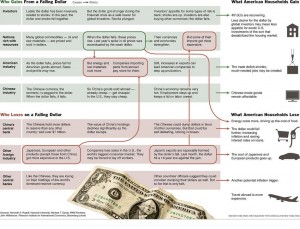
Last Sunday’s edition of The New York Times offered a nice graphic showing the household consequences of changes in the value of the dollar.
Around the Dial – Dec. 8
Economic policy reports, blog postings, and media stories of interest:
- The Baseline Scenario asks about the costs of not fixing the finance sector.
- In The New York Times, Robert Frank explains federal budget deficit math.
- Naked Capitalism wonders if Bank of America is gaming the taxpayers.
- The Times presents the need for extended jobless benefits.
What Does Temporary Hiring Mean?
Analysts have made much of the fact that temporary hiring has increased across the county in recent months. This trend, so the argument goes, suggests that the labor market is improving and presages permanent hiring on the art of employers.
Yet as an article in The San Francisco Chronicle asks, what if that assumption is wrong?
BLS economist Amar Mann said an analysis by the San Francisco office suggests that employers are getting more sophisticated about using temp hiring as a clutch to downshift into recessions and upshift into recoveries.
…
Mann said temp jobs started down a month after overall employment dropped during the 1990-91 recession. But by the 2001 downturn, employers started cutting temps about five months before they started issuing pink slips to the general workforce.
…
In the current recession, he said, companies began shedding temps 12 months before they started cutting permanent payrolls.
…
A similar pattern prevailed in the two prior recoveries, Mann said. Temp jobs came back at the same time as overall employment after the 1991 recovery. Temporary employment rebounded five months before the general job market turned positive following the 2001 dip.
…
If that pattern holds, it could be next summer before general payrolls start to grow.
…
Mann refused to speculate about the timing, but said temps are playing an increasing role in the job cycle.
…
“Employers are getting more savvy about using just-in-time labor on the way down and on the way up,” he said.
Imagining a Better South
The Center for a Better South, a nonprofit organization in Charleston, S.C., recently released an agenda for policy change in the South. The agenda is an outgrowth of discussion process that involved civic leaders drawn from across the South. The agenda focused on policy goals in the following areas:
- Nurturing economic development and education.
- Boosting wellness.
- Improving energy efficiency.
- Reforming taxes.
- Investing in infrastructure.
- Cultivating governance.
- Ensuring opportunities.
- Fostering safe communities.
 Email Sign-Up
 RSS Feed