

Around the Dial – Oct. 26
Economic policy reports, blog postings, and media stories of interest:
- Economist’s View blogs about the need for additional stimulus for state and local governments.
- The New York Times’ Paul Krugman battles “zombie fallacies” about the dollar’s value.
- Economix notes the 100th bank failure of the year.
- The Balance Sheet reports n the state of the U.S. Chamber of Commerce.
- The Winston-Salem Journal looks at the “12 in 6” program.
Missing the Work First Story
A weekend story in The News & Observer of Raleigh discussed changes to the work participation rules associated with the Work First program, North Carolina’s version of the federal Temporary Aid to Needy Families program. These alterations are needed to bring the state into compliance with recent changes in federal policy.
The N&O, however, missed the real story about Work First; namely, just how few adults receive assistance and how limited the program’s impact is.
According to data compiled by the UNC Jordan Institute for Families, North Carolina had 27,566 Work First cases (non-diversion) in September. These cases involved 52,062 individuals (approx. 0.6 percent of the state population). Of the total cases, 65 percent involved only children while children accounted for 82 percent of the individuals receiving assistance. Additionally, the median payment in September equaled $236. 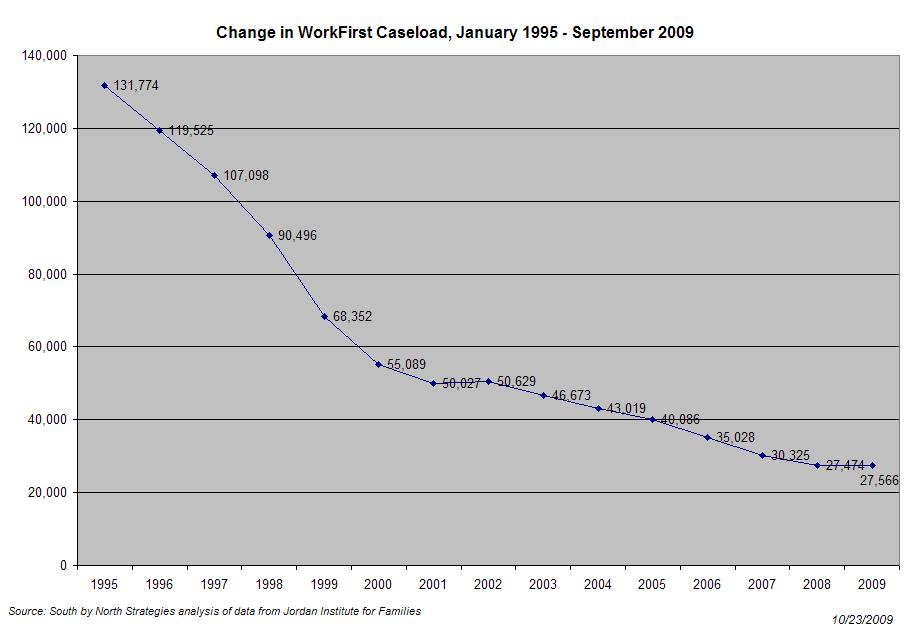
Since the “welfare reform” of the late 1990s, the Work First program has seen its significance as a social program decline sharply. The total caseload has fallen by 79 percent (graph, right), and the program now touches less than one percent of the state’s residents.
Additionally, the program is no longer reflective of larger economic conditions. Since the onset of the recession in December 2007 and September 2009, the monthly Work First caseload has remained relatively flat (down 0.3 percent).
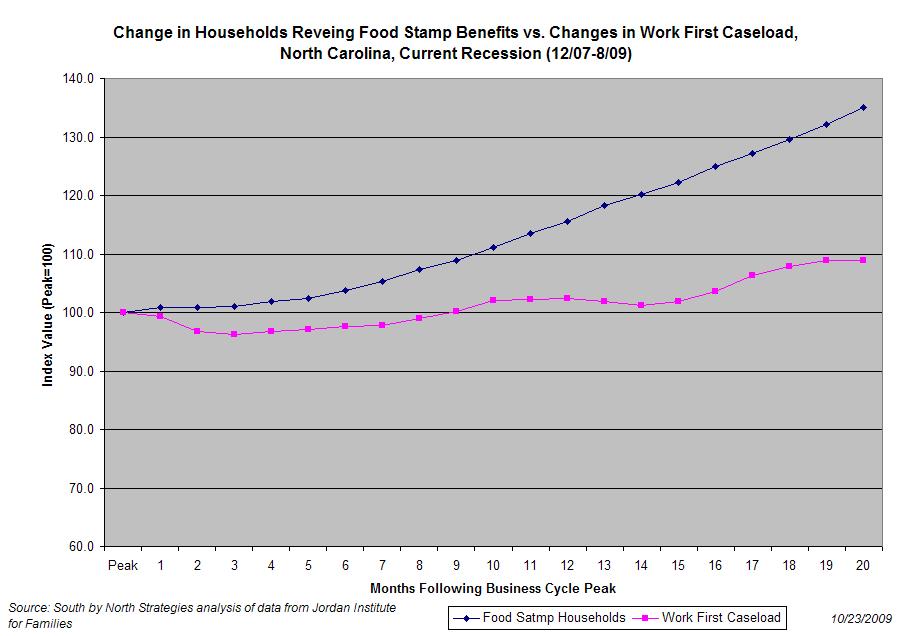 In contrast, the number of households receiving Food Stamp assistance has soared. Between the start of the recession and September 2009, the Food Stamp caseload grew by 35 percent. Last month, 1.3 million North Carolinians — approximately 14 percent of the state’s population — lived in a household receiving food assistance.
The disconnect between the directions of the Work First and Food Stamp caseloads (graph, above) illustrates just how small a role Work First plays in aiding families struggling with economic hardship.
Inequality as Public Policy
In a new paper, John Schmitt of the Center for Economic and Policy Research documents the deliberate public policy choices that have helped fuel rising levels of income inequality in the United States over the last 30 years. Argues Schmitt:
Each of the major policy initiatives of the last three decades claims to offer important efficiency advantages. The long decline in the inflation-adjusted value of the minimum wage was supposed to correct a distortion in the low-wage labor market. The deregulation (more accurately, re-regulation) of the airline, trucking, railway, financial, and telecommunications industries was supposed to lower consumer prices in those markets. The liberalization of foreign trade through a plethora of bilateral and multilateral trade agreements was similarly supposed to lower consumer prices on imported goods. The privatization of many federal, state, and local government functions – from school bus drivers to the administration of welfare policy and even much of the U.S. war in Iraq and Afghanistan – was supposed to lower the cost of government. The steady, policy-enabled, deterioration of unionization in the private sector – from over one-third of workers in the 1950s to about eight percent today – was supposed to improve the competitiveness of U.S. firms.
These policies, sold as ways to enhance national efficiency, however, also have another common thread. They all work to lower the bargaining power of workers relative to their employers. In many cases, the alleged efficiency gains have not materialized. In every case, the negative impact on workers has been obvious and substantial.
Economic Analysis Informs Media Coverage
South by North Strategies analysis of local employment data for September informed a variety of media stories, including the following:
- Asheville Citizen-Times: “Western North Carolina Unemployment Remains High”
- Greensboro News & Record: “September Jobless Rate Falls in NC”
- WCHL Radio: “September Unemployment Rate Holds Steady”
- High Point Enterprise: “Joblessness Moderates”
Weekend Wonk Out
A round-up of policy reports from the week ending on 10/23:
- The Workforce Strategy Center profiles highlights ways of helping low-income youth earn college credentials.
- The Center for Economic and Policy Research shows how to make Medicare drug benefits more cost efficient.
- Demos analyzes how adults in their 20s and 30s are faring in the recession.
- The U.S. Department of Labor studies the Trade Adjustment Assistance Act.
 Email Sign-Up
 RSS Feed