

Job Openings In July
From the Economic Policy Institute’s analysis of the July version of the Job Openings and Labor Turnover Survey (JOLTS) …
The July Job Openings and Labor Turnover Survey(JOLTS), released today by the Bureau of Labor Statistics, underscores the slow nature of the recovery. At 3.7 million, job openings in July were little changed from June. The number of unemployed workers in July was 12.8 million (unemployment data are from the Current Population Survey and can be found here), meaning that the “job-seekers ratio”—the ratio of unemployed workers to job openings—was 3.5-to-1. This is a slight increase from the 3.4-to-1 ratio in June.
…
While the ratio has been generally improving since reaching its peak of 6.7-to-1 in summer 2009, the odds are still stacked strongly against job seekers; the job-seekers ratio has been at 3-to-1 or above since September 2008. A job-seekers ratio above 3-to-1 means that there are simply no jobs for more than two out of three unemployed workers.
Around The Dial – September 10, 2012
Economic policy reports, blog postings, and media stories of interest:
- Matt Stoller rounds up “broken Democratic platform promises from 2008.”
- Simon Johnson mulls the relationship between government and enterprise.
- Working Economics graphs rising health care spending by seniors.
- Economist’s View highlights new data on economic mobility.
- Dean Baker rises to slay the structural unemployment zombie … again.
The Productivity-Wage Disconnect In NC
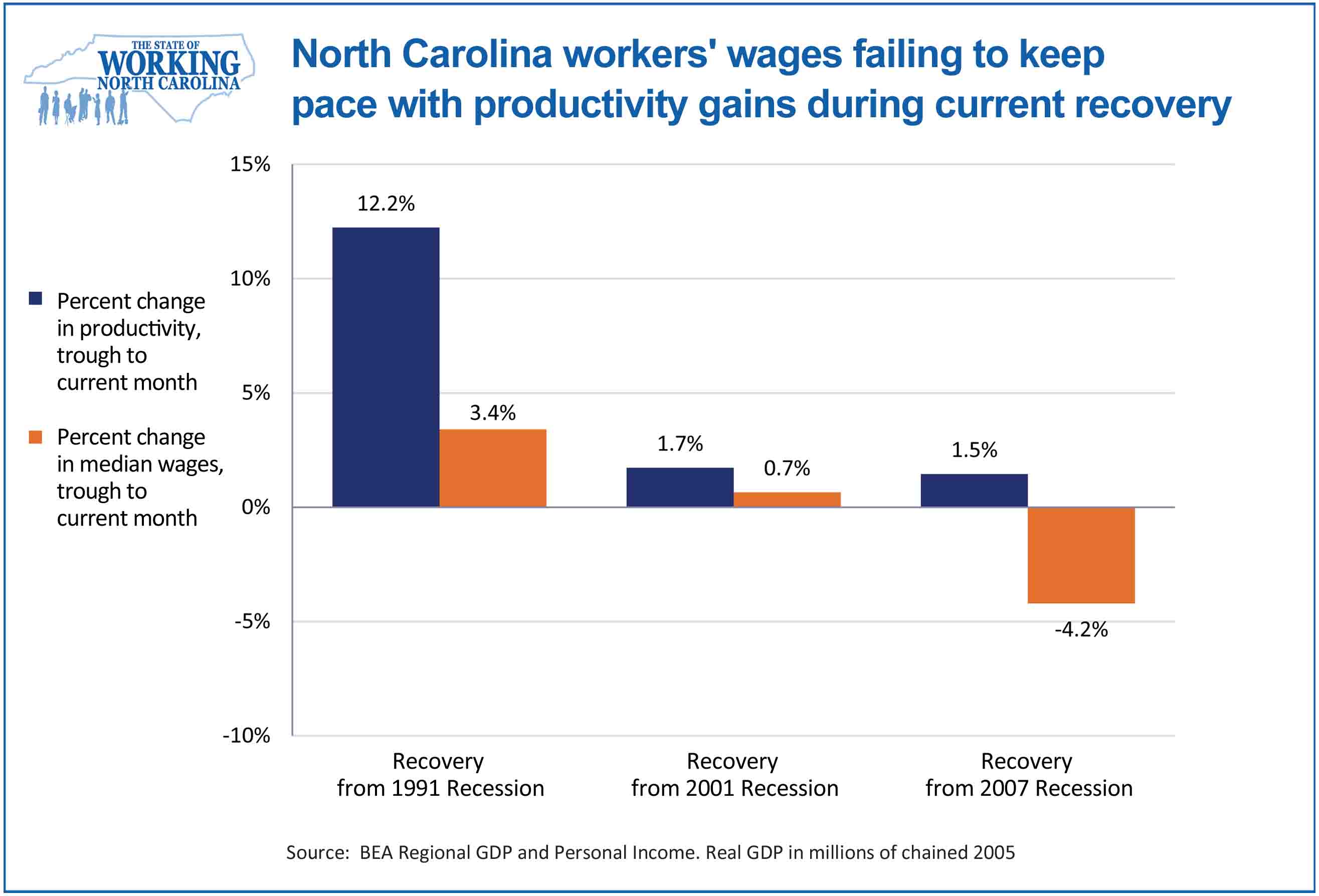
The latest State of Working North Carolina report graphs the troubling disconnect between worker productivity and worker wages. The study finds that “despite increasing productivity by 1.5 percent since the end of the Great Recession, North Carolina’s workers have seen their wages fall by 4 percent….”
Around The Dial – September 7, 2012
Economic policy reports, blog postings, and media stories of interest:
- The Atlantic blogs about the state of organized labor.
- Joseph Stiglitz argues for everyone to pay a fair share of public costs.
- Nancy Folbre sees “the twilight of the public corporation.”
- Rortybomb points out the consistency in the GOP’s economic policies.
A Lost Decade In North Carolina
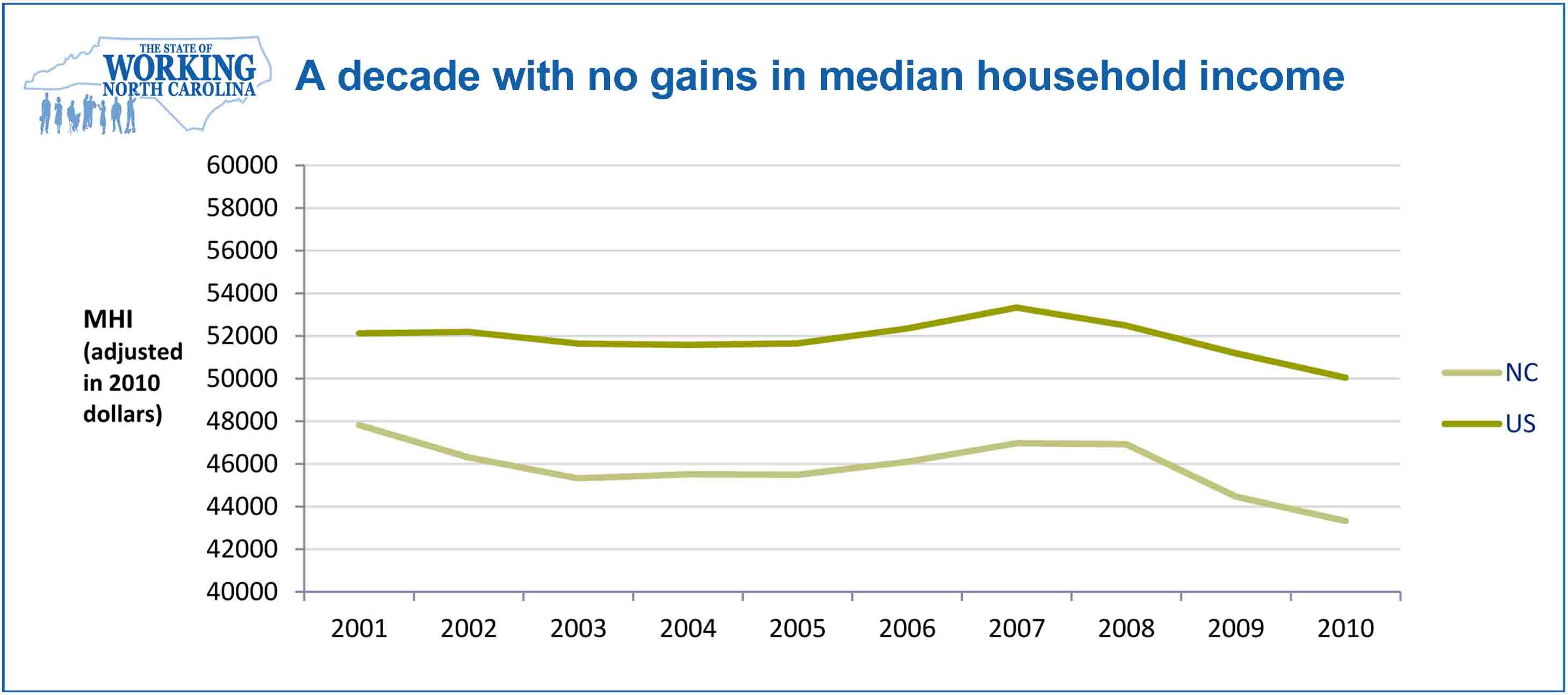
The State of Working North Carolina graphs the decline in median household income that occurred over the 2000s; as a result, “North Carolina households brought in less income at the end of the decade than they did at the beginning.”
 Email Sign-Up
 RSS Feed