

Around The Dial – August 2, 2012
Economic policy reports, blog postings, and media stories of interest:
- Paul Krugman worries about the future of the Euro.
- Robert Reich describes “the anti-election of 2012.”
- Nancy Folbre looks at ways of cutting skilled-labor costs.
- Stateline reports on state unemployment insurance loans.
- Jared Bernstein discusses the effects of cutting Social Security benefits.
NC Unemployment Claims: Week Of 7/14/12
For the benefit week ending on July 14, 2012, some 11,390 North Carolinians filed initial claims for state unemployment insurance benefits and 102,412 individuals applied for state-funded continuing benefits. Compared to the prior week, there were fewer initial and fewer continuing claims. These figures come from data released by the U.S. Department of Labor.
Averaging new and continuing claims over a four-week period — a process that helps adjust for seasonal fluctuations and better illustrates trends — shows that an average of 14,322 initial claims were filed over the previous four weeks, along with an average of 104,312 continuing claims. Compared to the previous four-week period, the average number of initial claims was higher, as was the average number of continuing claims .
One year ago, the four-week average for initial claims stood at 13,931, and the four-week average of continuing claims equaled 113,296.
In recent weeks covered employment has increased and now exceeds the level recorded a year ago (3.8 million versus 3.7 million). Nevertheless, there are still fewer covered workers than there were in January 2008, which means that payrolls are smaller today than they were over four years ago.
The graph shows the changes in unemployment insurance claims measured as a share of covered employment in North Carolina since the recession’s start in December 2007. 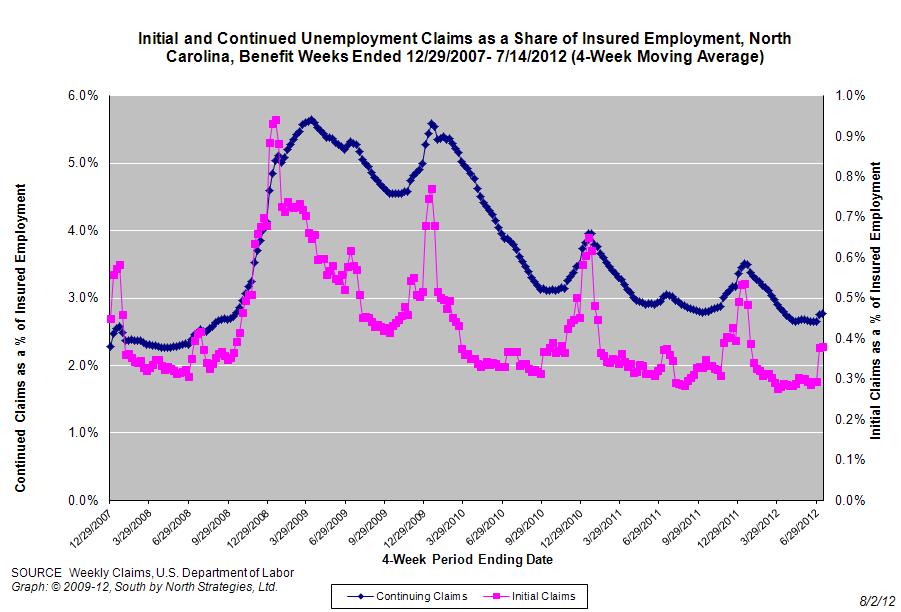
Both new and continuing claims appear to have peaked for this cycle, and the four-week averages of new and continuing claims have fallen considerably. Yet continuing claims remain at an elevated level, which suggests that unemployed individuals are finding it difficult to find new positions.
Picturing High Health Care Costs
A recent infographic prepared by the Center for American Progress documents the problem of high health care costs that troubles the United States.

Around The Dial – August 1, 2012
Economic policy reports, blog postings, and media stories of interest:
- Peter Edelman asks how to end poverty in America.
- The News & Record reports on rail service in North Carolina.
- Beat the Press lays out some facts about demographic change.
- Jared Bernstein mulls “food stamps, poverty, and the budget.”
- Matt Stoller looks at looming efforts to cut Social Security and Medicare.
Educational Levels And The Minimum Wage
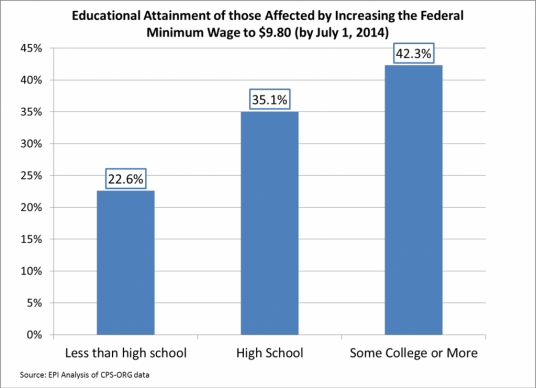
Working Economics graphs the educational attainment of the estimated 28 million workers who would benefit from an increase in the federal minimum wage to $9.80 by July 2014. Contrary to popular stereotypes, 42.3 percent of affected workers have completed at least some college, while 77.4 percent have completed high school or more.
 Email Sign-Up
 RSS Feed