

Around The Dial – July 26, 2012
Economic policy reports, blog postings, and media stories of interest:
- The American Prospect asks how to create “a countercyclical welfare system.”
- Betsy Stevenson and Justin Wolfers want “to put economics back into the economic debate.”
- Jared Bernstein looks at rising rates of poverty.
- Bruce Bartlett thinks about what GDP statistics tell us.
- Off the Charts says claims about small businesses and taxes are exaggerated.
Service Activity In The South Atlantic: July 2012
From the Federal Reserve Bank of Richmond’s latest survey of service-sector activity in the South Atlantic (District of Columbia, Maryland, North Carolina, South Carolina, Virginia and West Virginia):
Service sector activity weakened in July, according to the latest survey by the Federal Reserve Bank of Richmond. Shopper traffic dissipated and overall retail sales dropped, despite solid big-ticket sales. Retail inventories declined. The softness extended to non-retail services firms, where revenues also fell. Looking ahead six months, retail merchants remained unenthusiastic about sales. Services-providers’ expectations were subdued, compared to the previous month’s outlook.
…
Employment measures in the service sector also diminished in July. Survey participants reduced the number of employees at their establishments this month, and gains in average wages slowed.
..
Price increases in the broad service sector picked up somewhat this month. The six-month outlook for price change in the overall service sector was for faster price increases, compared to the current pace and to the outlook of a month ago.
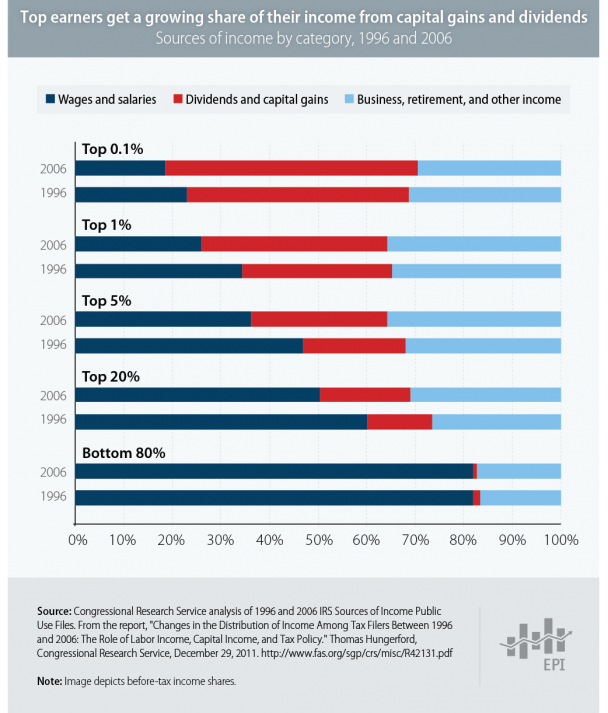
Show Us The Money
A new infographic from the Economic Policy Institute shows the sources from which various income groups derive their annual incomes. (Hint: the very rich are very different.)
Around The Dial – July 25, 2012
Economic policy reports, blog postings, and media stories of interest:
- Working Economics points out “the five serious flaws of Simpson-Bowles.”
- Nouriel Roubini isn’t bullish on the American economy.
- Nancy Folbre worries about “discouraged dads.”
- The AP reports that poverty is on track to reach a 50-year high.
- Randall Wray explains “why we’re screwed.”
Manufacturing In The South Atlantic: July 2012
From the Federal Reserve Bank of Richmond’s latest survey of manufacturing activity in the South Atlantic (District of Columbia, Maryland, North Carolina, South Carolina, Virginia and West Virginia):
The pullback in manufacturing activity in the central Atlantic region deepened in July, after edging lower in June, according to the Richmond Fed’s latest seasonally adjusted survey.* The index of overall activity was pushed lower as shipments and new orders declined further into negative territory. Employment remained in positive territory, but grew at a pace below June’s rate. Other indicators also suggested additional softness. District contacts reported that backlogs, capacity utilization, and delivery times continued to contract. Moreover, manufacturers reported that finished goods inventories grew at a much quicker pace, while raw materials were nearly unchanged.
…
Looking ahead, manufacturer’s optimism regarding future business prospects dropped considerably in July. An increasing number of firms anticipated slower growth across the board with the exception of capital expenditures, which grew at a pace slightly above June’s rate.
 Email Sign-Up
 RSS Feed