

Around The Dial – June 22, 2012
Economic policy reports, blog postings, and media stories of interest:
- The New York Times reports on public-sector employment trends.
- The Atlantic notes that kids are more expensive than they used to be.
- Simon Johnson worries about “predators and professors.”
- Off the Charts points out five facts about public employees.
- The Center for American Progress explains budget sequestration.
Local Unemployment Rates Fall Over The Year
CHAPEL HILL (June 22, 2012) – Between May 2011 and May 2012, unemployment rates fell in 88 of North Carolina’s 100 counties and in 13 of the state’s 14 metropolitan areas. Over that same period, labor force sizes contracted in 65 counties and in four metro areas. These findings come from new estimates prepared by the Labor and Economic Analysis Division of the North Carolina Department of Commerce.
“Local unemployment rates dropped across much of North Carolina over the past year, but unemployment nevertheless remains at distressingly high levels,” said John Quinterno, a principal with South by North Strategies, Ltd., a research firm specializing in economic and social policy. “While unemployment rates fell in 88 counties and 13 metros over the year, unemployment rates at or above 10 percent were found in 51 counties and in 2 metros.”
Compared to December 2007, which is when the economy fell into recession, North Carolina has 5.7 percent fewer jobs (-237,700) and has seen its unadjusted unemployment rate climb from 4.7 percent to 9.4 percent. In May, the state lost 16,500 more payroll jobs than it gained. Since bottoming out in February 2010, the state’s labor market has netted an average of roughly 3,281 jobs per month, resulting in a cumulative gain of 88,600 positions (+2.3 percent).
Between April and May, unemployment rates rose in 76 counties, and slightly more than half of all North Carolina counties posted unemployment rates of at least 10 percent. Individual county rates ranged from 5.2 percent in Currituck County to 16.9 percent in Scotland County. Compared to the prior month, unemployment rates were higher in 76 counties, lower in 21 counties, and unchanged in three counties.
“Non-metropolitan labor markets continue to struggle compared to metropolitan ones,” added Quinterno. “In May, 10.5 percent of the non-metro labor force was unemployed, compared to 9 percent of the metro labor force. Compared to December 2007, the non-metro labor force is now 1 percent smaller in size, while 6.2 percent fewer individuals are employed. Meanwhile, the number of unemployed rural persons has grown by 87.5 percent and now totals 139,221. Over the year, the non-metro labor force has declined by 1.7 percent, or 22,677 persons.”
Over the month, unemployment rates rose in 13 of the state’s 14 metro areas and fell in one metro (Burlington). Rocky Mount had the highest unemployment rate (12.5 percent), followed by Hickory-Morganton-Lenoir (10.9 percent). Durham-Chapel Hill had the lowest rate (7.4 percent), followed by Asheville (7.6 percent) and Raleigh-Cary (7.7 percent).
Compared to May 2011, unemployment rates were lower in 88 counties and 13 metros. Some 65 counties and four metros experienced declines in the sizes of their local labor forces. Among metros, Wilmington’s labor force contracted at the fastest rate (-2.6 percent), followed by Hickory-Morganton-Lenoir (-1 percent), Rocky Mount (-0.4 percent), and Charlotte (-0.1 percent). With those changes, metro areas now are home to 71.5 percent of the state’s labor force, with half of the labor force residing in the Triangle, Triad, and Charlotte metros.
In the long term, any meaningful recovery will hinge on economic and employment growth in the Charlotte, Research Triangle, and Piedmont Triad regions. Yet growth remains weak. Collectively, employment in these three metro regions has risen by just 0.6 percent since December 2007, and the combined May unemployment rate in the three regions equaled 8.8 percent. Of the three broad regions, the Research Triangle had the lowest unemployment rate (7.8 percent), followed by the Piedmont Triad (9.5 percent), and Charlotte (9.7 percent).
“Although local unemployment rates fell across much of the state over the past year, local labor markets remain far from healthy,” said Quinterno. “Unemployment rates remain elevated, and sizable numbers of North Carolinians remain jobless. The past year has witnessed noticeable drops in the sizes of local labor forces—drops that suggest that unemployment rates are declining due to people leaving the labor force rather than obtaining jobs.”
Around The Dial – June 21, 2012
Economic policy reports, blog postings, and media stories of interest:
- Matt Taibbi flags senators behaving embarrassingly before Wall St.
- Wolfgang Munchau asks what will happen in Europe if Germany gets its way.
- Matt Stoller sees more cynical moves from the Obama administration.
- Off the Charts sets “the record straight on Pells.”
- The Center for American Progress explains the benefits of the minimum wage.
Losing The Retirement Race
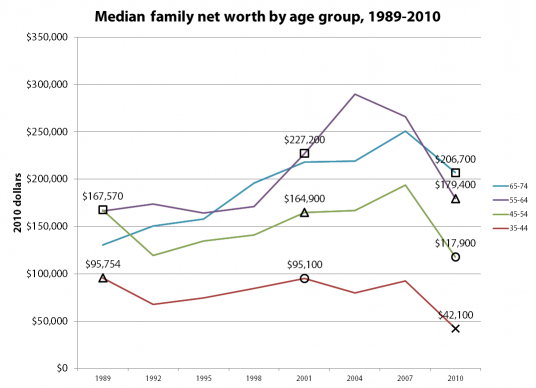
Working Economics graphs just how far behind American families of every age have fallen behind in saving for retirement.
Economists At Work
The PBS NewsHour recently profiled Nobel laureate economist Paul Krugman.
Watch Krugman’s Solution to Fiscal Stimulus? It Involves Aliens on PBS. See more from PBS NewsHour.
 Email Sign-Up
 RSS Feed