

Around The Dial – June 13, 2012
Economic policy reports, blog postings, and media stories of interest:
- Robert Kuttner wonders why policymakers are ignoring top economists.
- James Kwak notes the GOP’s “passion for raising taxes on the poor.”
- Jared Bernstein explains the importance of the labor force participation rate.
- Felix Salmon lays out “how the middle class enables the ultra-rich.”
- Joseph Stiglitz identifies “the price of inequality.”
A Crisis Ignored
Writing in The Fiscal Times, economist Mark Thoma asks why policymakers aren’t more concerned about unemployment.
The imbalance in political power, obstructionism from Republicans designed to improve their election chances, and attempts by Republicans to implement a small government ideology are a large part of the explanation for why the unemployed aren’t getting the help they deserve.
…
But Democrats aren’t completely off the hook either. Centrist Democrats beholden to big money interests are definitely a problem, and Democrats in general have utterly failed to bring enough attention to the unemployment problem. Would these things happen if workers had more political power?
…
When we talk about leveling the playing field, it is generally in terms of economic opportunity. However, leveling the political playing field is just as important, and in the past unions provided workers with a powerful voice in the political arena. But unions have largely faded from the scene, leaving workers with very little organized power. Correcting the political imbalance this has created through the renewed political empowerment of the working class must be part of any attempt to improve our response to serious recessions.
Making Performance Funding Work For All
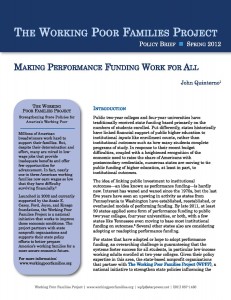 States traditionally have tied funding for two- and four-year colleges and universities to student enrollment. Yet in recent years, prompted by state budget constraints and the need to increase the number of Americans with postsecondary credentials, states have begun tying public funding to an array of student outcomes–an approach known as performance funding.
In early 2012, The Working Poor Families Project, a national initiative to strengthen state policies influencing the well-being of low-income working families, commissioned South by North Strategies, Ltd. to prepare a policy brief summarizing the current state of performance funding.
The resulting report provides an overview of performance funding in the states, highlighting the importance of performance funding systems that cover all students, including non-traditional students, and values their progress and success in determining institutional funding. The brief concludes with policy recommendations for state policy organizations interested in ensuring that performance funding works for all students.
Around The Dial – June 12, 2012
Economic policy reports, blog postings, and media stories of interest:
- Off the Charts proposes four ways of bettering the TANF program.
- The Progressive Pulse graphs drops in funding for early care and education in NC.
- George Soros contemplates the future of the Eurozone.
- Policy Shop explains the failures of the 401(k) system.
- Naked Capitalism links to a debunking of the writer Malcolm Gladwell.
Public Payrolls Continue To Shrink
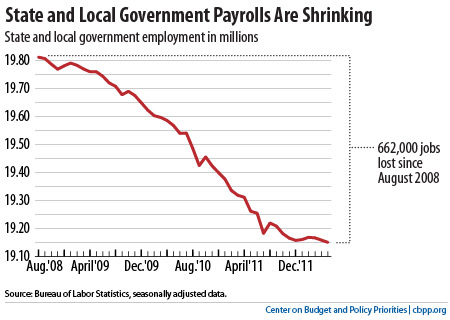
Off the Charts traces the ongoing contraction of the payrolls of state and local governments.
 Email Sign-Up
 RSS Feed