

State Job Market Weakens In May
CHAPEL HILL (June 15, 2012) – Labor market conditions in North Carolina deteriorated in May, with the state losing 16,500 more jobs than it gained. This marked the third consecutive month of negative job growth in the state. While the statewide unemployment rate remained at the lowest level recorded since early 2009, the steady rate resulted from a contraction in the size of the labor force. These findings come from new data released by the Labor and Economic Analysis Division of the NC Department of Commerce.
“Key labor force indicators in North Carolina have weakened over the course of 2012,” said John Quinterno, a principal with South by North Strategies, Ltd., a research firm specializing in economic and social policy. “The state recorded gains in jobs in January and February, but growth has since turned negative. Over the past three months, the labor market has given back more than three-fourths of the gains logged earlier in the year.”
In May, North Carolina employers cut 16,500 more jobs than they added (- 0.4 percent). This was the largest monthly decline in absolute terms since June 2009. Last month, private-sector payrolls fell by 15,800 positions (-0.5 percent), and public-sector employment levels dipped by 700 positions (-0.1 percent). Within the private sector, professional and business services shed the most jobs (-7,000, -1.3 percent) due to sizable payroll reductions in the administrative and waste management subsector. The construction industry lost 4,800 jobs (-2.8 percent), followed by leisure and hospitality services (-3,600, -0.9 percent) and education and health services (-2,600, -0.5 percent). The trade, transportation, and utilities sector gained the most jobs (+1,900, +0.3 percent), followed by manufacturing, which netted 400 jobs (+0.1 percent).
A negative revision to the April payroll data found that the state lost 2,600 more jobs than first reported (-3,900 versus -1,300). With that revision, North Carolina now has, on net, 237,700 fewer payroll positions (-5.7 percent) than it did in December 2007. Since bottoming out in February 2010, the state has netted an average of 3,281 payroll jobs per month, resulting in a cumulative gain of 88,600 positions (+2.3 percent).
“Over the past few years, North Carolina had succeeded in closing some of the job gap caused by the recent recession,” noted Quinterno. “Over the past three months, however, the state’s labor market has given back a portion of those modest gains. Compared to December 2007, North Carolina has fewer payroll jobs in every major private industry sector except for educational and health services and professional and business services.”
The household data for May also point to a stagnant labor market. While the unemployment rate held constant at 9.4 percent, the steady rate was tied to a contraction in the size of the labor force. Over the month, the size of the labor force fell by 9,478 individuals (-0.2), driven by drops in both the numbers of employed persons (-5,803, -0.1 percent) and unemployed persons (-3,675, -0.8 percent) in the state.
While the unemployment rate of 9.4 percent is the lowest one recorded in the state since early 2009, unemployment remains widespread across North Carolina. Not only is the statewide unemployment rate 4.4 percentage points greater than it was almost 4.5 years ago, but the number of unemployed Tar Heels also is 90.6 percent higher.
To place the scale of unemployment in context, consider how the number of unemployed North Carolinians in May (435,908) exceeded the total population of the City of Raleigh, which was the state’s second most populous municipality in 2010. Furthermore, the number of people added to the unemployment rolls since 2007 (+207,188) is roughly equivalent to the population of the City of Fayetteville, which was the state’s sixth most populous city in 2010.
Other troubling labor market indicators include a statewide unemployment rate that has exceeded 10 percent in 35 of the last 41 months and the fact that the labor force participation rate has fallen steadily since January. Similarly, the share of the adult population with a job remains at a depressed level.
“North Carolina’s job market began 2012 on a positive note yet has been unable to maintain that momentum,” observed Quinterno. “The state has experienced negative net job growth for the past three months and has given back the bulk of the gains recorded earlier in the year. As has been the case for the past several years, the jobs data call out for policymakers to change course and pay considerably more attention to the ongoing, slow-moving crisis in the labor market.”
The Recovery Act At Work: Anti-Poverty Edition
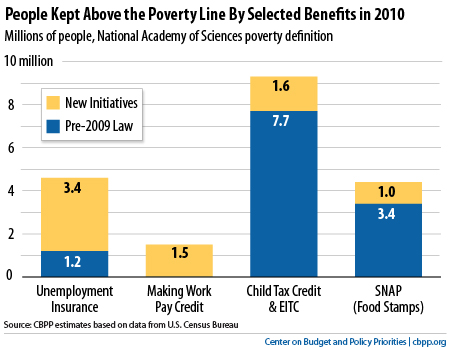
Off the Charts explains how six aspects of the American Recovery and Reinvestment Act alone kept 6.9 million Americans out of poverty in 2010.
Around The Dial – June 14, 2012
Economic policy reports, blog postings, and media stories of interest:
- Economix notes “America’s hidden austerity program.”
- The NC Budget & Tax Center analyzes the proposed House budget.
- John Cassidy explains that “we are all still Keynesians.”
- Mohamed El-Erian asks if America is “healing fast enough.”
NC Unemployment Claims: Week Of 5/26/12
For the benefit week ending on May 26, 2012, some 9,048 North Carolinians filed initial claims for state unemployment insurance benefits and 99,177 individuals applied for state-funded continuing benefits. Compared to the prior week, there were fewer initial and fewer continuing claims. These figures come from data released by the U.S. Department of Labor.
Averaging new and continuing claims over a four-week period — a process that helps adjust for seasonal fluctuations and better illustrates trends — shows that an average of 11,204 initial claims were filed over the previous four weeks, along with an average of 100,624 continuing claims. Compared to the previous four-week period, the average number of initial claims was lower, and the average number of continuing claims was higher.
One year ago, the four-week average for initial claims stood at 11,636, and the four-week average of continuing claims equaled 107,855.
In recent weeks covered employment has increased and now exceeds the level recorded a year ago (3.76 million versus 3.71 million). Nevertheless, there are still fewer covered workers than there were in January 2008, which means that payrolls are smaller today than they were over four years ago.
The graph shows the changes in unemployment insurance claims measured as a share of covered employment in North Carolina since the recession’s start in December 2007. 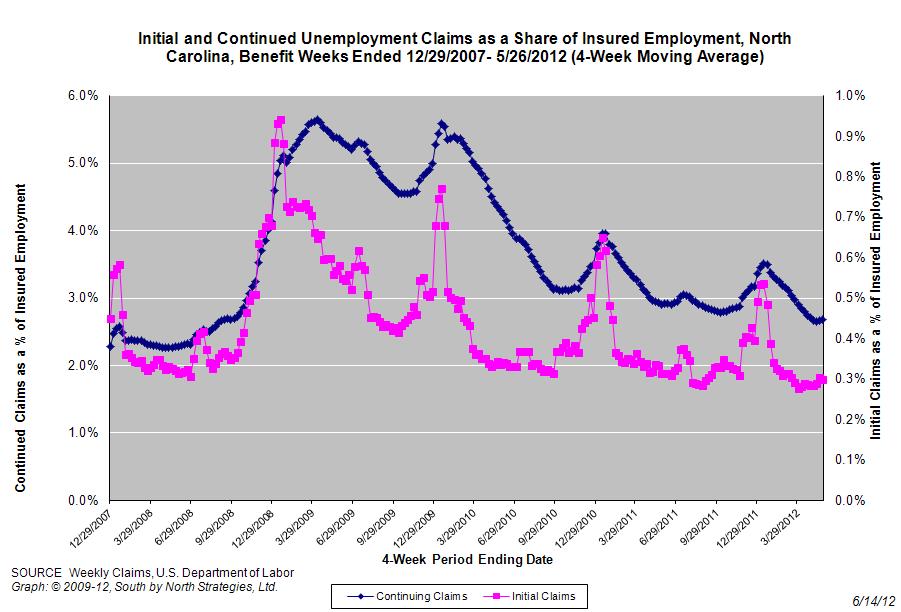
Both new and continuing claims appear to have peaked for this cycle, and the four-week averages of new and continuing claims have fallen considerably. Yet continuing claims remain at an elevated level, which suggests that unemployed individuals are finding it difficult to find new positions.
The Weight Of Student Loan Debt
The PBS NewsHour reports on the problems with student loan debt.
Watch Student Loans: More Debt, More Defaults, More Problems on PBS. See more from PBS NewsHour.
 Email Sign-Up
 RSS Feed