

NC Unemployment Claims: Week of 3/17/12
For the benefit week ending on March 17, 2012, some 9,895 North Carolinians filed initial claims for state unemployment insurance benefits and 108,769 individuals applied for state-funded continuing benefits. Compared to the prior week, there were fewer initial and continuing claims. These figures come from data released by the U.S. Department of Labor.
Averaging new and continuing claims over a four-week period — a process that helps adjust for seasonal fluctuations and better illustrates trends — shows that an average of 11,354 initial claims were filed over the previous four weeks, along with an average of 113,785 continuing claims. Compared to the previous four-week period, the average number of initial claims was lower, as was the average number of continuing claims.
One year ago, the four-week average for initial claims stood at 12,907, and the four-week average of continuing claims equaled 124,835.
In recent weeks covered employment has increased and now slightly exceeds the level recorded a year ago (3.74 million versus 3.71 million). Nevertheless, there are still fewer covered workers than there were in January 2008, which means that payrolls are smaller today than they were four years ago.
The graph shows the changes in unemployment insurance claims measured as a share of covered employment in North Carolina since the recession’s start in December 2007. 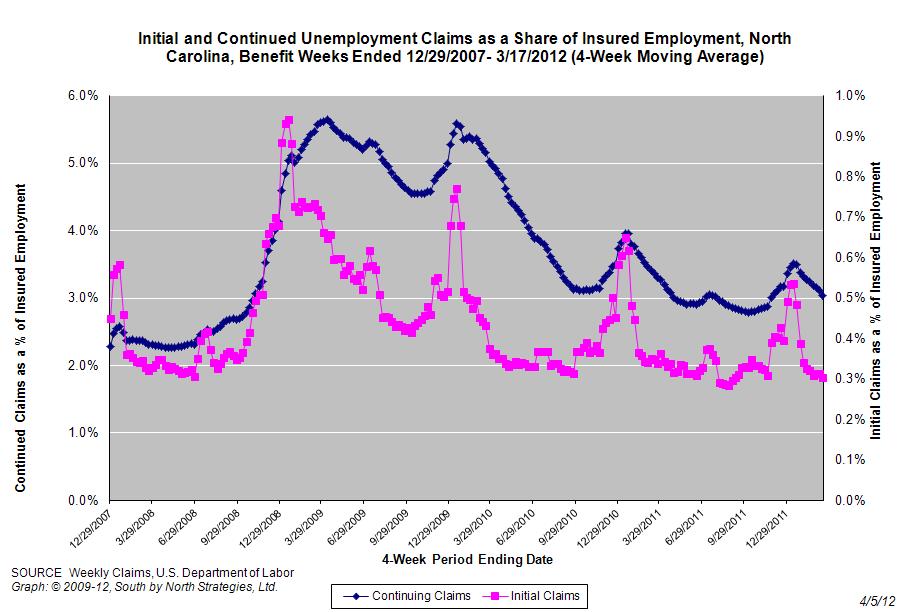
Both new and continuing claims appear to have peaked for this cycle, and the four-week averages of new and continuing claims have fallen considerably. Yet continuing claims remain at an elevated level, which suggests that unemployed individuals are finding it difficult to find new positions.
The Great Cost Shift
 Completed in early 2012 for Demos, a public policy organization in New York City, The Great Cost Shift: How Higher Education Cuts Undermine The Future Middle Class, examines how state disinvestment in public higher education over the past two decades has shifted costs to students and their families. Such disinvestment has occurred alongside rapidly rising enrollments and demographic shifts that are yielding more economically, racially, and ethnically diverse student bodies. As a result students and their families now pay—or borrow—a lot more for a college degree or are getting priced out of an education that has become a requirement for getting a decent job and entering the middle class.
The study traces trends in the size and composition of the young adult population and analyzes patterns in state support for public higher education over the past two decades. Trends in tuition and financial aid are also examined and policy recommendations are presented for ways to renew America’s commitment to nurturing a strong and inclusive middle class through investments in public higher education.
Reminder: Research Forum On College Afforability
Over the winter, South by North Strategies, Ltd. conducted research into changes in state support in public higher education from 1990 onward for Demos, a national public policy organization based in New York City.
The forthcoming report, entitled The Great Cost Shift in Higher Education, will be the subject of a forum to be held at North Carolina Central University in Durham at 7:30 p.m. on April 4, 2012. The event, which will feature South by North Strategies’ research, is being sponsored by Demos, the NC Justice Center, the Campaign for Young America, and NC Central University.
Click here to register for the event, which will take place in the Alfonso Elder Student Union on the campus of NC Central University (campus map).
Around The Dial – April 3, 2012
Economic policy reports, blog postings, and media stories of interest:
- Crooked Timber notes that “socialism for the rich” is a joke become real.
- Felix Salmon argues that the financial payment system in the US is broken.
- Paul Krugman writes about “pink slime economics.”
- The News & Observer reports on the state of workers compensation in NC.
- Calculated Risk points out that seniors owe $36 billion in student loans.
Sinking Despite A Rising Tide
The Brookings Institution graphs changes in the share of total income received by those in the bottom 10 percent of the income distribution compared to those in the top 10 percent from 1945 to 2008. Since 1975, the gap between the two groups has widened considerably.

 Email Sign-Up
 RSS Feed