

Job Growth Slows, Unemployment Falls in February
CHAPEL HILL (March 30, 2012) – The pace of job growth in North Carolina slowed in February, while the statewide unemployment rate fell below 10 percent for the first time in three years. Yet unemployment remains elevated with the current rate of job growth insufficient to close the job gap anytime soon. These findings come from new data released by the Labor and Economic Analysis Division of the NC Department of Commerce.
“The rate of job growth slowed in February, rising by 0.2 percent compared to a 0.6 percent rate of growth in January,” said John Quinterno, a principal with South by North Strategies, Ltd., a research firm specializing in economic and social policy. “Last month, the labor force expanded, the number of employed persons rose, and both the number of unemployed persons and the share of the labor force that was jobless fell. The share of the adult population with a job, though still extremely depressed, also rose to the highest level recorded since August 2009.”
In February, North Carolina employers added 8,300 more payroll jobs than they cut. Net gains occurred largely in the public sector (+5,600), though the private sector netted 2,700 jobs. Within the private sector, leisure and hospitality services added the most jobs in absolute terms (+1,900, driven almost entirely by gains in the accommodation and food services subsector). Professional and business services netted 1,600 positions with the gains concentrated in the professional, scientific, and technical services subsector. Education and health services also gained 1,400 positions. Meanwhile, other services shed the most positions (-1,300), followed by construction (-600) and manufacturing (-300).
A positive revision to the January 2012 labor market data found that the state gained 4,900 more jobs than first reported (+21,900 versus +17,000). North Carolina now has, on net, 214,300 fewer positions (-5.1 percent) payroll jobs than it did in December 2007. Since bottoming out in February 2010, the state has netted an average of roughly 4,700 payroll jobs per month, resulting in a cumulative gain of 112,000 positions (+2.9 percent).
“Over the past two years, North Carolina has logged some progress in closing the job gap caused by the recent recession with the past six months or so witnessing some welcome improvements,” noted Quinterno. “When compared to December 2007, North Carolina still has fewer payroll jobs in every major private industry sector except for educational and health services and professional and business services. At current rates of growth, a full recovery in the labor market remains elusive.”
The household data for February also point to a weak labor market. Positively, North Carolina experienced an increase in the size of the labor force (+5,287, +0.1 percent, as well as a rise in the number of employed North Carolinians (+16,813, +0.4 percent). The number of unemployed persons fell (-11,526, -2.4 percent), as did the unemployment rate. February also marked the first time since March 2010 that the statewide unemployment rate was below 10 percent.
Joblessness remained widespread in February. There were over twice as many unemployed North Carolinians in February 2012 as there were in December 2007, and the statewide unemployment rate was 4.9 percentage points greater than it was more than four years ago. And, the monthly statewide unemployment rate has exceeded 10 percent in 35 of the last 36 months.
“New data suggest that North Carolina’s labor market has experienced some real improvements over the past few months,” observed Quinterno. “At the same time, conditions remain alarmingly bad by any objective or historical measure. Recent improvements do not alter the facts that a shockingly high share of the labor force remains without work and that the economy is not adding positions quickly enough to accommodate all those who need jobs.”
Insurance For Its Own Sake
James Kwak points out that health insurance has a value as insurance, meaning security against illness and financial loss, even if someone who is insured is fortunate enough never to become ill and draw on a policy.
…Health insurance, like any kind of insurance, can be framed after the fact as redistribution. You pay health insurance premiums, you stay healthy, and therefore you “lose”—your money goes to pay for other people’s losses. But this is true of any kind of insurance….
…
The other way to think of insurance is, well, as insurance. We want and value insurance in the current period, before we know if we’ll be “winners” or “losers” in the future period. The insurance itself has value to us. In fact, whenever you buy insurance, you are hoping that you will end up as a loser.
…
The framing of the health care individual mandate as a transfer from the healthy to the sick is the exact same as the framing of tax-funded social insurance programs as a transfer from the rich to the poor. At the time you enter the system, you probably don’t know which category you will fall into. You might have some knowledge of the probabilities, but you could turn out to be very wrong: there are plenty of people who are healthy in their twenties but get very sick later. In either case, the framing as redistribution and the focus on winners and losers is a way of making something that all people value—protection from risk, backed by the federal government’s balance sheet—seem like a from of zero-sum redistribution brokered by that evil, meddling federal government.
Around The Dial – March 29, 2012
Economic policy reports, blog postings, and media stories of interest:
- E.J. Dionne points out that Supreme Court conservatives are acting as judicial activists.
- Economix traces the long-term consequences of unemployment.
- Brad DeLong gazes at “the shadow of depression.”
- WRAL.com reports on the use of film incentives in North Carolina.
- Econbrowser considers the reasons for high oil prices.
NC Unemployment Claims: Week of 3/10/12
For the benefit week ending on March 10, 2012, some 11,551 North Carolinians filed initial claims for state unemployment insurance benefits and 113,250 individuals applied for state-funded continuing benefits. Compared to the prior week, there were fewer initial and continuing claims. These figures come from data released by the U.S. Department of Labor.
Averaging new and continuing claims over a four-week period — a process that helps adjust for seasonal fluctuations and better illustrates trends — shows that an average of 11,739 initial claims were filed over the previous four weeks, along with an average of 116,323 continuing claims. Compared to the previous four-week period, the average number of initial claims was lower, as was the average number of continuing claims.
One year ago, the four-week average for initial claims stood at 13,058, and the four-week average of continuing claims equaled 126,768.
In recent weeks covered employment has increased and now slightly exceeds the level recorded a year ago (3.74 million versus 3.71 million). Nevertheless, there are still fewer covered workers than there were in January 2008, which means that payrolls are smaller today than they were four years ago.
The graph shows the changes in unemployment insurance claims measured as a share of covered employment in North Carolina since the recession’s start in December 2007. 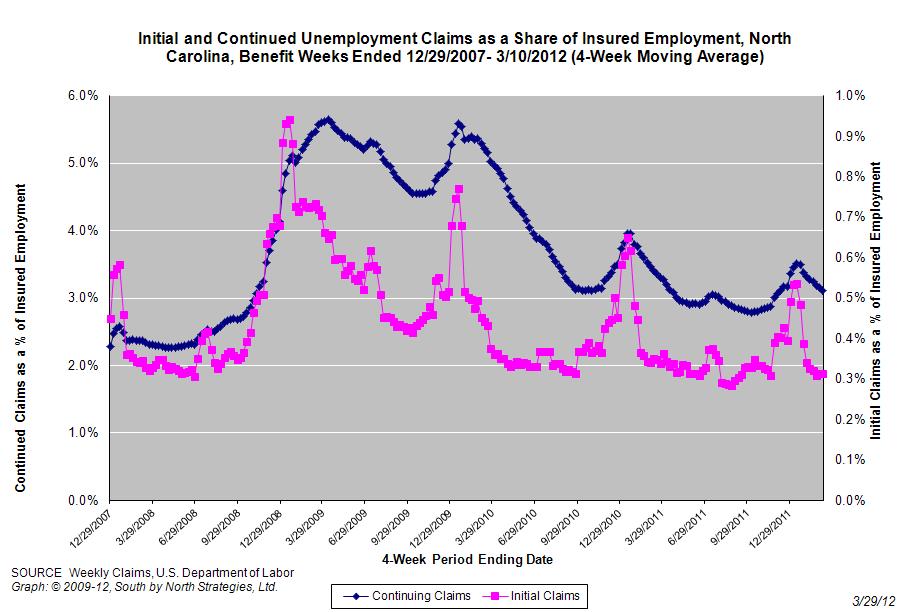
Both new and continuing claims appear to have peaked for this cycle, and the four-week averages of new and continuing claims have fallen considerably. Yet continuing claims remain at an elevated level, which suggests that unemployed individuals are finding it difficult to find new positions.
Service Activity In The South Atlantic: March 2012
From the Federal Reserve Bank of Richmond’s latest survey of service-sector activity in the South Atlantic (District of Columbia, Maryland, North Carolina, South Carolina, Virginia and West Virginia):
Activity in the service sector strengthened in March, according to the latest survey by the Federal Reserve Bank of Richmond. Retail sales accelerated and revenues at non-retail services firms also rose sharply. Retail shopper traffic surged and big-ticket sales expanded, while merchants’ inventories flattened. Looking ahead six months, survey respondents were decidedly optimistic about demand for their goods and services.
…
On the labor front, retail hiring and average wages slowed, while employment and average wages at non-retail firms picked up.
…
Price growth in the broad service sector edged up in March, and survey participants generally expected further acceleration during the next six months.
 Email Sign-Up
 RSS Feed