

Concentrated Poverty In North Carolina
A new report from the N.C. Budget and Tax Center traces the extent of concentrated poverty across the state.
In 2006-2010, there were 2,195 census tracts and 9,013,443 million people living in North Carolina. 100 census tracts were concentrated-poverty neighborhoods, representing roughly 1 of 22 neighborhoods in the state. Of the 293,135 residents living in these neighborhoods, 143,445 residents lived below the federal poverty level—which is nearly 104,000 more than the 39,632 poor residents in 2000. The concentrated poverty rate—the proportion of all poor people residing in a concentrated-poverty neighborhood—was 10.2 percent in 2006-2010, up 6.1 percentage points since 2000 when the concentrated poverty rate was 4.1 percent.
…
The 100 concentrated-poverty neighborhoods were located in only 30 of the state’s 100 counties, with the largest share located in Guilford and Mecklenburg counties. Of these 100 neighborhoods, 63 were in urban counties, with the remaining 37 located in rural counties. The largest share of people who were poor within these 100 neighborhoods were also clustered in Guilford and Mecklenburg counties….
Around The Dial – March 19, 2012
Economic policy reports, blog postings, and media stories of interest:
- Uwe Rheinhardt argues for taxing capital gains like ordinary income.
- Naked Capitalism points out another example of the need for regulation.
- Off the Charts explains why good jobs reports aren’t enough.
- David Cay Johnston writes on how “the richest get richer.”
Minimum Wage Is “Too Damn Low”
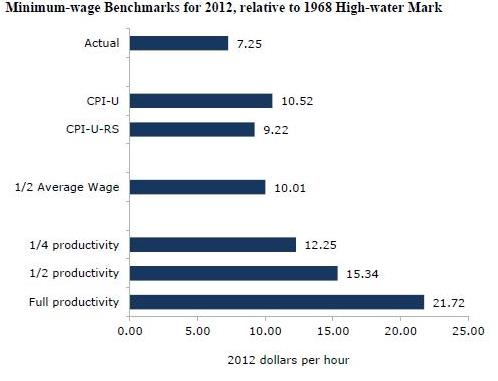
A new issue brief from the Center for Economic and Policy Research points out that by a variety of measures –inflation, wage growth, and productivity increases — the minimum wage of $7.25 is “too damn low” relative to 1968, the year in which the minimum wage had its peak value.
Around The Dial – March 16, 2012
Economic policy reports, blog postings, and media stories of interest:
- Talking Points Memo tells “a tale of two economies.”
- Jamie Surowiecki sees some positive economic data.
- Simon Johnson describes “when populism is sound.”
 Email Sign-Up
 RSS Feed