

Democratic Inequality
Raghuram Rajan summarizes new research that connects income inequality with pre-crisis economic policy.
This is one of the first detailed studies of the adverse effects of income inequality that I have seen. It goes beyond the headline-grabbing “1%” debate to show that even the everyday inequality that most Americans face – between the incomes of, say, typical readers of this commentary and the rest – has deep pernicious effects.
…
Equally interesting is the link that the study finds between income inequality and pre-crisis economic policy. Republican Congressmen from districts with higher levels of income inequality were more likely to vote for legislation to expand housing credit to the poor in the years before the crisis (almost all Democrats voted for such legislation, making it hard to distinguish their motives). And the effect of spending by the rich on non-rich households’ spending was higher in areas where house prices could move more, suggesting that housing credit and the ability to borrow against rising home equity may have supported over-consumption by the non-rich.
Around The Dial – March 15, 2012
Economic policy reports, blog postings, and media stories of interest:
- Fed Watch recaps this week’s FOMC meeting.
- The Economic Policy Institute worries about the low quit rate.
- Off the Charts explains the weakening of the TANF safety net.
- The Baseline Scenario asks exactly who is a “freeloader.”
NC Unemployment Claims: Week of 2/25/12
For the benefit week ending on February 25, 2012, some 11,749 North Carolinians filed initial claims for state unemployment insurance benefits, and 117,629 individuals applied for state-funded continuing benefits. Compared to the prior week, there were more initial and fewer continuing claims. These figures come from data released by the U.S. Department of Labor.
Averaging new and continuing claims over a four-week period — a process that helps adjust for seasonal fluctuations and better illustrates trends — shows that an average of 11,549 initial claims were filed over the previous four weeks, along with an average of 119,452 continuing claims. Compared to the previous four-week period, the average number of initial claims was lower, as was the average number of continuing claims.
One year ago, the four-week average for initial claims stood at 12,762, and the four-week average of continuing claims equaled 131,225.
In recent weeks covered employment has increased and now slightly exceeds the level recorded a year ago (3.74 million versus 3.71 million). Nevertheless, there are still fewer covered workers than there were in January 2008, which means that payrolls are smaller today than they were four years ago.
The graph shows the changes in unemployment insurance claims measured as a share of covered employment in North Carolina since the recession’s start in December 2007. 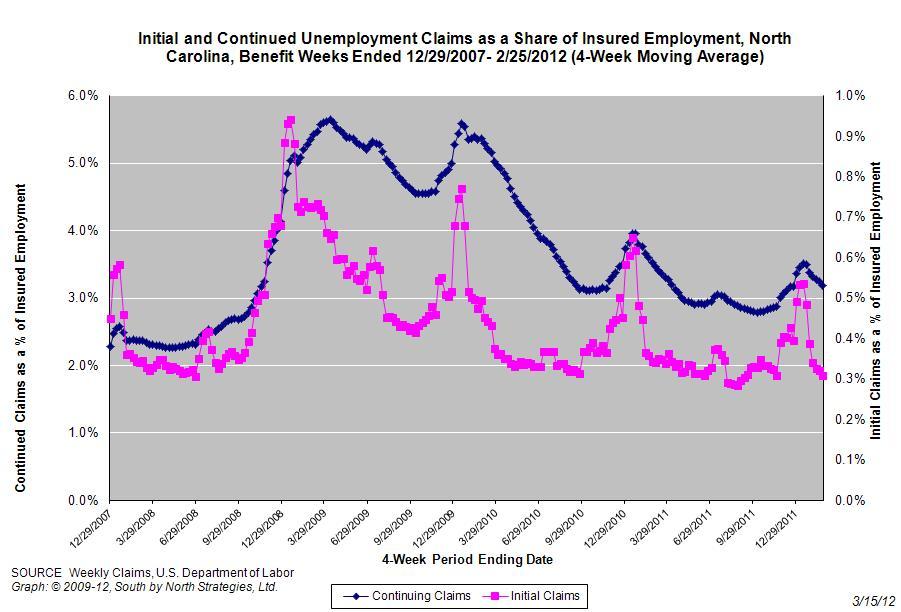
Both new and continuing claims appear to have peaked for this cycle, and the four-week averages of new and continuing claims have fallen considerably. Yet continuing claims remain at an elevated level, which suggests that unemployed individuals are finding it difficult to find new positions.
Poverty Among Veterans
The Center for American Progress summarizes the challenges, including the risks of becoming poor and homeless, that face returning veterans. From the analysis …
In order to support our veterans, policymakers must act to create jobs and protect the safety net from cuts to programs such as veteran housing and employment services, SNAP/food stamps, and the Low Income Home Energy Assistance Program. These programs and other services help struggling veterans and nonveterans alike get back on their feet. America must continue to honor and protect those who defend us by providing the support and resources necessary to help them find stability and opportunity.
Around The Dial – March 14, 2012
Economic policy reports, blog postings, and media stories of interest:
- Rortybomb analyzes gender patterns in employment.
- Free Exchange looks at the problems with measuring employment.
- Off the Charts takes down “the myth of the non-paying 47 percent.”
- Joseph Stiglitz notes that “the US labour market is still a shambles.”
- The Baseline Scenario points out that “Americans like regulations.”
 Email Sign-Up
 RSS Feed