

No Rebound For NC Job Market In 2011
CHAPEL HILL (February 10, 2012) – North Carolina’s labor market experienced modest payroll employment growth in 2011, netting a total of 19,600 jobs (+0.5 percent). With such restrained growth, little progress was made against joblessness. The state ended the year with more unemployed workers and a higher unemployment rate than it had one year earlier.
These findings come from a year-end review of labor market conditions released today by South by North Strategies, Ltd., a research firm specializing in economic and social policy. Available at Policy Points, the firm’s blog, the year-end review summarizes the major labor market trends of 2011.
“North Carolina netted more jobs in 2011 than in 2010, but the growth was insufficient to recover much of the ground lost during the recession,” said John Quinterno, a principal with South by North Strategies.”2011 was a ‘good’ year relative to the dismal standards of the recent past, but the performance of the labor market remained unimpressive when measured against any objective yardstick. Not only did North Carolina have fewer jobs in December 2011 than it did in December 2007, when the national recession began, but it also had fewer jobs than it did in December 1999. North Carolina simply has logged no net job growth over the last 12 years.”
The review notes that, on a number of indicators, the state’s labor market made little progress in 2011. While private-sector employment grew slightly, sizable reductions in public-sector payrolls offset one-third of the net gain. Even then, the private sector did not grow enough to put a perceptible dent in the monthly unemployment rate, which averaged 10 percent for the year.
“Economic hardship remained widespread in 2011,” added Quinterno. “Nearly 18 of every 100 members of the state’s labor force were underemployed due to the relative scarcity of job openings.”
The review expresses particular concern about the decline of the employment-to-population ratio to its lowest level since 1976, the prospects of the long-term unemployed, and the struggles facing families trying to make ends meet in the wake of job losses. The review notes, for example, that in October 2011, the most recent month with data, 17.6 percent of the state’s population was participating in the Supplemental Nutrition Assistance Program (formerly known as food stamps). The number of participants has grown by 79.2 percent since December 2007, as job losses have pushed the incomes of many households below the program’s strict income eligibility level.
“Unfortunately, there exists little evidence that points to an imminent change from the status quo,” observed Quinterno. “Many factors could weigh on the state’s economy in 2012, and absent robust job growth, joblessness and the associated hardships will remain widespread. 2012 could well be the fifth consecutive year of negative or minimal job growth in North Carolina.”
The full review is at http://www.sbnstrategies.com/?p=9798. Individuals also may access the full review on a smartphone by scanning the Quick Response code below.

Around The Dial — February 9, 2012
Economic policy reports, blog postings, and media stories of interest:
- Simon Johnson argues for long-term unemployment insurance benefits.
- Calculated Risk mulls possible changes in the unemployment rate.
- Heidi Shierholz says the US lacks enough work, not skilled workers.
- Robert Greenstein calls for repairing the safety net.
- Naked Capitalism lists “twelve reasons why you should hate the mortgage settlement.”
NC Unemployment Claims: Week of 1/21/12
For the benefit week ending on January 21, 2012, some 12,351 North Carolinians filed initial claims for state unemployment insurance benefits, and 125,036 individuals applied for state-funded continuing benefits. Compared to the prior week, there were fewer initial and continuing claims. These figures come from data released by the U.S. Department of Labor.
Averaging new and continuing claims over a four-week period — a process that helps adjust for seasonal fluctuations and better illustrates trends — shows that an average of 18,083 initial claims were filed over the previous four weeks, along with an average of 131,057 continuing claims. Compared to the previous four-week period, the average number of initial claims was lower, as was the average number of continuing claims.
One year ago, the four-week average for initial claims stood at 22,963, and the four-week average of continuing claims equaled 146,817.
In recent weeks covered employment has increased and now slightly exceeds the level recorded a year ago (3.74 million versus 3.71 million). Nevertheless, there are still fewer covered workers than there were in January 2008, which means that payrolls are smaller today than they were four years ago.
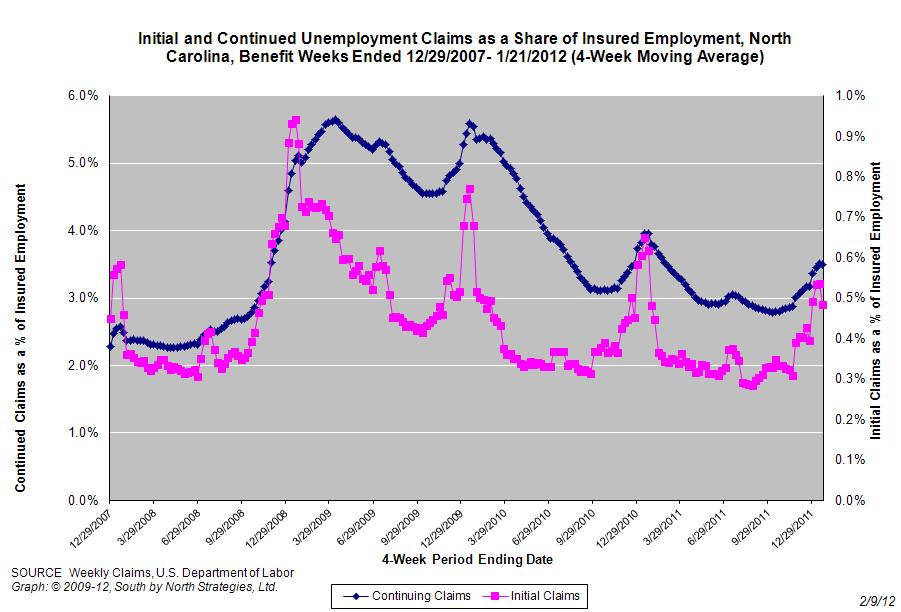
The graph shows the changes in unemployment insurance claims measured as a share of covered employment in North Carolina since the recession’s start in December 2007.
Both new and continuing claims appear to have peaked for this cycle, and the four-week averages of new and continuing claims have fallen considerably. Yet continuing claims remain at an elevated level, which suggests that unemployed individuals are finding it difficult to find new positions.
Midweek Humor: Unemployment Statistics Edition
People who spend significant amounts of time working with unemployment statistics will appreciate both this analysis and policy solution.
Job Openings In December 2011
From the Economic Policy Institute’s analysis of the December version of the Job Openings and Labor Turnover Survey (JOLTS) …
… While the job seekers ratio has been slowly improving since its peak of 6.9-to-1 in the summer of 2009, today’s data release marks three years and three months that the ratio has been above 3-to-1. A job seekers ratio of more than 3-to-1 means that for more than two out of every three unemployed workers, there simply are no jobs. In December, there were 9.7 million more unemployed workers than job openings. Furthermore, the lack of job openings is in no way limited to particular industries such as construction—unemployed workers dramatically outnumber job openings across every major industry.
…
Three years and three months—169 weeks—of a job seekers ratio above 3-to-1 is why the current extended unemployment insurance benefits, which last a maximum of 99 weeks, remain crucial. There are 5.5 million people in this country who have been unemployed for more than half a year, up from 1.2 million in 2007. It is not, of course, that these millions of workers have become lazy, unskilled, or unproductive, it is that there are not enough jobs available. New research by economists at the Federal Reserve Bank of San Francisco shows that increased unemployment duration is primarily due to “the severe and persistent weakness in aggregate demand for labor.” Nevertheless, Congress is now debating whether to renew or cut back on legislation that extends unemployment insurance benefits for the long-term unemployed. It is too early to cut back. …
 Email Sign-Up
 RSS Feed