

Service Activity In The South Atlantic: Jan. 2012
From the Federal Reserve Bank of Richmond’s latest survey of service-sector activity in the South Atlantic (District of Columbia, Maryland, North Carolina, South Carolina, Virginia and West Virginia):
Service sector activity continued to improve overall in January, according to the latest survey by the Federal Reserve Bank of Richmond. Retail sales accelerated, despite a sharp fall in big-ticket sales and declining shopper traffic. Retailers’ inventories grew more quickly this month. Revenues at non-retail services providers also advanced, although somewhat more slowly than a month ago. Retail merchants were generally more cautious in their outlook for sales over the next six months, while services providers expected increased demand for their services.
…
In service sector labor markets, hiring slowed slightly at non-retail firms and retailers cut workers. Average wage growth slowed at services businesses. At retail establishments, average wages declined.
…
Price change in the overall service sector slowed slightly, compared to a month ago. Survey participants expected slightly faster price growth in the next six months, compared to their expectations in December.
Around The Dial – January 25, 2012
Economic policy reports, blog postings, and media stories of interest:
- Robert Johnson sees economics as “a profession at sea.”
- Economist’s View weighs in on the (economic) State of the Union.
- Working Economics points out the importance of exchange rates.
- Rortybomb graphs changes in income and wealth.
- Robert Reich sees “a state of disunion.”
Manufacturing In The South Atlantic: Jan. 2012
From the Federal Reserve Bank of Richmond’s latest survey of manufacturing activity in the South Atlantic (District of Columbia, Maryland, North Carolina, South Carolina, Virginia and West Virginia):
Manufacturing activity in the central Atlantic region advanced somewhat faster in January after firming somewhat in December, according to the Richmond Fed’s latest survey. All broad indicators — shipments, new orders and employment — landed in positive territory, with manufacturers noting their first increase in worker numbers since September 2011. Most other indicators were also positive, including capacity utilization. Only backlogs inched lower. Delivery times were virtually unchanged, while finished goods inventories grew at a slower rate.
…
Looking forward, assessments of business prospects for the next six months were more optimistic in January. Contacts at more firms anticipated that shipments, new orders, backlogs, capacity utilization, and capital expenditures would grow more quickly during the next six months.
Facts About Food Stamps
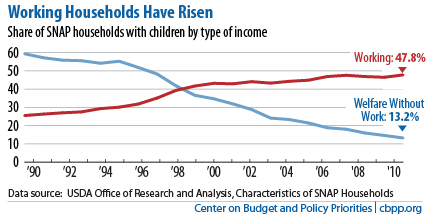
Off the Charts explains “five things you probably don’t know about Food Stamps,” otherwise known as the Supplemental Nutrition Assistance Program. Perhaps the most noteworthy fact is that nearly half of all participating households with children are working households. For many of these households, there jobs simply don’t pay enough to keep them above the program’s eligibility level (income below 130% of the federal poverty level).
Around The Dial – January 24, 2012
Economic policy reports, blog postings, and media stories of interest:
- Nancy Folbre discusses “the best states to grow up in.”
- Martin Wolf lays out “seven ways to fix the system’s flaws.”
- Paul Krugman sees some evidence of a healing economy.
- Calculated Risk previews the Federal Reserve meeting.
- Tapped sees an “Atlas slugged.”
 Email Sign-Up
 RSS Feed