

Around The Dial – January 27, 2012
Economic policy reports, blog postings, and media stories of interest:
- The NY Times reports on Apple’s labor relations with Chinese suppliers.
- Bill Moyers and Michael Winship watch the spinning of the revolving door.
- Policy Shop asks “what job training can-and cannot–fix.”
- Brad DeLong points out the terrible shape of the British economy.
- Paul Krugman explains the advantages of economic clustering.
End Of The Week Humor
People who spend more time with Google Reader or an e-reader than out in the sun will relate to this clip ….
Refuting Defenses of The Indefensible
Over at Crooked Timber, John Quiggin aggressively refutes arguments in defense of “entrenched inequality.” From the conclusion of a post that refutes seven arguments in favor of inequalities in income and wealth …
…As Mitt Romney’s tax returns show, wealthy Americans have the rules rigged in their favor from day one. And that’s assuming they obey the rules. Unlike the poor, they can mostly cheat with impunity. In these circumstances, it’s unsurprising that US inequality is so deeply entrenched. The only surprise is the suddenness with which the facts have become common knowledge.
…
It remains to be seen how this will play out electorally, but there are at least some promising signs. Eight months ago, the situation in the US, seemed if anything even worse than in Europe. Obama seemed determined to capitulate to the Repubs, with the support of the entire centrist establishment, still committed to the idea of bipartisanship. Political discussion was dominated by the claims of the Tea Party, essentially identical to those of the European Austerians. The debt-ceiling debacle, the success of Occupy Wall Street and the recent Romney revelations have changed that. First, the fact that the Repubs are extreme reactionaries, uninterested in any kind of bipartisan compromise, has finally sunk in to all but the most obtuse centrists. Second, the point that the rich play by different rules from the rest of us has been made glaringly obvious.
Around The Dial – January 26, 2012
Economic policy reports, blog postings, and media stories of interest:
- TaxVox worries about government by tax cut.
- Public Citizen says it is time to break up BofA.
- The NY Times reports on the Fed’s bleak view of the economy.
- Felix Salmon sees “fear in Davos.”
- Elise Gould notes that job creation is the best way to help families.
NC Unemployment Claims: Week of 1/7/12
For the benefit week ending on January 7, 2012, some 18,447 North Carolinians filed initial claims for state unemployment insurance benefits, and 130,450 individuals applied for state-funded continuing benefits. Compared to the prior week, there were fewer initial and continuing claims. These figures come from data released by the U.S. Department of Labor.
Averaging new and continuing claims over a four-week period — a process that helps adjust for seasonal fluctuations and better illustrates trends — shows that an average of 19,380 initial claims were filed over the previous four weeks, along with an average of 129,096 continuing claims. Compared to the previous four-week period, the average number of initial claims was higher, as was the average number of continuing claims.
One year ago, the four-week average for initial claims stood at 22,567 and the four-week average of continuing claims equaled 142,397.
In recent weeks covered employment has increased slightly and has returned to the 3.7 million level recorded a year ago. Nevertheless, there are still fewer covered workers than there were in January 2008, which means that payrolls are smaller today than they were almost three years ago.
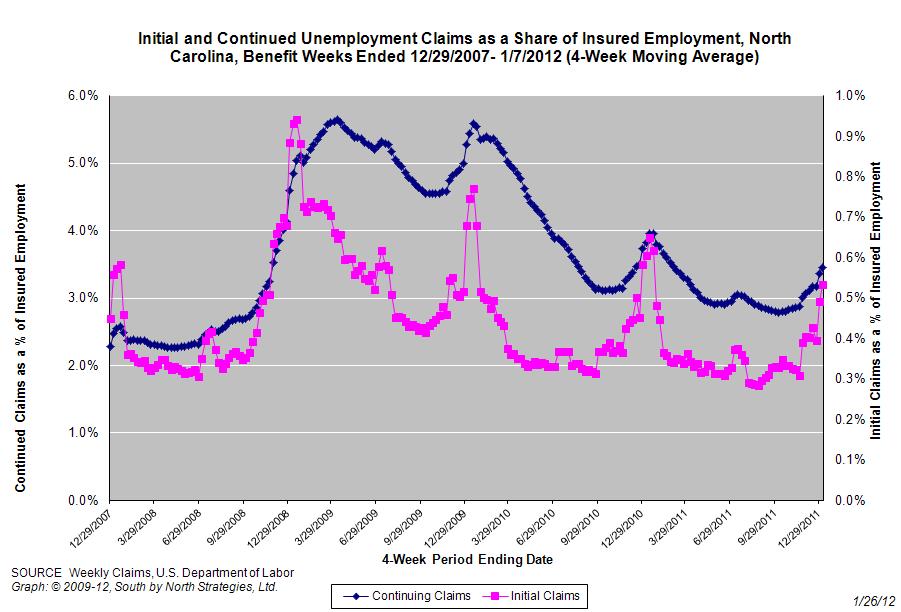
The graph shows the changes in unemployment insurance claims measured as a share of covered employment in North Carolina since the recession’s start in December 2007.
Both new and continuing claims appear to have peaked for this cycle, and the four-week averages of new and continuing claims have fallen considerably. Yet continuing claims remain at an elevated level, which suggests that unemployed individuals are finding it difficult to find new positions.
 Email Sign-Up
 RSS Feed