

Put The Cork Back In The Champagne
Dean Baker does not buy the received wisdom regarding the most recent GDP report …
The long and short is that there was likely little change in the underlying rate of growth from the third quarter to the fourth quarter. The winding down of the stimulus, coupled with the negative impact from the Japan earthquake brought growth to a near halt in the first half of the year.
…
Now that the stimulus has almost fully unwound we are back on a growth path of around 2.5 percent — pretty much the economy’s trend rate of growth. This means that we are making up little or none of the ground lost during the recession. That is a really bad story.
Watching The Trains Collide
Paul Krugman “troubles deaf heaven with his bootless cries” against austerity …
It’s hard to overstate just how wrong all this is. We have a situation in which resources are sitting idle looking for uses — massive unemployment of workers, especially construction workers, capital so bereft of good investment opportunities that it’s available to the federal government at negative real interest rates. Never mind multipliers and all that (although they exist too); this is a time when government investment should be pushed very hard. Instead, it’s being slashed.
…
What an utter disaster.
Around The Dial – January 30, 2012
Economic policy reports, blog postings, and media stories of interest:
- Andy Kohut says economic unfairness is what angers Americans.
- Felix Salmon sees Lawrence Summers get bottled up.
- Matt Taibbi wonders if “Obama’s ‘economic populism’ is for real.”
- Fed Watch sees the zero interest rate policy as “pushing on a string.”
Persistent Poverty In North Carolina
A recent policy brief from the NC Budget and Tax Center analyzes the characteristics of the 10 North Carolina counties that have experienced “persistent poverty,” meaning that they have had a countywide poverty rate of at least 20 percent in every decennial census since 1970.
As of 2000, there were 10 counties in North Carolina that fit the definition of persistently poor: Bertie, Bladen, Columbus, Halifax, Martin, Northampton, Pitt, Robeson, Tyrrell and Washington counties.
…
All of North Carolina’s persistently poor counties are located in the eastern region of the state. This area is part of the northern tip of the Black Belt, a crescent of economically distressed communities that stretches south to Louisiana. The challenges for these communities can be traced back to the economic oppression of slavery and the economic exclusion of segregation and discrimination. As a result, these communities have long struggled with a lack of connection to the opportunities that generate improved economic outcomes such as education, employment, infrastructure, and technology. More recently, these communities have been impacted by economic restructuring—the dramatic decline in the state’s manufacturing employment base and the rise of low‐paying service‐sector jobs—and the need to adapt to today’s highly competitive economy.
…
The lack of employment opportunities has meant these communities have little to offer residents in terms of good jobs and opportunities for advancement. Often, those residents who achieve middle‐class status leave the Black Belt to continue their post‐secondary education or seek higher‐paying jobs.
Show Me The Money! Capital Gains/Dividend Version
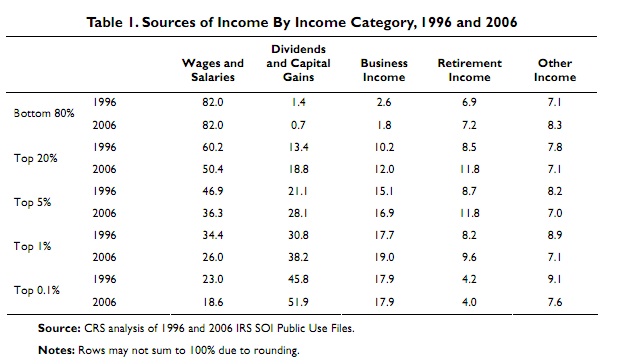
Rortybomb summarizes recent data about changes in “the concentration of capital gains and dividend income.” The post includes the chart below, which nicely documents the extent to which the richest tax filers rely on income from capital gains and dividends.
 Email Sign-Up
 RSS Feed