

NC Unemployment Claims: Week of 1/14/12
For the benefit week ending on January 14, 2012, some 13,572 North Carolinians filed initial claims for state unemployment insurance benefits, and 126,078 individuals applied for state-funded continuing benefits. Compared to the prior week, there were fewer initial and continuing claims. These figures come from data released by the U.S. Department of Labor.
Averaging new and continuing claims over a four-week period — a process that helps adjust for seasonal fluctuations and better illustrates trends — shows that an average of 20,020 initial claims were filed over the previous four weeks, along with an average of 131,553 continuing claims. Compared to the previous four-week period, the average number of initial claims was higher, as was the average number of continuing claims.
One year ago, the four-week average for initial claims stood at 24,151, and the four-week average of continuing claims equaled 147,191.
In recent weeks covered employment has increased and now slightly exceeds the level recorded a year ago (3.73 million versus 3.72 million). Nevertheless, there are still fewer covered workers than there were in January 2008, which means that payrolls are smaller today than they were four years ago.
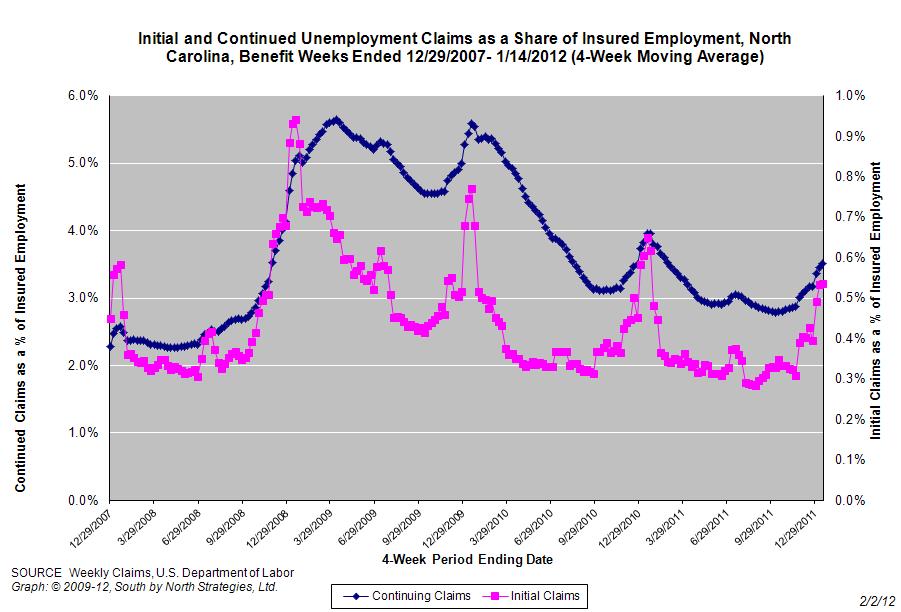
The graph shows the changes in unemployment insurance claims measured as a share of covered employment in North Carolina since the recession’s start in December 2007.
Both new and continuing claims appear to have peaked for this cycle, and the four-week averages of new and continuing claims have fallen considerably. Yet continuing claims remain at an elevated level, which suggests that unemployed individuals are finding it difficult to find new positions.
Around The Dial – February 1, 2012
Economic policy reports, blog postings, and media stories of interest:
- Economix breaks down federal government wage trends.
- Jared Bernstein thins about inequality and the middle class.
- Brad DeLong praises Neville Chamberlain, though not for what you think.
- Working Economics charts “austerity’s effects on state job growth.”
Local Job Markets Post Little Progress In 2011
CHAPEL HILL (February 1, 2012) – Between December 2010 and December 2011, unemployment rates rose in 68 of North Carolina’s 100 counties and in 8 of the state’s 14 metropolitan areas. In December 2011, 29 counties and 3 metros had labor forces that were smaller in size compared to one year ago. These findings come from new estimates from the North Carolina Department of Commerce Division of Employment Security.
“December was the weak end to weak year for most of North Carolina’s local labor markets,” said John Quinterno, a principal with South by North Strategies, Ltd., a research firm specializing in economic and social policy. “In 59 counties, at least 10 percent of the labor force was unemployed in December, up from 57 counties a year ago. Similarly, the size of the labor force fell in 29 counties, which suggests that joblessness is more widespread than captured in the official unemployment statistics.”
Since the economy fell into recession in December 2007, North Carolina has lost, on net, 7.1 percent of its payroll employment base (-295,300 positions) and has seen its unadjusted unemployment rate climb from 4.7 percent to 9.8 percent. In December, the state shed 4,400 more payroll jobs than it added. Since bottoming out in February 2010, the state’s labor market has netted an average of 1,300 jobs per month, resulting in a cumulative gain of just 27,700 jobs.
Between November and December, unemployment rates rose in 93 counties and were at or above 10 percent in 59 counties. Individual county rates ranged from 6.1 percent in Orange County to 17.5 percent in Graham County. Compared to a year ago, unemployment rates were higher in 68 counties, unchanged in 5 counties, and lower in 27 counties.
“Non-metropolitan labor markets remained weak in 2011,” added Quinterno. “In December, 10.9 percent of the non-metro labor force was unemployed, compared to 9.4 percent of the metro labor force. Over the year, the rural unemployment rate held steady. Compared to December 2007, the non-metro labor force is 3.5 percent smaller. Similarly, the number of employed rural residents has fallen by 9 percent, while the number of unemployed rural persons has grown by 90.8 percent and now numbers 141,741.”
Last month, unemployment rates rose in 13 of the state’s metropolitan areas and fell in one metro (Burlington). Rocky Mount had the highest unemployment rate (12.9 percent), followed by Hickory-Morganton-Lenoir (11.9 percent). Durham-Chapel Hill had the lowest rate (7.5 percent), followed by Asheville (7.9 percent).
Compared to December 2010, unemployment rates were higher in 69 counties and 8 metros. Moreover, 29 counties and 3 metros had smaller labor forces. Among metros, Wilmington recorded the largest decline in the size of its labor force (-2 percent), followed by Hickory-Morganton-Lenoir (-1.9 percent). Fayetteville posted the largest increase (+3.3 percent), followed by Greensboro (+1.9 percent) and Greenville (+1.6 percent).
In the long term, any meaningful recovery will hinge on growth in the state’s three major regions: Charlotte, the Research Triangle, and the Piedmont Triad. Yet growth remains sluggish. Collectively, employment in these three metro regions has fallen by 4.2 percent since December 2007, and the combined December unemployment rate in the three metros equaled 9.1 percent. Of the three broad regions, the Research Triangle had the lowest unemployment rate (8 percent), followed by the Piedmont Triad (9.8 percent), and Charlotte (10.5 percent).
“North Carolina’s local labor markets ended 2011 little different than they started the year,” said Quinterno. “Statewide job growth has been anemic at best, and as a result, nearly a half million North Carolinians are jobless and actively seeking work. The same basic dynamic is playing out to differing degrees in communities throughout the state.”
Weak Labor Demand = Long Unemployment Spells
A research letter from the Federal Reserve Bank of San Francisco analyzes the causes of the increasing duration of spells of unemployment …
The analyses discussed here suggest that weak labor demand is the primary explanation for prolonged unemployment duration observed in the recent recession and recovery. The weak recovery of employment is similar to the jobless recoveries that followed the 1990–91 and 2001 recessions. This suggests that the labor market has changed in ways that prevent the cyclical bounceback in the labor market that followed past recessions. The shift towards jobless recoveries probably reflects a reduction in temporary layoffs during cyclical downturns. Stricter market incentives to control costs in the face of stiff domestic and international competition may also be factors. In addition, anecdotal evidence suggests that recent employer reluctance to hire reflects an unusual degree of uncertainty about future growth in product demand and labor costs. These special factors are not readily addressed through conventional monetary or fiscal policies. But such policies may be able to offset the central obstacle of weak aggregate demand.
Around The Dial – January 31, 2012
Economic policy reports, blog postings, and media stories of interest:
- Marshall Auerback sees “Anschulss economics” at work in Europe.
- Robert Frank argues that “higher taxes help the richest, too.”
- Robert Kuttner asks if the administration’s financial investigations are serious.
- An op-ed in The Washington Post wonders if working less would benefit Americans.
 Email Sign-Up
 RSS Feed