

A 25-Year Low
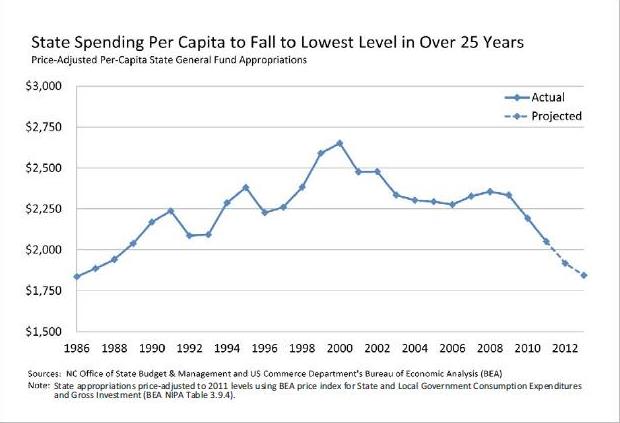
A research brief from the NC Budget & Tax Center explains how state spending per capita has fallen to the lowest level in 25 years.
Comparing Income Inequality
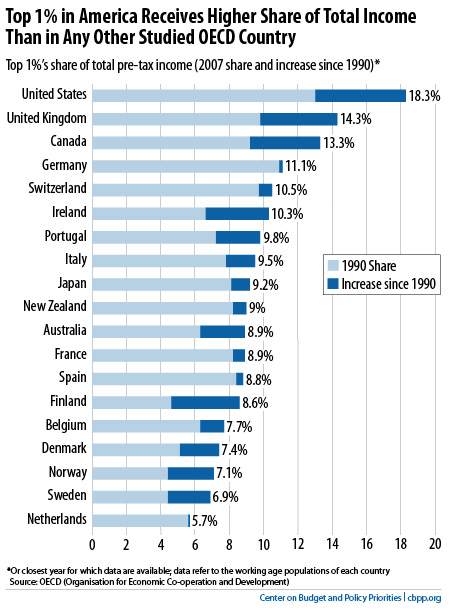
Off the Charts summarizes the key points of a new OECD study comparing income inequality in various rich nations. Compared to most rich nations, the United States has an extremely skewed distribution of income.
Around The Dial – December 16, 2011
Economic policy reports, blog postings, and media stories of interest:
- Katrina vanden Heuvel sketches “the limits of our jobs debate.”
- The NY Times reports on state economic development incentives.
- Working Economics takes on “fairy tales about inequality.”
- Policy Shop outlines challenges facing community college students.
- The Center for American Progress looks at the Federal Housing Administration.
Unemployment In NC: Age Differences
A research note from the NC Budget & Tax Center analyzes differences in unemployment by age. From the note …
Older workers are less likely to be unemployed than younger workers, but when they do experience unemployment, 56 percent are likely to be without a job for 26 weeks or longer.
…
Long-term unemployment continues to be driven by the lack of jobs but is further compounded for older workers by the challenge of finding similar employment despite strong work histories.
…
Due to longer periods of unemployment, older workers are more likely to exhaust their unemployment benefits and can be pushed into unplanned retirement.
Job Openings In October 2011
From the Economic Policy Institute’s analysis of the October version of the Job Openings and Labor Turnover Survey (JOLTS) …
… While the job-seekers ratio has been generally slowly improving since its peak of 6.9-to-1 in the summer of 2009, today’s data release marks two years and 10 months—147 weeks—that the ratio has been above 4-to-1. A job-seekers ratio of more than 4-to-1 means that for more than three out of four unemployed workers, there simply are no jobs. In October, there were 10.6 million more unemployed workers than job openings. Furthermore, the lack of job openings relative to unemployed workers is in no way limited to particular industries such as construction—unemployed workers dramatically outnumber job openings across the board, in every major industry.
 Email Sign-Up
 RSS Feed