

Around The Dial – December 15, 2011
Economic policy reports, blog postings, and media stories of interest:
- Nancy Folbre describes the failure of welfare reform.
- Working Economics discusses ways of measuring unemployment.
- Martin Wolf explains the defects of the Euro.
- Ezra Klein notes “the GOP’s two conversations over taxes.”
- Off the Charts is “taking stock of the safety net.”
NC Unemployment Claims: Week of 11/26/11
For the benefit week ending on November 26, 2011, some 24,804 North Carolinians filed initial claims for state unemployment insurance benefits, and 126,279 individuals applied for state-funded continuing benefits. Compared to the prior week, there were more initial and continuing claims. These figures come from data released by the U.S. Department of Labor.
Averaging new and continuing claims over a four-week period — a process that helps adjust for seasonal fluctuations and better illustrates trends — shows that an average of 14,599 initial claims were filed over the previous four weeks, along with an average of 112,122 continuing claims. Compared to the previous four-week period, the average number of initial claims and the number of continuing claims were higher.
One year ago, the four-week average for initial claims stood at 15,880 and the four-week average of continuing claims equaled 121,819.
In recent weeks covered employment has increased slightly and has returned to the 3.73 million level recorded a year ago. Nevertheless, there are still fewer covered workers than there were in January 2008, which means that payrolls are smaller today than they were almost four years ago.
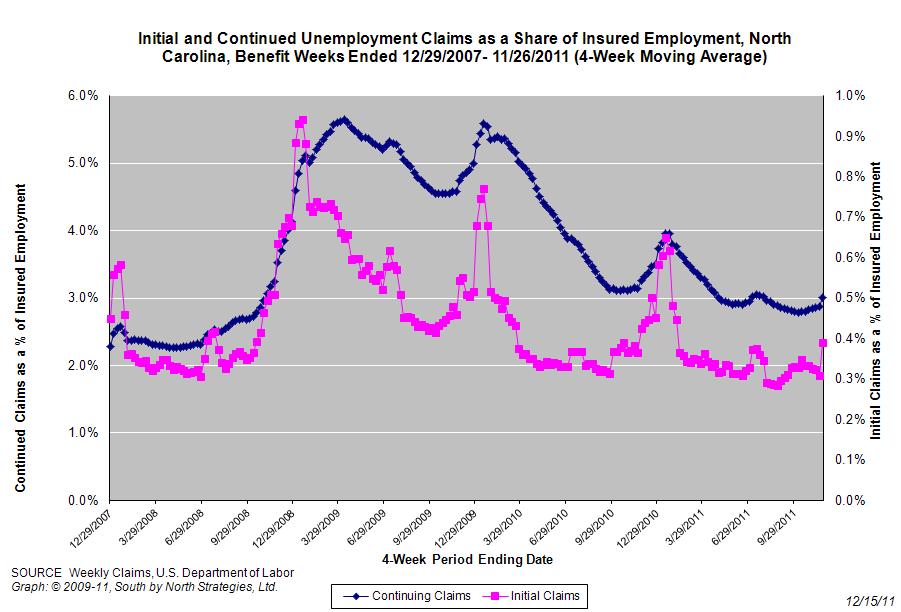 The graph shows the changes in unemployment insurance claims (as a share of covered employment) in North Carolina since the recession’s start in December 2007.
Both new and continuing claims appear to have peaked for this cycle, and the four-week averages of new and continuing claims have fallen considerably. Yet continuing claims remain at an elevated level, which suggests that unemployed individuals are finding it difficult to find new positions.
The Importance Of Unemployment Insurance
Heather Boushey of the Center for American Progress lays out reasons for continuing emergency unemployment benefits.
But many people may feel like they have no choices left, thus leaving the workforce and the unemployment insurance program. Although the unemployment level decreased to 8.6 percent in November—its lowest point in two-and-a-half years—the drop is due at least in part to people completely leaving the workforce. Unemployed workers face daunting odds finding employment in this labor market. The employment rate—the share of Americans with a job—is 58.5 percent, and it remains just 0.4 percentage points higher than the near-30-year low point reached this July.
…
The extension of unemployment benefits cannot be allowed to expire. Far from giving people a reason not to find work, they have been shown to spare active job seekers from living in poverty, and to boost the struggling economy. This, in turn, can only serve to create the jobs that people both want and need.
Around The Dial – December 14, 2011
Economic policy reports, blog postings, and media stories of interest:
- Helen Ladd and Ed Fiske point out that “class matters.”
- Fed Watch remains a “Europessimist.“
- The Center for American Progress worries about the long-term unemployed.
- Off the Charts wonders about the House unemployment insurance proposal.
- James Kwak describes the problems with private long-term care insurance.
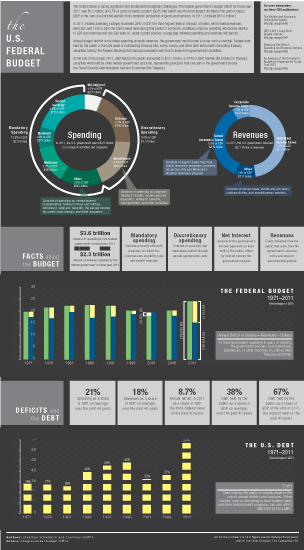
Picturing The Federal Budget
A recent infographic prepared by the Congressional Budget Office provides an accessible overview of the federal budget.
 Email Sign-Up
 RSS Feed