

The African-American Population And Census 2010
Random Samplings, the blog of the US Census Bureau, points out that the nation’s African-American population remained highly concentrated in the South in 2010.
The Black population was highly concentrated in counties in the South. In 106 counties, the Black alone-or-in-combination population represented 50 percent or more of the total county population. All of these counties were located in the South except for the city of St. Louis, MO, which is considered a county equivalent. These patterns were similar for the Black alone population.
…
Concentrations of Blacks outside of the South tended to be in counties located within metropolitan statistical areas. There were 317 counties where the Black alone-or-in-combination population was 25.0 percent to 49.9 percent of the county population, and only 17 of these counties were not in the South. Of these 17 counties, 15 were in metro areas. This pattern was similar for the Black alone population.
Around The Dial – December 2, 2011
Economic policy reports, blog postings, and media stories of interest:
- The New Republic profiles the educational expert Diane Ravitch.
- Off the Charts describes the link between income inequality and mobility.
- Dahila Lithwick reviews the tenure of Supreme Court Justice Elena Kagan.
- Katrina Vanden Heuven looks at progressive opinion about Pres. Obama.
- The NY Times reports the surge of children qualifying for subsidized school meals.
Labor Market Records Some Growth In November
CHAPEL HILL (December 2, 2011) – In November, the American economy gained 120,000 more payroll jobs than it lost. While the private sector netted 140,000 positions, the public sector shed 20,000 jobs, due overwhelmingly to payroll cuts on the part of local and state governments. Also, some 8.6 percent of the labor force was unemployed in November, and the underemployment rate equaled 15.6 percent. These findings come from today’s national employment report.
“The November employment report was a weak one,” said John Quinterno, a principal with South by North Strategies, Ltd., a research firm specializing in economic and social policy. “Job growth outpaced the level needed to keep pace with the size of the working-age population but was insufficient to replace the positions lost earlier in the downturn. The unemployment rate did fall in November, though roughly half of the decline was attributable to individuals leaving the labor market altogether rather than finding jobs.”
In November, the nation’s employers added 120,000 more payroll jobs than they cut. The private sector added 140,000 positions, but a net loss of 20,000 public-sector jobs erased 14.3 percent of that gain. Local government reductions (-11,000, due mainly to a loss of 6,000 education jobs) drove the public-sector decline. In recent months, public-sector cuts have weighed down job growth. Since November 2010, government payrolls have shed 278,000 positions (-1.3 percent). This drop offset 14.8 percent of the private-sector job growth that occurred during the same period.
Additionally, the payroll employment estimates for September and October underwent upward revisions. With the changes, the economy netted 310,000 jobs over those two months, not 238,000 positions as first reported.
Several private industries recorded net job growth in November. Trade, transportation, and utilities netted 58,000 positions with 85.8 percent of that growth occurring in the retail trade sub-sector (+49,800). Professional and business services added 33,000 jobs, of which 63.3 percent were in the administrative and waste services sub-sector (+20,900), which includes temporary help services (+22,300). Education and health care services netted 27,000 positions, while leisure and hospitality services gained 22,000 positions, almost entirely in the accommodation and food services sub-sector (+20,900). The construction industry lost 12,000 positions, and the information industry shed 4,000 jobs.
“The November employment report is not a particularly impressive one,” noted Quinterno. “Over the past year, net job growth has averaged 133,300 positions per month–a level grossly insufficient for replacing the jobs lost during the Great Recession.”
The inability of the current pace of job growth to alter employment conditions was evident in the November household survey. Last month, 13.3 million Americans (8.6 percent of the labor force) were jobless and seeking work. While the unemployment rate and number of unemployed individuals dropped over the past year, the share of the population with a job remains depressed. In November, the share of the adult population that was employed (58.5 percent) remained near levels last seen in the early 1980s.
Another cause for concern is the fact that long-term unemployment remains elevated. Last month, 43 percent of all unemployed workers had been out of work for at least 27 weeks. A year ago, the comparable figure was 42.2 percent.
In November, proportionally more adult male workers were unemployed than female ones (8.3 percent vs. 7.8 percent). Similarly, unemployment rates were higher among Black (15.5 percent) and Hispanic workers (11.4 percent) than among White ones (7.6 percent). The unemployment rate among teenagers was 23.7 percent. Between October and November, the unemployment rates among adult men and White workers fell, but the rates for most every other major demographic group held steady.
Additionally, 7.4 percent of all veterans were unemployed in November. The unemployment rate among recent veterans (served after September 2001) was 11.1 percent.
“Jobs remained scarce in November,” added Quinterno. “This led many individuals simply to abandon their job searches. Compared to a year ago, America has a labor force that is smaller despite overall population growth, while the number of working-age individuals who are effectively jobless remains at a disturbingly elevated level.”
A more extensive measure of labor underutilization is the underemployment rate, which equaled 15.6 percent in November. Further evidence of the difficulty in finding a job is that, among unemployed workers, the average time out of work in November equaled 40.9 weeks, compared to 33.9 weeks a year ago.
“The American economy has not managed to create many jobs over the past year, and as a result, labor market conditions clearly have not fundamentally improved. While the scope and contours of the problems are plainly evident in the data, policymakers are proving reluctant to pursue solutions that would help millions of Americans. Joblessness clearly is the greatest problem facing the American economy.”
NC Unemployment Claims: Week of 11/12/11
For the benefit week ending on November 12, 2011, some 12,862 North Carolinians filed initial claims for state unemployment insurance benefits, and 108,917 individuals applied for state-funded continuing benefits. Compared to the prior week, there were more initial and continuing claims. These figures come from data released by the U.S. Department of Labor.
Averaging new and continuing claims over a four-week period — a process that helps adjust for seasonal fluctuations and better illustrates trends — shows that an average of 12,100 initial claims were filed over the previous four weeks, along with an average of 106,650 continuing claims. Compared to the previous four-week period, the average number of initial claims was lower and the number of continuing claims was higher.
One year ago, the four-week average for initial claims stood at 14,281 and the four-week average of continuing claims equaled 117,477.
In recent weeks covered employment has increased slightly and has returned to the 3.73 million level recorded a year ago. Nevertheless, there are still fewer covered workers than there were in January 2008, which means that payrolls are smaller today than they were almost three years ago.
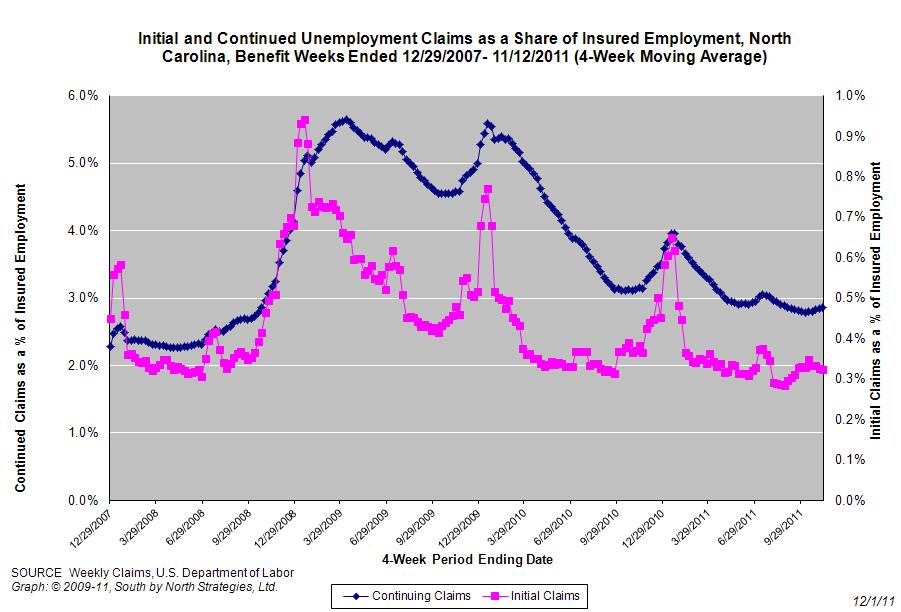 The graph shows the changes in unemployment insurance claims (as a share of covered employment) in North Carolina since the recession’s start in December 2007.
Both new and continuing claims appear to have peaked for this cycle, and the four-week averages of new and continuing claims have fallen considerably. Yet continuing claims remain at an elevated level, which suggests that unemployed individuals are finding it difficult to find new positions.
Around The Dial – December 1, 2011
Economic policy reports, blog postings, and media stories of interest:
- Bloomberg reports on the incredible extent of Fed lending during the crisis.
- Off the Charts provides an overview of income inequality in the US.
- The Hill looks at the fighting at the National Labor Relations Board.
- Joe Nocera argues that Germany is cutting off its own nose.
 Email Sign-Up
 RSS Feed