

Public Programs At Work
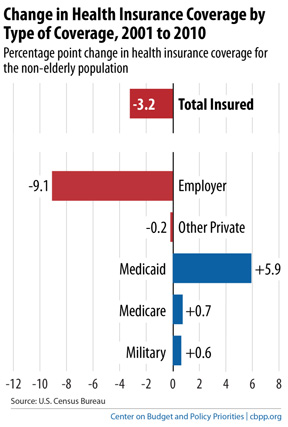
Off the Charts points out that even more Americans would be uninsured if not for public insurance programs like Medicaid. In fact, when it comes to children, “the increase in public coverage (through Medicaid and the Children’s Health Insurance Program, or CHIP) over the past decade more than offset the decline in private coverage, so the total number of uninsured children went down. ”
The chart below shows changes in insurance coverage within the non-elderly population between 2001 and 2010.
Around The Dial – September 21, 2011
Economic policy reports, blog postings, and media stories of interest:
- Robert Frank explains why “the invisible hand” doesn’t always work.
- Paul Krugman likens austerity to bloodletting.
- Fed Watch thinks the Fed is interested in “rearranging the deck chairs.”
- Simon Johnson wonders “who will eclipse America.”
- TaxVox summarizes the Obama administration’s deficit proposal.
Declining Public School Employment
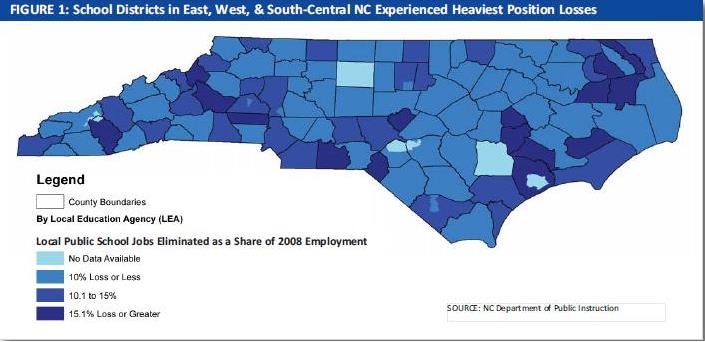
A recent report from the N.C. Budget & Tax Center tracks the elimination of public school jobs across North Carolina since 2008. The study finds that “in the last four years, North Carolina public schools report having eliminated 16,678 positions, nearly one in ten positions compared to 2008 staffing levels.”
As the map below shows, school districts in East, West, and South-Central North Carolina have experienced the greatest staffing reductions.
Don’t Hide The Benefits
Writing in The New York Times, Suzanne Mettler, a professor of government at Cornell University, explains some of the problems associated with delivering government benefits in a “submerged” manner, such as through the tax code.
The submerged state obscures the role of government and exaggerates that of the market. It leaves citizens unaware of the source of programs and unable to form meaningful opinions about them.
…
Until political leaders reveal government benefits for what they are by talking openly about them, we cannot have an honest discussion about spending, taxes or deficits. The stipulation in the new health care reform law that W-2 forms must indicate the value of untaxed employer-provided health care benefits is a step in the right direction. The government should also provide “receipts” that inform people of the size of each benefit they get through the tax code.
…
The threat to democracy today is not the size of government but rather the hidden form that so much of its growth has taken. If those who assume government has never helped them could see how it has, it might help defuse our polarized political climate and reinvigorate informed citizenship.
Around The Dial – September 20, 2011
Economic policy reports, blog postings, and media stories of interest:
- Sylvia Nasar describes Keynes as “the sunny economist.”
- The New York Times profiles Adam Posen of the Bank of England.
- Nouriel Roubini explains the risks of a severe economic contraction.
- Brad DeLong reflects on the first 2.75 of the Obama administration.
- Working Economics explains why “macroeconomics is not a religion.”
 Email Sign-Up
 RSS Feed