

Around The Dial – September 16, 2011
Economic policy reports, blog postings, and media stories of interest:
- Robert Reich sees a “weapon of mass cynicism.”
- Off the Charts graphs the latest income and poverty data.
- David Callahan describes “how ideology keeps the economy down.”
- Matt Stoller points out that the financial crisis still isn’t over.
A Stormy Month For N.C.’s Job Market
CHAPEL HILL (September 16, 2011) – August was a stormy month for North Carolina’s labor market. Last month, the state gained 16,500 more payroll jobs than were lost, thanks to an increase in local government payrolls. At the same time, both the number of unemployed persons and the statewide unemployment rate rose sharply, with the unemployment rate reaching the highest level recorded since June 2010. These findings come from new data from the Employment Security Commission.
“Storm winds tossed around North Carolina’s labor market in August,” said John Quinterno, a principal with South by North Strategies, Ltd., a research firm specializing in economic and social policy. “A jump in local government employment tied in part to the start of the school year led to the second-highest monthly job gain posted so far in 2011, yet overall employment conditions remained weak. Last month, the labor force contracted, the number of people with a job fell, the unemployment rate reached its highest level in over a year, and the share of adults with a job fell to a 35-year low.”
In August, North Carolina employers added 16,500 more payroll jobs than they cut. Net gains occurred primarily in the public sector (+13,600, driven by a net gain of 16,800 local government jobs), while the private sector netted just 2,900 jobs. Within the private sector, professional and business services gained the most jobs in absolute and relative terms (+3,900, +0.8 percent), while trade, transportation, and utilities lost the most jobs in absolute terms (-3,600, driven by a net loss of 3,800 jobs in the retail trade sub-sector).
A revision to the July data also found that the state lost 2,100 more payroll jobs than first reported (-6,200, versus an original estimate of -4,100). With that adjustment, North Carolina has lost, on net, 289,300 positions, or 6.9 percent of its payroll base, since December 2007. Since bottoming out in February 2010, the state has netted an average of 1,872 payroll jobs per month, resulting in a cumulative gain of just 33,700 positions (+0.9 percent)
“Compared to December 2007, North Carolina has fewer payroll jobs in every major industry sector except for educational and health services and leisure and hospitality services,” noted Quinterno. “While public-sector employment had been a source of strength earlier in the downturn, it recently has weighed on growth. Since February 2010, local government employment has fallen by 1 percent, and state government employment has declined by 7.7 percent.”
Between August 2010 and August 2011, North Carolina gained, on net, 21,100 jobs (+ 0.6 percent). Approximately 42 percent of the net growth that occurred in the private sector (+35,800 positions) was offset by net public-sector losses (-14,700). In terms of individual private industries, professional and business services grew the most in absolute and relative terms (+15,500, +3.2 percent). In the public sector, net losses stemmed from declines in state (-16,300, -8.3 percent) and federal employment (-3,000, -4.3 percent).
The household data for August were particularly alarming. Last month, the total number of employed individuals fell by 14,524 (-0.4 percent), while the number of unemployed individuals rose by 11,747 (+2.6 percent). The size of the workforce fell slightly (-0.1 percent).
Over the year, the number of unemployed North Carolinians rose by 14,556 (+3.2 percent), while the number of employed individuals remained essentially flat. Between August 2010 and August 2011, the size of the labor force increased by 13,577 individuals (+0.3 percent). Over the year, the unemployment rate rose to 10.4 percent from 10.1 percent. The August unemployment rate also was the highest recorded since June 2010, a month when 10.5 percent of the labor force was unemployed.
“North Carolina’s labor market continues to move in the wrong direction,” observed Quinterno. “The job shortfall has closed only marginally, and the unemployment rate has been trending upward since March. Especially alarming is the fact that the share of working-age North Carolinians with a job has fallen to the lowest level recorded since 1976. In August, just 55.3 percent of working-age North Carolinians were employed.”
“Like the nation at large, North Carolina remains mired in a severe jobs crisis—a crisis that only has worsened in recent months,” added Quinterno. “There exist few signs that any kind of recovery is underway, and unless public leaders act aggressively, conditions will continue to deteriorate.”
Explaining The Health Care Arms Race, Dr. Seuss-style
The public radio program Marketplace explains the “medical arms race” in a manner that would make Dr. Seuss proud.
Oh The Jobs (Debt?) You’ll Create! from Marketplace on Vimeo.
Around The Dial – September 15, 2011
Economic policy reports, blog postings, and media stories of interest:
- The New Republic points out an early success of health care reform.
- Economix wonders what is next for Greece and Europe.
- Martin Wolf argues that it is “time for Germany to make its fateful choice.”
- Dani Rodrick describes “the crisis of fiscal imagination.”
NC Unemployment Claims: Week of 8/27/11
For the benefit week ending on August 27, 2011, some 10,931 North Carolinians filed initial claims for state unemployment insurance benefits, and 105,974 individuals applied for state-funded continuing benefits. Compared to the prior week, there were more initial and continuing claims. These figures come from data released by the U.S. Department of Labor.
Averaging new and continuing claims over a four-week period — a process that helps adjust for seasonal fluctuations and better illustrates trends — shows that an average of 10,594 initial claims were filed over the previous four weeks, along with an average of 107,383 continuing claims. Compared to the previous four-week period, the averages of initial and continuing claims were lower.
One year ago, the four-week average for initial claims stood at 12,250 and the four-week average of continuing claims equaled 127,596.
While the number of claims has dropped over the past year so has covered employment. Last week, covered employment totaled 3.7 million, down from 3.8 million a year ago.
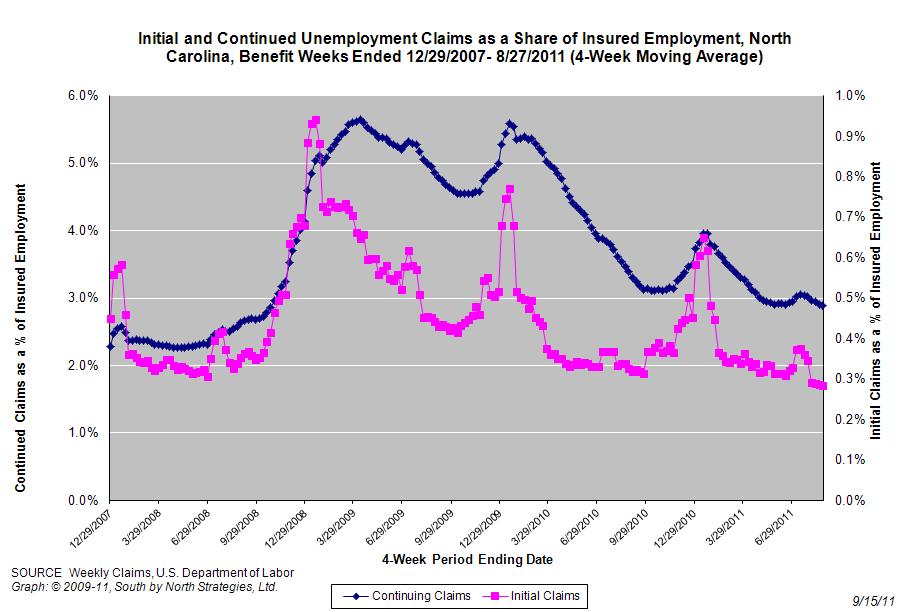 The graph shows the changes in unemployment insurance claims (as a share of covered employment) in North Carolina since the recession’s start in December 2007.
Both new and continuing claims appear to have peaked for this cycle, and the four-week averages of new and continuing claims have fallen considerably. Yet continuing claims remain at an elevated level, which suggests that unemployed individuals are finding it difficult to find new positions.
 Email Sign-Up
 RSS Feed