

Service Activity In The South Atlantic: August
From the Federal Reserve Bank of Richmond’s latest survey of service-sector activity in the South Atlantic (District of Columbia, Maryland, North Carolina, South Carolina, Virginia and West Virginia):
Service sector activity retreated in August, according to the latest survey by the Federal Reserve Bank of Richmond. Retail sales fell, as shopper traffic declined and big-ticket sales dropped. Retail inventories inched up. Revenues at non-retail services firms also edged higher, compared to July. Retailers had a bleak outlook for sales in the six months ahead, while survey participants at non-retail firms were mildly optimistic about demand for their services.
…
The number of employees in the service sector dipped as retailers and non-retail services providers trimmed their payrolls. Average wage growth was little changed at retail establishments; wage growth slowed at services providers.
…
Price increases picked up somewhat in August, and survey respondents anticipated a slightly faster pace in the six months ahead, with most of the escalation coming from retailers
Around The Dial – August 25, 2011
Economic policy reports, blog postings, and media stories of interest:
- Rortybomb rounds up ideas for dealing with the housing market.
- Jagdish Bhagwati debunks some myths about outsourcing.
- Tapped notes the birthday of welfare reform.
- Annie Lowrey reports on ideas for helping the long-term unemployed.
- Ruy Teixeira thinks about “America’s contradictory relationship to Keynes.”
NC Unemployment Claims: Week of 8/6/11
For the benefit week ending on August 6, 2011, 10,893 North Carolinians filed initial claims for state unemployment insurance benefits, and 108,849 individuals applied for state-funded continuing benefits. Compared to the prior week, there were fewer initial and more continuing claims. These figures come from data released by the U.S. Department of Labor.
Averaging new and continuing claims over a four-week period — a process that helps adjust for seasonal fluctuations and better illustrates trends — shows that an average of 10,863 initial claims were filed over the previous four weeks, along with an average of 109,981 continuing claims. Compared to the previous four-week period, the averages of initial and continuing claims were lower.
One year ago, the four-week average for initial claims stood at 12,541 and the four-week average of continuing claims equaled 135,928.
While the number of claims has dropped over the past year so has covered employment. Last week, covered employment totaled 3.7 million, down from 3.8 million a year ago.
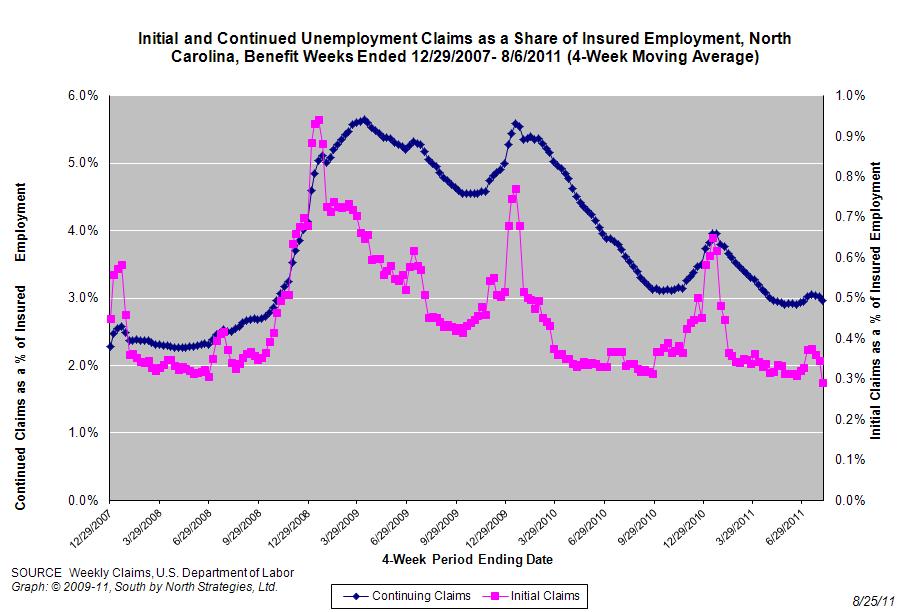 The graph shows the changes in unemployment insurance claims (as a share of covered employment) in North Carolina since the recession’s start in December 2007.
Both new and continuing claims appear to have peaked for this cycle, and the four-week averages of new and continuing claims have fallen considerably. Yet continuing claims remain at an elevated level, which suggests that unemployed individuals are finding it difficult to find new positions.
Manufacturing In The South Atlantic: August
From the Federal Reserve Bank of Richmond’s latest survey of manufacturing activity in the South Atlantic (District of Columbia, Maryland, North Carolina, South Carolina, Virginia and West Virginia):
Manufacturing activity in the central Atlantic region pulled back in August after stalling in July, according to the Richmond Fed’s latest survey. The index of overall activity was pushed lower as growth in new orders and shipments declined further into negative territory. Employment remained in positive territory but grew at a pace below July’s rate. Other indicators also suggested weakening activity. District contacts indicated that backlogs and capacity utilization continued to contract, while delivery times turned negative. Moreover, manufacturers reported that inventory building remained on pace with July.
Around The Dial – August 24, 2011
Economic policy reports, blog postings, and media stories of interest:
- Off the Charts notes that the top 1% had $1.7 trillion in income in 2008.
- Marshall Auerback asks if “we are approaching the endgame for the Euro.”
- The Charlotte Observer reports on unemployment among African Americans.
- Bruce Bartlett thinks top tax brackets must rise.
- Henry Blodget argues that BofA needs more capital.
- Off the Charts runs down facts on the TANF program.
 Email Sign-Up
 RSS Feed