

Around The Dial – August 29, 2011
Economic policy reports, blog postings, and media stories of interest:
- David Leonhardt attempts to explain the Federal Reserve’s thinking.
- Matt Stoller points out flaws with the Obama Administration’s policies & politics.
- Fed Watch assesses the sad state of macroeconomic policy.
- Nancy Folbre wonders if time is money for the unemployed.
A Discussion Of Unemployment In North Carolina
Last weekend, John Quinterno of South by North Strategies appeared as guest on the weekly television show Political Connections, produced by News 14 Carolina. Quinterno spoke about unemployment and the health of North Carolina’s labor market. Click here or on the image below to view the show; Quinterno’s segment starts around minute 11:00.

A Demographic Tipping Point
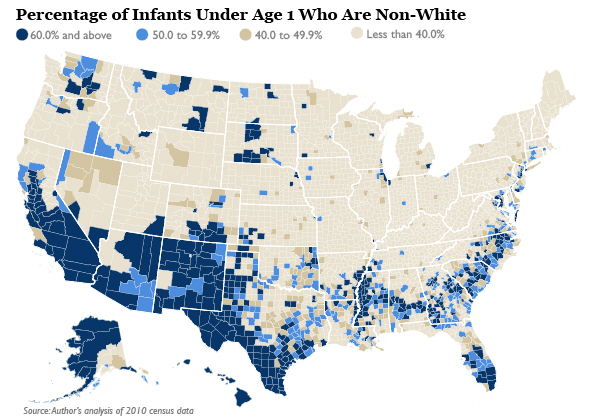
William Frey of The Brookings Institution writes that America has reached “its demographic tipping point.” According to Frey, data from the 2010 Census show that 49.8 percent of infants under age were were members of a racial or ethnic minority group.
Moreover, as the map below shows, infants belonging to racial and ethnic minority groups account for “at least 40 percent of infants in more than half of all states, with the white share of infants declining in all of them, with the exception of the District of Columbia.”
Around The Dial – August 26, 2011
Economic policy reports, blog postings, and media stories of interest:
- Robert Kuttner notes “how austerity feeds on itself.”
- Jonathan Chait asks why the GOP has turned against cuts in payroll taxes.
- Mike Leachman looks at differences in state economic performance.
- Dylan Matthews runs down nine studies on the Recovery Act’s impact.
- Paul Krugman writes about the intimidation of the Fed.
Weak Job Conditions Prevail Across N.C.
CHAPEL HILL (August 26, 2011) – Between July 2010 and July 2011, unemployment rates rose in 54 of North Carolina’s 100 counties and in 6 of the state’s 14 metropolitan areas. At the same time, 49 counties and 8 metros had labor forces in July that were smaller compared to a year ago. These findings come from new estimates from the Employment Security Commission.
“Sizable reductions in local government payrolls in July led to a further deterioration in employment conditions across North Carolina,” said John Quinterno, a principal with South by North Strategies, Ltd., a research firm specializing in economic and social policy. “In many communities, there were no meaningful improvements in the local job market.”
Since the economy fell into recession in December 2007, North Carolina has lost, on net, 7.3 percent of its payroll employment base (-303,700 positions) and has seen its unadjusted unemployment rate climb from 4.7 percent to the current level of 10.3 percent. In July, the state lost 4,100 more payroll jobs than it gained. Over the past year, employers cumulatively added 4,400 more payroll jobs than they cut, but that level of growth—an average of just 367 jobs per month—simply was insufficient to bring down joblessness.”
Compared to the prior month, unemployment rates rose in 39 counties in July, held steady in 13 counties, and fell in 48 counties. Unemployment rates were at or above 10 percent in 66 counties. Individual county rates ranged from 5.2 percent in Currituck County to 17.7 percent in Scotland County. Compared to a year ago, unemployment rates were higher in 54 counties, unchanged in 2 counties, and lower in 44 counties.
“Non-metropolitan labor markets remained especially pressured in July,” added Quinterno. “Last month, 11.3 percent of the non-metro labor force was unemployed, as opposed to 9.9 percent of the metro labor force. While conditions in non-metro communities improved marginally over the year, unemployment remained widespread. When compared to December 2007, the non-metro labor force now is 2.1 percent smaller. Similarly, the number of unemployed individuals has doubled, while the number of employed persons has dropped by 8 percent.”
Last month, unemployment rates fell in 11 of the state’s metropolitan areas. Rocky Mount had the highest rate (13.8 percent), followed by Hickory-Morganton-Lenoir (12.4 percent). Durham-Chapel Hill had the lowest rate (7.9 percent), followed by Asheville (8.1 percent).
Compared to July 2010, unemployment rates were higher in 54 counties and 6 metros. Moreover, 49 counties and 8 metros had smaller labor forces. Among metros, Hickory-Morganton-Lenoir (-2.7 percent) recorded the largest decline in the size of its labor force, followed by Jacksonville (-2.1 percent). Rocky Mount posted the largest increase (+2.6 percent), followed by Fayetteville (+2.3 percent) and Raleigh-Cary and Wilmington (both +0.7 percent).
In the long term, any meaningful recovery will hinge on growth in the state’s three major regions: Charlotte, the Research Triangle, and the Piedmont Triad. Yet growth remains sluggish. Collectively, employment in these three metro regions has fallen by 3.6 percent since December 2007, and the combined July unemployment rate in the three metros equaled 9.8 percent. Of the three, the Research Triangle had the lowest unemployment rate (8.5 percent), followed by the Piedmont Triad (10.6 percent) and Charlotte (11.5 percent). While improvements occurred in all three areas over the year, particularly in the Research Triangle and Piedmont Triad, the improvements did not fundamentally alter the employment situation.
“In recent months North Carolina has witnessed a steady worsening of labor market conditions,” said Quinterno. “Private-sector job growth remains sluggish, and the gains that are occurring are being erased by public-sector cuts. Most indicators now are trending in the wrong direction, and 2011 is on its way to becoming the third consecutive lost year for working North Carolinians.”
 Email Sign-Up
 RSS Feed