

No Policy Is Better Than Bad Policy
Naked Capitalism points out that the adoption of “weak and ineffective” public policies is not harmless.
Earth to base: implementing weak and ineffective polices DOES have a cost, which is that it takes political capital and keeps a bad status quo intact. Remedies of this sort then lead to “well we need to see how this works” arguments that then delay more effective measures from being implemented Even worse, they also serve to feed the false perception that nothing will work. Notice how the stimulus program at the beginning of the Obama administration, which pretty much every reputable economist said was too small to do much, is now being used to argue that stimulus doesn’t work? Yet another at best not-very-effective housing market remedy will serve to cement beliefs that government intervention won’t work, when that is the only possible route out of a massive private market failure.
…
So yes, there are plenty of reasons not to act for the mere sake of acting. But that logic doesn’t register with the defenders of this Administration, it seems.
Helping The Poor In A Globalized World
In a recent op-ed, French political scientist Dominique Moisi wonders how to help the poor in an increasingly globalized world.
It would be absurd to condemn, as some do, globalization as the main and only culprit in the erosion of traditional sources of support for the poor. Globalization is above all a context, an environment, even if the consequences of the first major financial and economic crisis of the global age will further deepen the gap between the very rich and the very poor.
…
But globalization makes the weakest among us more visible, and therefore makes the absence of social justice more unacceptable. A world of much greater transparency and interdependency creates new responsibilities for the rich. Or, more precisely, it makes the old responsibility to protect the weakest both more difficult and more urgent.
…
In a world of increasing complexity, perhaps what is needed are simple solutions. One could follow, for example, Adam Smith’s principle of comparative advantage: what Europe does best is the state, while Asia still relies on the family and the US continues to focus on individual initiative. The problem is that in a world of universal benchmarking, the legitimacy of solutions will stem more than ever from their cultural acceptability and their efficiency.
He goes on to conclude the following:
Globalization does appear to have weakened cultural differences noticeably in the past decade. But, when it comes to the protection of the weakest and the struggle against rising social injustice, perhaps “global deculturation” creates an opportunity to combine the best of what remains in particular traditions. Perhaps countries should seek to base their social-welfare systems on a new synthesis of the state, the family, and philanthropy.
Around The Dial – August 30, 2011
Economic policy reports, blog postings, and media stories of interest:
- Ed Glaeser says “universal refinancing” won’t fix the housing market.
- Adam Levitan agrees that the plan is “malarkey,” though for different reasons.
- The PBS NewsHour reports on America’s changing marriage patterns.
- Peter Goodman doesn’t think a change in staff means a change in policy.
- Joschka Fisher describes “Europe’s shaky foundations.”
SBN In The News: August 2011
In August 2011, South by North Strategies was featured in a number of news stories focusing on economic and social policy issues.
- The News & Record: “Metro area sees job growth slow in July”
- Charlotte Business Journal: “Charlotte region in jobs slump”
- The Winston-Salem Journal: “Triad jobless rate falls slightly”
- News 14 Carolina: “Political Connections: Unemployment in NC”
Going, Going, Gone
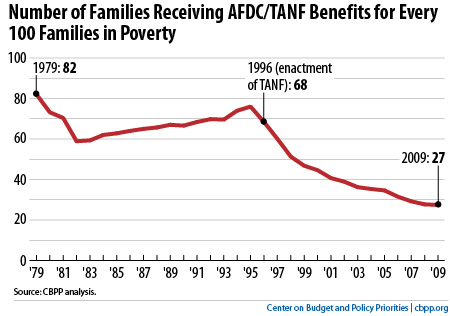
In a series of four blog posts, Off the Charts explains what has happened to the Temporary Assistance for Needy Families (TANF) program since the enactment of “welfare reform” in 1996. Among other findings, the reform sparked a continuous decline in the number of families receiving assistance and the decline has continued irrespective of the health of the larger labor market.
As the graph below shows, only 27 of every 100 families in poverty participated in TANF in 2009, down from the 1996 level of 68 out of every 100 poor families.
 Email Sign-Up
 RSS Feed