

NC Unemployment Claims: Week of 7/23/11
For the benefit week ending on July 23rd, 9,992 North Carolinians filed initial claims for state unemployment insurance benefits, and 109,753 individuals applied for state-funded continuing benefits. Compared to the prior week, there were fewer initial and continuing claims. These figures come from data released by the U.S. Department of Labor.
Averaging new and continuing claims over a four-week period — a process that helps adjust for seasonal fluctuations and better illustrates trends — shows that an average of 13,365 initial claims were filed over the previous four weeks, along with an average of 113,152 continuing claims. Compared to the previous four-week period, the averages of initial and continuing claims were somewhat lower.
One year ago, the four-week average for initial claims stood at 13,822 and the four-week average of continuing claims equaled 142,647.
While the number of claims has dropped over the past year so has covered employment. Last week, covered employment totaled 3.72 million, down from 3.76 million a year ago.
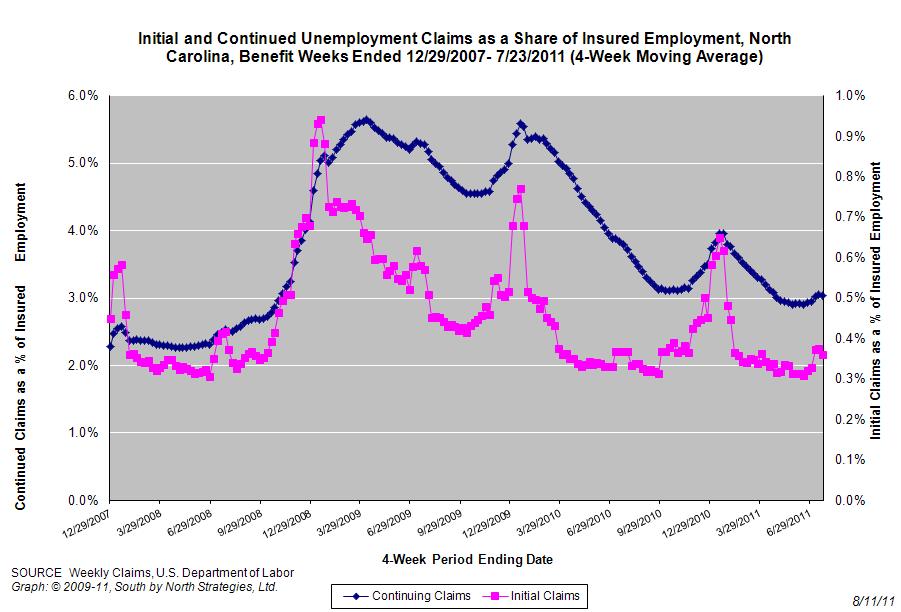 The graph shows the changes in unemployment insurance claims (as a share of covered employment) in North Carolina since the recession’s start in December 2007.
Both new and continuing claims appear to have peaked for this cycle, and the four-week averages of new and continuing claims have fallen considerably. Yet continuing claims remain at an elevated level, which suggests that unemployed individuals are finding it difficult to find new positions.
Around The Dial – August 11, 2011
Economic policy reports, blog postings, and media stories of interest:
- John Quiggin wonders “what to do about the ratings agencies.”
- Dan Rodrick discusses “the manufacturing imperative.”
- Robert Kuttner describes the rising price of austerity.
- Bruce Bartlett mulls the research regarding “an experiment with austerity.”
- Fed Watch isn’t impressed by the latest actions of the Fed.
The Future of NC’s Eastern Region
The latest issue of Carolina Context, a publication of the UNC Program on Public Life, summarizes the findings of a two-year study into how the future of North Carolina’s Eastern Region can be viewed “as a metropolitan opportunity rather than a rural problem.” From the report’s conclusion …
As identified in our inquiry and interviews, the region has significant assets—miles and miles of coastline and riverfront property, 11 community colleges, two military installations and related communities, and East Carolina University, the state’s third-largest public university by total student head-count, second-ranked in undergraduate enrollment. The challenge that emerges from our study is how to take fuller advantage of these assets to expand business opportunities, to provide more jobs for residents, to lift personal income and to enhance the quality of life.
…
And yet, we found that barriers anchored in history continue to inhibit economic vitality and progress. Barriers include lingering racial attitudes and intra-community rivalries. Still, we found residents of the region eager to talk about their aspirations and the course of their communities.
The report continues …
The region can no longer count on tobacco and small-shop manufacturing as its economic foundation. Likewise, Eastern North Carolina can no longer count on its current crop of long-time leaders of the baby-boom generation, many of whom will surely age out of their leadership roles after many years of service. Discussions of the region’s future often turn to the need for fresh leadership. Young professionals in the East appear less invested in old rivalries between towns and more concerned with building communities that work for themselves and their children. Thus, local and regional governments, businesses, nonprofits and schools should create mechanisms to engage young adults in informed conversations on the future of the region.
Not Too Technical
Writing in The Guardian, Dean Baker of the Center for Economic and Policy Research explains how there is nothing “technical” about changing Social Security’s annual cost of living adjustment. Instead, it is a backdoor way to cut benefits.
A reduction of 0.3 percentage points in benefits may seem small, but this will accumulate through time. After being retired ten years, benefits will be almost 3% lower with the CCPI. After 20 years, the loss will be near 6%, and after 30 years, the reduction in benefits will be close to 9%. This is a serious loss of income for seniors, the vast majority of whom rely on social security for most of their income.
…
The justification for the change in the benefit formula is that the CCPI [chained consumer price index] takes account of the substitutions that consumers make in response to changing prices. The classic story is that if the price of beef rises and the price of chicken doesn’t, people will buy more chicken and less beef. The CCPI takes this switching from beef to chicken into account in calculating inflation. The current CPI [consumer price index] does not.
Baker goes on to recommend the following:
At this point, we don’t know what a full elderly index that included substitution would show about the cost of living for the elderly. However, if the point of changing the indexation formula for social security is to make the indexation more accurate, then it would seem that we would want to find out. In other words, if the people who claim to want a more accurate cost of living adjustment are being honest, then they should be calling for the BLS to construct a full elderly index. This index would then be used for adjusting social security benefits. At this point, we don’t know if this index will show a higher or lower rate of inflation. We just know that it will be more accurate.
Around The Dial – August 10, 2011
Economic policy reports, blog postings, and media stories of interest:
- Naked Capitalism has started “a Bank of America death watch.”
- TaxVox explains S&P’s $2 trillion math error.
- Policy Shop notes the 150th birthday of the federal income tax.
- Robert Reich wonders why the administration doesn’t have a bold jobs plan.
- Drew Westen asks about “what happened to Obama?”
 Email Sign-Up
 RSS Feed