

Not So Mysterious
Rortybomb notes that the causes of the growth in long-term unemployment aren’t particularly mysterious.
There also shouldn’t be any mystery of long-term unemployment either. Every month the average and median duration of unemployment goes up, reflecting a large share of the unemployed being unemployed longer. Commentators are surprised. Right-wing economists come up with all kinds of convoluted theories about how the long-term unemployed are taking a year off to coach junior’s baseball team (instead of suffering high rates of mental illness and suicide from the shock that comes with being out of the workforce for an extended period of time). But the simple answer is that there was a period in 2009 when the economy shoved 7 million people out of the workforce and then stopped creating jobs.
A Shrinking Pool Of Small Businesses
Random Samplings, the blog of the U.S. Census Bureau, notes that, due largely to the recession, the U.S. lost 260,000 non-employer businesses between 2008 and 2009. Businesses without employees (e.g., independent consultancies and “mom and pop” retail stores) account for the overwhelming majority of the nation’s small business establishments.
The U.S. contained 21.1 million non-employer firms in 2009. Of those firms, 18.7 million were organized as sole proprietorships, 1.4 million as corporations, and 1.0 million as partnerships.
Around The Dial – August 9, 2011
Economic policy reports, blog postings, and media stories of interest:
- Randall Wray describes a “Rube Goldberg Doomsday Machine.”
- Rortybomb is amazed by most states’ approach to prison labor.
- Crooked Timber runs down “the deficiencies of left neo-liberalism.”
- Economix looks at tie between deunionization and wage inequality.
- The Huffington Post explains “how Congress corrupted patent reform.”
- Joseph Stiglitz warns against “a contagion of bad ideas.”
Just Asking
Felix Salmon looks at this chart…
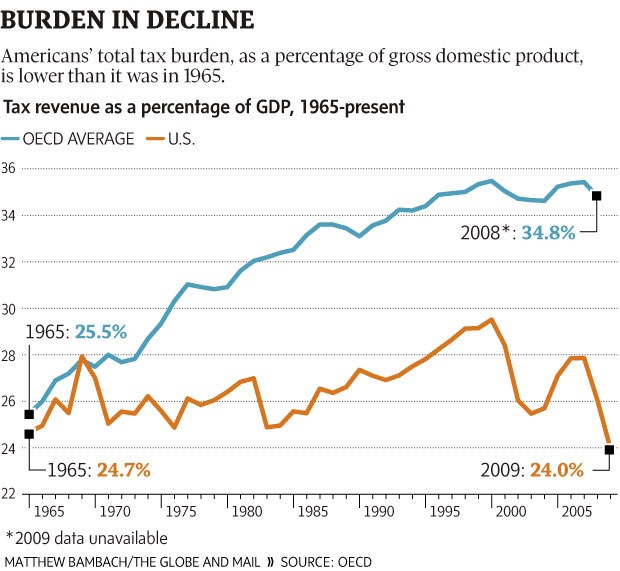 And then asks several questions …
This raises two questions. The first is why America’s taxes are so much lower than anybody else’s. Its system of government, after all, is a pretty standard democracy, so it’s not exactly baked in to the Constitution. The second question is why Americans don’t actually appreciate how low taxes are here. It’s a standard talking point in US politics that taxes are too high, and must be lowered; Republicans are adamant that even modest tax hikes, to levels still well below the rest of the developed world, would be economically devastating.
…
Right now a deal seems to be getting done in Washington which reduces the deficit by means solely of spending cuts, with no tax hikes at all. That makes no sense: just as it’s right that people should pay a higher tax rate as they get richer, the same is true of countries as well. Instead, the US seems to think that it can work as an advanced democracy while maintaining a tax rate more commonly associated with tinpot basketcases. Up until now, it’s managed to do that by borrowing the difference. But if it wants to try to cut spending to a level commensurate with its tiny tax base, it’ll soon learn how economically disastrous that can be.
Business Closings In 2009
Random Samplings, the blog of the U.S. Census Bureau, notes that, due in large part to the recession, the U.S. lost 168,000 business establishments and 6 million employees between 2008 and 2009. Additionally, as the chart shows, the number of business establishments fell in 16 of 19 major industrial sectors with the greatest decline occurring in construction.

 Email Sign-Up
 RSS Feed