

Around The Dial – August 8, 2011
Economic policy reports, blog postings, and media stories of interest:
- Mother Jones tours “the United States of austerity.”
- TaxVox lists “ten things you should know about the debt limit deal.”
- Bob Herbert calls the debt limit deal “unfair and unwise.”
- Ezra Klein’s Research Desk explains what using “a chained CPI” means.
- Free Exchange argues that U.S. fiscal policy is “flying blind.”
SBN In The News: July 2011
In July 2011, South by North Strategies was featured in a number of news stories focusing on economic and social policy issues.
- The Winston-Salem Journal: “Full employment in WS area still far off”
- The News & Record: “Greensboro lacks Green Jobs”
- Triangle Business Journal: “Food stamps go to 16.2 percent in NC”
- The Durham Herald-Sun: “County jobless rate rises to 8.3 percent”
- The Progressive Pulse: “Latest data show jobs remain scarce”
- Yes Weekly: “An example of how government destroys jobs”
- Triangle Business Journal: “Google+ debut further stirs debate over use of social media”
- Triangle Business Journal: “Increasingly, youth working to pay for college”
- High Point Enterprise: “June brings rise in unemployment figures”
- The News & Record: “Jobless rate rises again for the Triad”
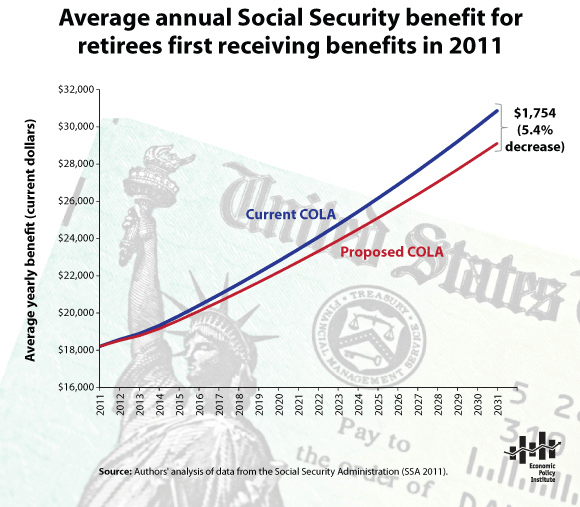
A Cascading Cut
The Economic Policy Institute explains how a change to the inflation formula used to compute Social Security benefits would reduce benefits in a way that compounds sharply over time. If proposed changes were to take effect, an average-wage worker retiring in 2011 would receive $1,754 less per year in 2031 than he/she would under current law.
Around The Dial – August 5, 2011
Economic policy reports, blog postings, and media stories of interest:
- Keith Hennessey summarizes the tax aspects of the Budget Control Act.
- The Guardian mourns “the fading genius of the US postal service.”
- The Wall St. Journal reports on the future of Pell Grants.
- Lawrence Summers isn’t wowed by the debt deal.
- Fed Watch isn’t too optimistic about the rest of 2011.
- David Cay Johnston reports on falling wages in 2009.
Nothing To Celebrate In July
CHAPEL HILL (August 5, 2011) – In July, the American economy added 117,000 more payroll jobs than it lost. While the private sector netted 154,000 positions, the public sector shed 37,000 jobs, due overwhelmingly to reductions by state and local governments. Also in July, 9.1 percent of the labor force was unemployed, while the underemployment rate equaled 16.1 percent. These findings come from today’s national employment report.
“Only in an economy as sickly as the current one could today’s employment report be called a ‘good’ one,” said John Quinterno, a principal with South by North Strategies, Ltd., a research firm specializing in economic and social policy. “Job growth was anemic and joblessness remains at a shockingly high level. While the unemployment rate dropped slightly, the fall was attributable to people leaving the labor force rather than finding jobs.”
In July, the nation’s employers added 117,000 more payroll positions than they cut. Gains occurred entirely within the private sector (+154,000), while government payrolls fell by 37,000 position. The public sector decline was driven by reductions among state (-23,000) and local (-16,000) governments. In recent months, public-sector reductions have weighed down job growth; in July, public cuts offset 24 percent of the private gains.
Furthermore, the payroll employment estimates for May and June underwent upward revisions. With the revisions, the economy netted 99,000 jobs over those two months rather than the 43,000 positions previously reported.
Several private industries recorded job growth in July. Education and health services added the most positions, (+38,000), followed by professional and business services (+34,000), and trade, transportation and utilities (+28,000). The manufacturing sector netted 24,000 positions due almost entirely to increases in durable goods manufacturing. Financial activities shed the most positions on net (-4,000), followed by information (-1,000).
“Although better than the June report, the July employment report is yet more proof that the American jobs machine is badly broken,” noted Quinterno. “Over the past three months, net job growth has averaged just 72,000 positions. This is not what a recovery looks like.”
The inability of the current pace of job growth to alter employment conditions was reflected in the July household survey. Last month, 13.9 million Americans (9.1 percent of the labor force) were jobless and seeking work. While the unemployment rate and number of unemployed individuals dropped over the past year, so did the share of the population participating in the labor force. In July, the share of the population participating in the labor force (63.9 percent) remained at a level last seen in the early 1980s.
Another cause for concern is the fact that long-term unemployment remains elevated. Last month, 44.4 percent of all unemployed workers had been out of work for at least 27 weeks. A year ago, the comparable figure was 44.7 percent.
In July, proportionally more adult male workers were unemployed than female ones (9 percent vs. 7.9 percent). Similarly, unemployment rates were higher among Black (15.9 percent) and Hispanic workers (11.3 percent) than among White ones (8.1 percent). The unemployment rate among teenagers was 25 percent. Between June and July, unemployment rates for most every major demographic group varied little.
Additionally, 8.4 percent of all veterans were unemployed in July. The unemployment rate among recent veterans (served after September 2001) was 11.8 percent.
“Jobs remained scarce in July,” added Quinterno. “This led many individuals simply to abandon their job searches. All of the improvements in unemployment seen in July were due to people leaving the labor force rather than finding jobs. In fact, the number of employed Americans actually fell in July.”
A more extensive measure of labor underutilization is the underemployment rate, which equaled 16.1 percent in July. Further evidence of the difficulty in finding a job is that, among unemployed workers, the average time out of work rose in July to 40.4 weeks. A year ago, the comparable figure was 33.9 weeks.
“While not as bad as the June report, the July employment report shows that the American labor market is not healing itself. Conditions clearly are not improving, yet policymakers still have not acknowledged the magnitude of the problem,” observed Quinterno. “Absent aggressive action, joblessness will continue to blight American society.”
 Email Sign-Up
 RSS Feed