

NC Unemployment Claims: Week of 7/16
For the benefit week ending on July 16th, 11,400 North Carolinians filed initial claims for state unemployment insurance benefits, and 111,055 individuals applied for state-funded continuing benefits. Compared to the prior week, there were fewer initial and continuing claims. These figures come from data released by the U.S. Department of Labor.
Averaging new and continuing claims over a four-week period — a process that helps adjust for seasonal fluctuations and better illustrates trends — shows that an average of 13,931 initial claims were filed over the previous four weeks, along with an average of 113,296 continuing claims. Compared to the previous four-week period, the averages of initial and continuing claims were higher.
One year ago, the four-week average for initial claims stood at 13,876 and the four-week average of continuing claims equaled 145,090.
While the number of claims has dropped over the past year so has covered employment. Last week, covered employment totaled 3.71 million, down from 3.78 million a year ago.
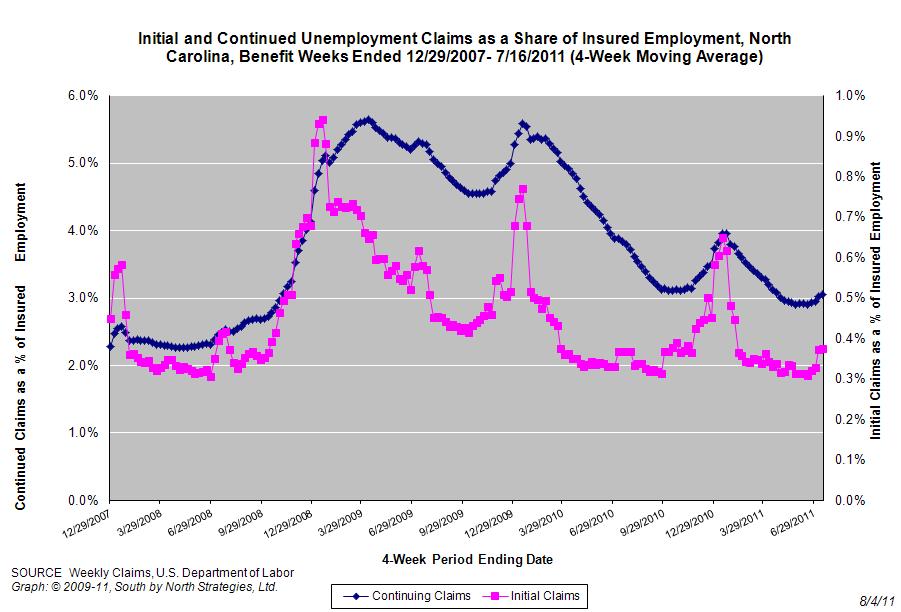 The graph shows the changes in unemployment insurance claims (as a share of covered employment) in North Carolina since the recession’s start in December 2007.
Both new and continuing claims appear to have peaked for this cycle, and the four-week averages of new and continuing claims have fallen considerably. Yet continuing claims remain at an elevated level, which suggests that unemployed individuals are finding it difficult to find new positions.
Around The Dial – August 4, 2011
Economic policy reports, blog postings, and media stories of interest:
- Dean Baker points out that joblessness is big problem.
- Fed Watch notes that consumers still are stressed.
- Keith Hennessey summarizes the provisions of the Budget Control Act.
- Off the Charts asks what the debt deal means for the states.
- Robert Frank argues for expanding the payroll tax cut.
Getting Beyond Tax Hype
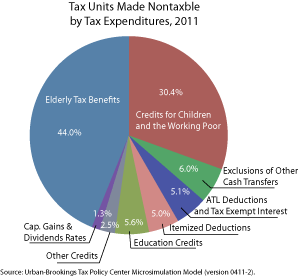
TaxVox explains that the reason why many American households have no federal income tax liability is because they have such low incomes.
Of the households that pay no federal income taxes due to tax deductions and credits (graph, below), ‘three-fourths of those households pay no income tax because of provisions that benefit senior citizens and low-income working families with children.”
Looking For Signs Of Structural Unemployment
Fed Watch looks at the arguments claiming that the high unemployment rate is the result of structural factors and finds them wanting.
… While not discounting the probability that some structural factors are at play, the primary challenge facing the US economy is insufficient demand. Optimally, I think the best solution to this challenge is that demand emerges from the external sector – and here I mean NET exports, export and import competing industries. This source of demand would support needed structural change, ultimately for the good of the US and global economies. This adjustment requires a relatively complicated expenditure-switching story on a global basis. I don’t know how to avoid such a story. Barring this outcome, one falls back on fiscal policy, which can surely do the job, but risks maintaining the current pattern of global imbalances. And perhaps such concerns are overblown; after all, so far the fears of a Dollar/current account crisis have not emerged….
…
In the end, I take something of a middle road. I don’t think we need sudden withdrawal of fiscal stimulus, although that appears to be what is happening. More appropriate would be near term expansion of fiscal stimulus sufficient at least to support the social safety net while allowing for an expenditure-switching story to build. But perhaps there are just too many moving pieces in such a plan to allow it to actually come to fruition. My fallback then is that we should not allow the reality of economic pain to take precedence over only imagined externally generated crisis.
Around The Dial – August 3, 2011
Economic policy reports, blog postings, and media stories of interest:
- The Washington Post reports on the checkered past of “super-committees.”
- Jacob Hacker and Oona Hathaway describe “an unbalanced democracy.”
- Free Exchange sees economic and political “distress signals” from the U.S.
- The PBS NewsHour seeks but can’t find “bond vigilantes.”
- Simon Johnson doesn’t find a balanced budget amendment a good idea.
- Naked Capitalism notes more flaws with the lack of industrial policy.
 Email Sign-Up
 RSS Feed