

Past The Point Of No Return?
Writing in The American Prospect, Louis Uchitelle asks if it is too late to reinvigorate domestic manufacturing.
One problem is clout. As manufacturing’s presence shrinks, so does its influence. Not that the nation’s manufacturers are milquetoasts when it comes to lobbying, but the voices from the growing financial and service sectors are louder, and globalization continues to be the flavor of the day. “If anything, business schools are teaching their students the importance of offshoring,” says Yoshi Tsurumi, a professor at the Zicklin School of Business, Baruch College, City University of New York.
…
Even labor has a diminished stake in defending manufacturing, since the portion of the workforce employed in the sector has shrunk to 10 percent today from 26 percent in 1960 and 13 percent as recently as 2000.
…
That decline can be reversed, but the will to do so — the laser-like focus on making things in America — may no longer exist or may be too compromised to be easily revived. The most powerful lobbyist on behalf of manufacturing is the National Association of Manufacturers. But its members include multinationals like Dow Chemical and Caterpillar with factory networks across the globe, thus dividing their loyalties. Even the NAM’s numerous small members aren’t as rooted in America as they once were, which helps to explain the NAM’s support of free-trade agreements that suppress barriers to the movement of goods across borders.
Around The Dial – June 29, 2011
Economic policy reports, blog postings, and media stories of interest:
- Tom Ferguson asks if Congressional gridlock has become the new (ab)normal.
- Ezra Klein asks whatever happened to “grand bargains.”
- Mother Jones points out that “you can’t go camping in a tax credit.”
- Bill Black asks if the European Union is destroying its periphery.
- Credit Writedowns explains the differences among QE1, 2 and 3.
Not So Structural
Economist’s View explains the evidence suggesting that structural unemployment is not the main problem facing the labor market.
The point is that when we talk about structural unemployment, we assume aggregate demand is not the problem. Thus, structural unemployment must be measured under an assumption that demand is sufficient to return us to full employment. Structural unemployment is driven by changes in tastes, technology, etc. that produce geographic, skill, or other mismatches that prevent reemployment. For example, if there is a change in tastes that causes the demand for hula hoops to fall and the demand for skateboards to increase, or a change in technology that causes the demand for typewriters to fall and the demand for word processing software to increase, then we have to move workers and other resources out of hula hoop and typewriter production and into the skateboard and word processing businesses. That will take time if there are geographic, training, or other barriers that prevent the quick translation of resources from one use or one place to another. Note, however, that the problem is not lack of demand. People want more skateboards and word processors than they currently have, so that unlike the example above where higher demand and the higher wages that come with it cause the worker to move and eliminate the mismatch, an increase in demand won’t fix the problem. If an increase in demand will fix the problem, as in the example above, then it’s not a structural problem.
The Geography of Immigrant Skills
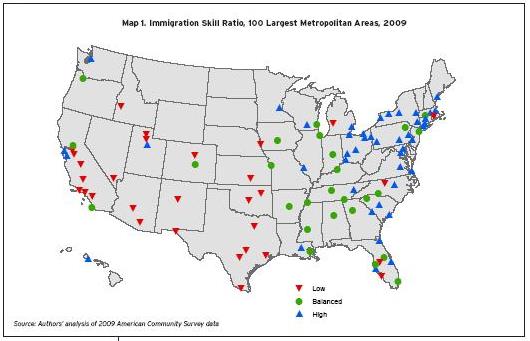
A recent paper from The Brookings Institution analyzed the distribution of high-skill and low-skill immigrants across America’s 100 largest metropolitan areas.
Interestingly, the three North Carolina metros included in the list (Raleigh-Cary, Charlotte-Gastonia, and Greensboro-High Point) displayed different patterns. Raleigh-Cary was a destination for highly skilled immigrants, while Greensboro-High Point was a destination for immigrants with low skills. Charlotte, meanwhile, attracted immigrants from both groups equally.
Remembrance Of Recoveries Past
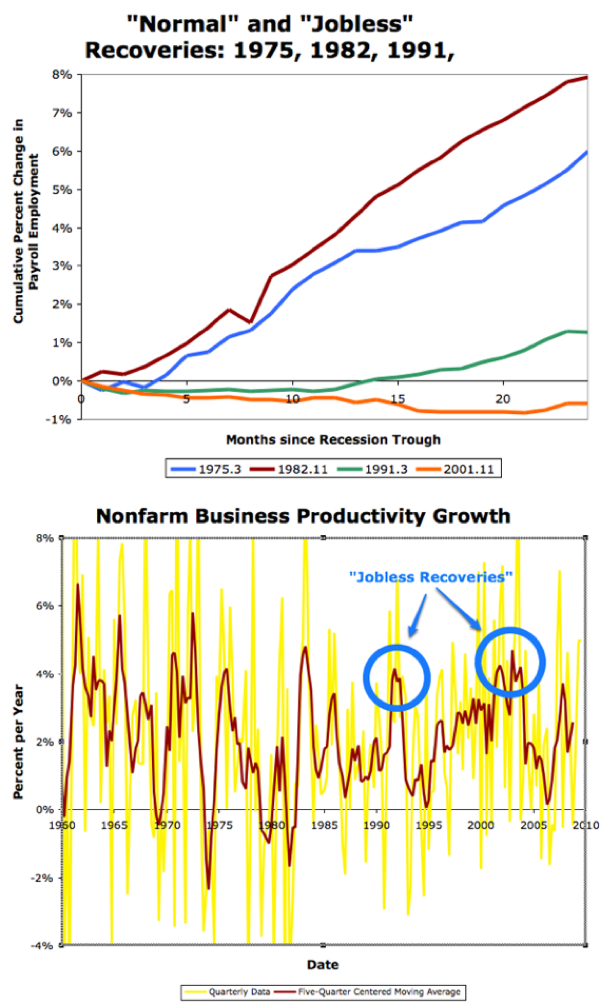
Brad DeLong points out what labor market recoveries used to look like.
 Email Sign-Up
 RSS Feed